Friday, April 17, 2009

In the backyard... Chestnut-backed Chickadee

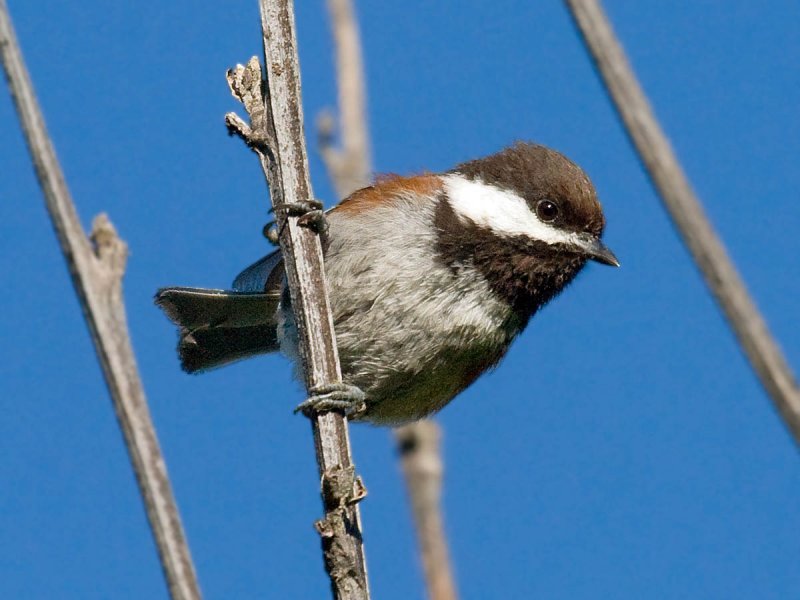
Chestnut-backed ChickadeeChestnut-backed Chickadee, Timber, Oregon on 28 June 2008 by Greg Gillson.


If one were to describe the typical habitat of the Chestnut-backed Chickadee, it would likely be the dark, cool, foggy, moss-covered coastal forests of ancient western hemlock and Sitka spruce. But these birds are equally at home in residential neighborhoods with conifer cover whether in Seattle or San Francisco.

In the western Cascades, they can be found from lowlands to high elevations. However, the Black-capped Chickadee is more common in the lowland valleys until the oaks and maples give way to solid Douglas-fir. Likewise, the Mountain Chickadee is the more expected species in the lodgepole pine and silver fir forest at the summit of the Cascades. The Chestnut-backed Chickadee is more common between them in the western Hemlock and Douglas-fir forest.

Chestnut-backed Chickadees are found from coastal Alaska south to coastal central California, west of the Cascades and northern Sierra-Nevada Mountains. They also occur in a limited area of the Rocky Mountains in northeastern Oregon, eastern Washington, northern Idaho, and southern British Columbia. They are absent in the Great Basin and most of the Central Valley of California.

The Chestnut-backed Chickadee is a very small chickadee. The bright chestnut back is an obvious field mark along with the black cap and throat and white side of face. The voice is a soft wheezy "tzick-a-dzee-dzee." Unlike other chickadees in the Pacific Northwest, these birds do not have a whistled song. From San Francisco southward, Chestnut-backed Chickadees lack the broad chestnut sides that birds to the north (as pictured above) show.

Like other chickadees, you can attract these birds to your backyard with black oil sunflower seeds and suet cakes. They will also use nest boxes.

Wednesday, April 15, 2009

At the pond... Cinnamon Teal

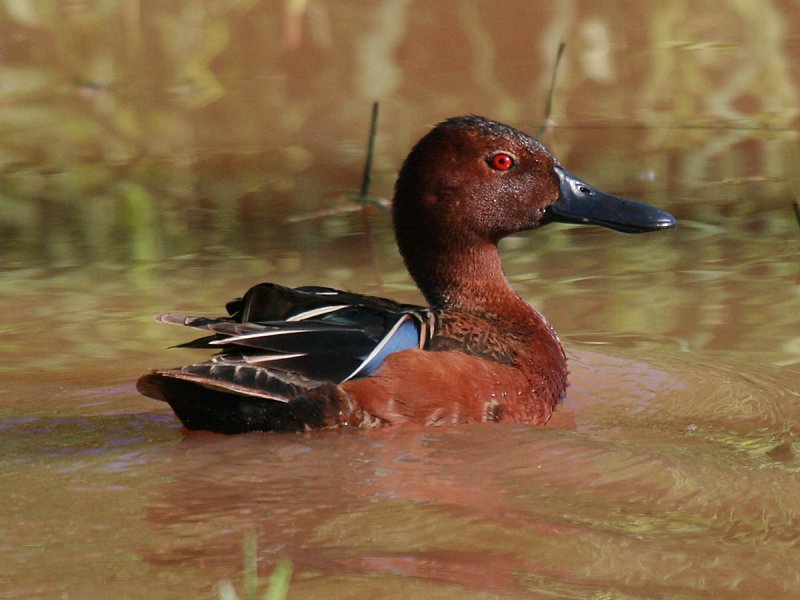
Cinnamon TealCinnamon Teal, Jackson Bottom Wetlands, Hillsboro, Oregon on 30 May 2008 by Greg Gillson.


The aptly named male Cinnamon Teal is a beautiful little duck in breeding plumage. In flight, the upperwing has a broad pale blue leading edge and green speculum (flight feathers on the inner wing). The male has a distinctive red eye. The brown mottled female, on the other hand, is extremely similar to the female Blue-winged Teal.

Male ducks molt into a cryptic "eclipse" plumage resembling the female from July to September. They will be flightless for a few weeks as they molt all their flight feathers at once, thus the need for this camouflaged plumage.

Interestingly, the Cinnamon Teal is the only duck with breeding populations in both North and South America. The North American population breeds in the West from southern British Columbia, Alberta, and Saskatchewan, south through California, extreme western Texas and into northern Mexico. In winter, birds withdraw from the frozen northern areas and extend well into Mexico.

Cinnamon Teal nest in marshes and shallow ponds throughout the Pacific Northwest. They are generally rare in the mountains and along the immediate coastline. A few birds may winter west of the Cascades in Oregon and Washington, and west of the Sierra-Nevadas of northern California. Migrant birds arrive by March, with some birds as early as January along the coast. In the Great Basin, birds arrive in April and May, where they become common in the marshlands of the high desert.

Sunday, April 12, 2009

In the backyard... European Starling

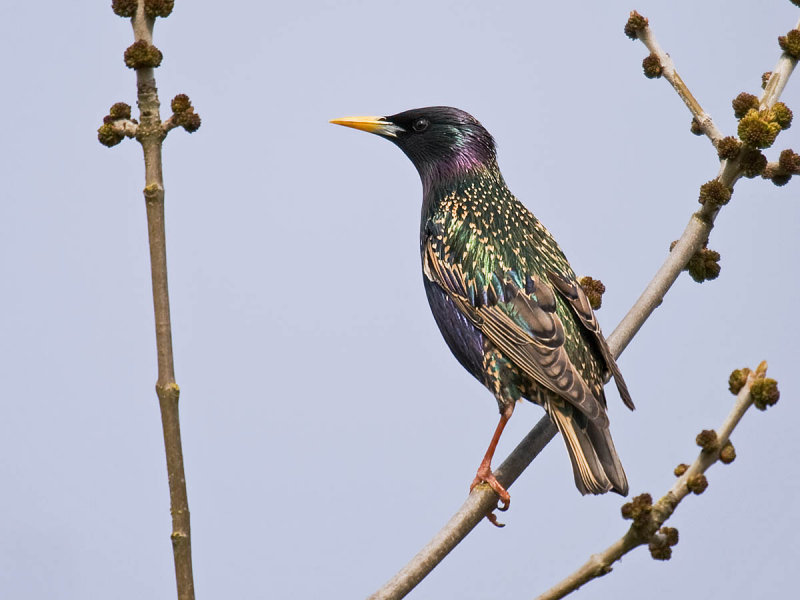
European StarlingEuropean Starling, Forest Grove, Oregon on 11 April 2009 by Greg Gillson.


It's too bad that the European Starling is such a pest. The breeding adult, as in the photo above taken yesterday, with the yellow bill, metallic purple and green iridescence, and white spangles, is actually quite a pretty bird. However, because of its overwhelming numbers and harmful behavior to North America's native birds, this introduced bird is universally hated by American birders.

Birds were released in New York City in 1890. They swarmed the continent, reaching Oregon by 1943. By the 1960's they were abundant, with counts of a million birds or more in Portland, Oregon during winter Christmas Bird Counts.

Starlings nest in tree cavities, throwing out whatever bird may be nesting there, and are blamed for the decline of populations of Lewis's Woodpeckers, Western Bluebirds, Purple Martins, and other cavity nesting species in the Pacific Northwest and across North America. For instance, Gabrielson and Jewett wrote in their 1940 book, Birds of Oregon, that the Western Bluebird in western Oregon, "vies with the robin for first rank as a dooryard bird." By the 1970's the Western Bluebird was eliminated as a backyard bird in western Oregon, and only the tireless efforts of individuals to create "Bluebird Trails" of specially designed bird houses, has returned the bluebird to many lowland areas west of the Cascades.

Not all the blame should be placed at the feet of the Starling, however. Certainly the introduction of another cavity nesting bird from Europe, the House Sparrow (North America releases from 1850-1870), pesticide spraying, expansion of towns and the elimination of family farms and orchards, as well as eliminating standing dead trees in timber harvesting practices, all contributed to the decline in bluebirds and other cavity nesting birds.

In the non-breeding season, the plumage of European Starling is less bright. The bill turns black and the white spangles disappear. Huge fall and winter flocks of slate gray juveniles and blackish adults roost at night in orchards or bridge structures. Black clouds of thousands of birds are often noted in the sky at dusk as birds make their way to the night roost.

Starlings are not related to the New World blackbirds. For one thing, starlings have short tails and shorter, triangular wings. Starlings are closely related to mynas and are fairly good mimics, adding the calls of killdeer, meadowlark, quail, pewee, and other birds to their repertoire, which consists primarily of unmusical squeals, grating cackles, and loud whistles.

Pretty or not, the European Starling is an example of why non-native plants and animals should not be released into the wild.

Friday, April 10, 2009

In the countryside... American Kestrel

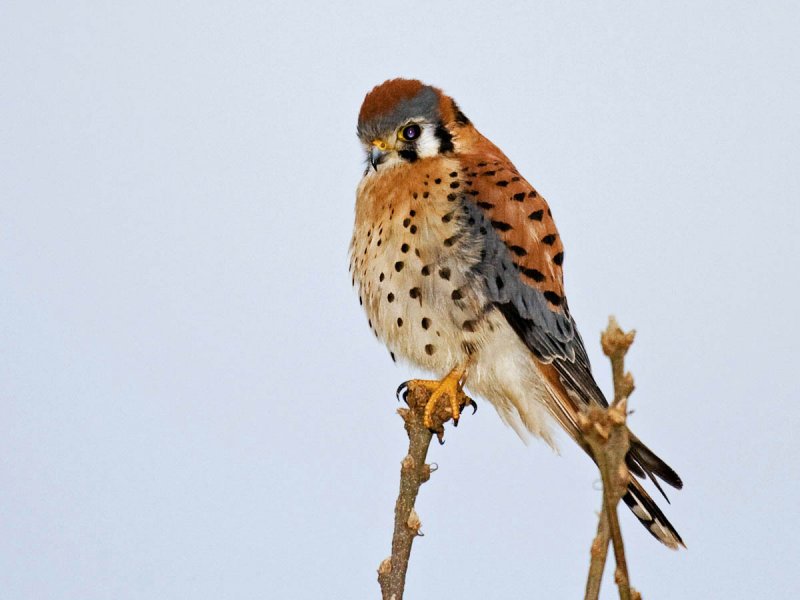
American KestrelAmerican Kestrel, Tualatin River NWR, Sherwood, Oregon on 7 February 2009 by Greg Gillson.


One of the frequent open country roadside birds in the Pacific Northwest and, indeed, most of North and South America, is the American Kestrel. These small falcons perch on isolated tree tops, telephone lines, and roadside signposts adjacent to grassy fields, prairies, and even the grassy meridian between Interstate freeways.

In the Pacific NW they are found throughout the region, but are typically scarce along the immediate coastline, in heavy forests, and in extensive grasslands that lack elevated hunting perches. In winter they move out of the mountain clearings and are much reduced in the Great Basin, but then move to the interior valleys in larger numbers. They nest in old flicker holes and will readily use nest boxes.

Like other falcons they have pointed wings and a fairly long tail. The male American Kestrel, as pictured above, has bluish-gray wings and rusty red tail ending in a black band, tipped narrowly in white. The female has rusty wings matching the back. The rusty tail of the female is barred throughout its length with thin black bars and a black terminal band as the male.

Unlike other North American falcons, the American Kestrel hovers in place while hunting, then drops to its prey. These birds are easily spotted hovering in place over fields, summer or winter. Their preferred food is grasshoppers, supplemented in winter with small mammals (mice, shrews, voles) and occasionally small birds. They are not too proud to eat angleworms, either.

Thursday, April 9, 2009

What bird is that?... Questions and answers

You have questions. Lots of questions!

This article starts a new feature. Send your queries about Pacific Northwest bird identification or behavior or other topics. I'll do my best to figure out what you saw. I'll do some research. Then I'll write an article to answer your question. If you have a certain question, no doubt others will, too, and appreciate knowing the answer. My goal will be to do one Q & A article each week, answering all the questions I receive that week. I'll just use your first name and city in my answers. If you send photos I will likely use them (perhaps cropping and adjusting exposure for the web) so others can see what you are seeing.

Send questions to me using this link: PNWBB Q & A

To get this started, and serve as a template for future Q & A's, Johnny in Sandy, Oregon agreed to help with the first batch of questions and he even supplied photos. Thanks, Johnny. Here we go...


Click for larger view "I had the arrival of a group of about 8 or 9 birds that I believe to be Pine Siskins, the day after the first Lesser Goldfinches came to my Njer seed feeder. The Goldfinches have not returned since the new guys took over. And they are constantly bickering and trying to keep everyone else from eating (see photos). Also these guys really put away the grocerys. They eat, go get a drink and eat some more. I don't know how they can fly the eat so much. Are they always like this, or is my flok simply a bunch of hooligans?"

Johnny
Sandy, Oregon

The tiny, goldfinch-sized Pine Siskins are heavily streaked with a strongly notched tail. In flight you can see the yellow wing stripe (Click photo for larger view). They are irruptive in nature, following food sources (seeds and budding trees); they can be unpredictably abundant one year, but perhaps absent or uncommon the next. They breed in the pine forests in mountains in the Pacifc NW, but descend to the lowland regularly in spring for the tree and flower buds. They may occasionally remain through the summer in the lowlands to breed if there is a reliable food source. They are highly social throughout the year, foraging in large flocks, often driving other larger birds from the feeder. In a few weeks they will likely disappear to the mountains. For more information, see Cornell Laboratory of Ornithology's web site on the Pine Siskin Irruption of 2008-09 that is happening primarily in the East. This article has many additional interesting facts about Pine Siskins.


Click for larger view "I had several new birds in my back yard yesterday. This one is a dead ringer for the female version of the Red Winged Blackbird, (even though it doesn't look at all like a black bird to me) that is on my backyard birds chart. Is It a Blackbird?"

Johnny
Sandy, Oregon

This is, indeed, a female Red-winged Blackbird. Although it may look like a large sparrow at first, its shape reveals its identity. The long, very pointed bill and flat forehead is common to the blackbirds, cowbirds, meadowlarks, and orioles, which are all in the same family. Sparrows have shorter, conical beaks and most have rather rounded heads. I will unabashedly point you to my Red-winged Blackbird photo album. Compare the head and bill shape of the males with the females. Then go over to my Song Sparrow photo album and compare the bill shape to that of the blackbirds.


Click for larger view "I had both of these guys in my yard yesterday. I'm pretty sure the yellow one is just a House Finch, but the other bird doesn't look like any I've been able to find. Look closely at the color around the eye."

Johnny
Sandy, Oregon

You are correct, Johnny, these are House Finches. The male is yellowish-orange and within normal range of color variation for this species. See our recent article on House Finches. The other bird is a female. I'm no expert on this, but the female appears to be suffering from the disease, avian conjunctivitis. Birds suffering from this disease display "red, swollen, watery, or crusty eyes; in extreme cases the eyes are so swollen or crusted over that the birds are virtually blind." This disease was first noted in the Eastern population of House Finches in the Washington D.C. area in 1994. It broke out in the West in 2004. For more information see the Cornell Laboratory of Ornithology's web page, House Finch Disease Survey.