Showing posts with label ID challenge. Show all posts

Sunday, September 1, 2013

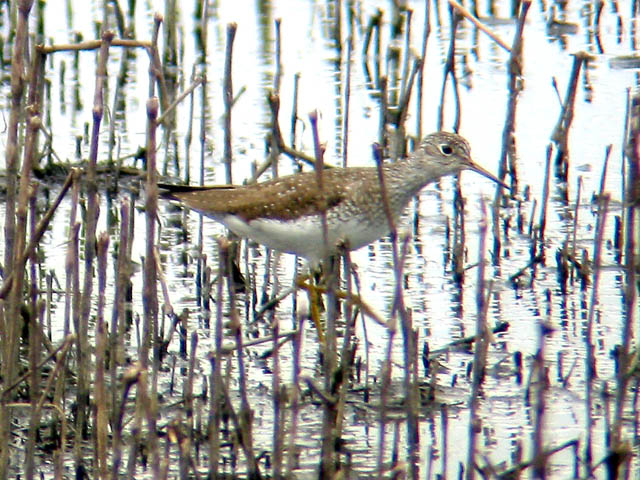
Juvenile Spotted Sandpipers masquerading as Solitary Sandpipers!

"Now I suppose you're going to tell me that juvenile spotted sandpipers don't have spots."

Well, yes; that is true. I know, fall shorebird identification is complex.

As a volunteer eBird reviewer I want to make sure birds reported into eBird in my local area are correct. Too many incorrect reports can really corrupt the data. Without this volunteer "cleaning" of the data, eventually every bird would be reported from every location. It becomes harder to find errors when birders are misidentifying birds that do occur in small numbers.

As reviewer I try to make these requests for more details a non-confrontational educational experience. [Oh-oh, the "E" word that my children used to dread!] It is my desire to create better birders submitting more accurate and complete lists of birds. When I go birding far away from home, it is not unusual for me to receive such "are you sure?" requests from other local reviewers asking about unusual species I may have reported. So don't take it personally.

For instance, when I see checklists with reports of Solitary Sandpipers (which do occur in small numbers in fall), but no reports of the abundant breeding Spotted Sandpiper, I ask the observer for more details for confirmation. [You can look up eBird fall reports of Solitary Sandpipers in your own county and check for this possible ID error yourself.]

Both Solitary Sandpipers and juvenile Spotted Sandpipers are medium small shorebirds with yellowish legs, a white eyering, and rather plain brown upper breasts. They are smaller than Lesser Yellowlegs, but barely so. Yellowlegs have a pale eyebrow stripe and longer, bright yellow legs.

Compare the following two photos taken at Fernhill Wetlands in Forest Grove, Oregon. Then we'll discuss them below. Initially they look much the same. Can you find 4 significant differences?

Juvenile Spotted Sandpiper
Don't let it fool you! This is a juvenile Spotted Sandpiper. Photo August 2, 2013 by Sandi Morey.


Solitary Sandpiper. Photo April 24, 2005 by Greg Gillson.
Did you find 4 differences in the above photos? Go ahead. Look again. I  have time...

OK, here they are.

1. Habitat. Empty mudflats on top, emergent weeds on the bottom. Yes, habitat is a key field mark for Solitary Sandpiper. Farm ponds, grassy edges. In contrast, the Spotted Sandpiper likes it a bit more open and often rocky--including rocky stream edges and lake shores.

2. Back and wing coverts. Both have brown upper parts. However, did you see the wavy black lines on the juvenile Spotted Sandpiper? What about the Solitary Sandpiper? It is lightly speckled with little white or pale cinnamon (western population juveniles) dots.

3. Breast. The upper breasts of both birds are rather smooth brown. However, the Solitary Sandpiper shows some streaking on lower breast.

4. Bill. The bill on Spotted Sandpiper is rather thick, especially compared to the needle thin bill of Solitary Sandpiper.

I hope this helps. The next time you record Solitary Sandpiper on your eBird list, go ahead and describe the habitat, wing coverts, breast, and bill in the comments section. Then anyone looking at your list will know that you didn't make this tricky identification error!

Friday, July 12, 2013

ID: brown swallows

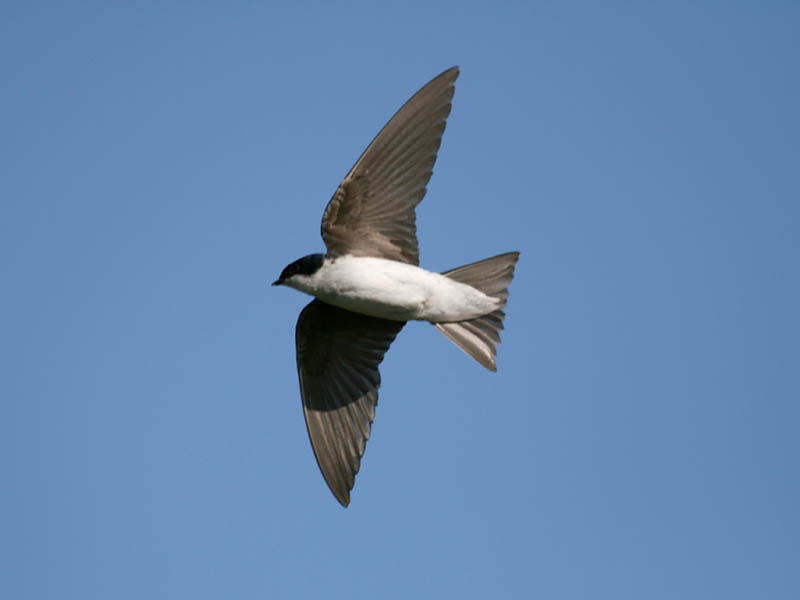
A family of Northern Rough-winged Swallows, 19 July 2011, Forest Grove, Oregon by Greg Gillson.
The identification of swallows is generally considered a "beginning birder's" identification problem. As Kenn Kaufman explained in Advanced Birding, it is not so much that swallows are misidentified, rather many swallows go unidentified as they fly by overhead twisting and turning, swooping and diving. As an eBird reviewer, however, I think that some misidentification is happening with swallows--and not just by beginners, either. The ID problem I want to highlight is the 3 brown swallows. Yes, three. Northern Rough-winged, Bank, and Tree swallows. Wait--Tree Swallows? Yes indeed!

You see, the first set of juvenile feathers on Tree Swallows are brown. Then these 3 or 4 month old swallows go through another complete "preformative" molt in fall--basically into an adult-like plumage. However, many of the first-year females have a dull brown plumage. They keep these feathers until the next autumn, so some first-year females arrive on the breeding grounds in spring a rather drab brown color. Thus, at any time of year you may encounter brown Tree Swallows. 

Northern Rough-winged Swallow
Rather evenly brown above. The throat and upper chest are pale brownish merging into white belly. Long winged and graceful languid flight. Call is a rough flatulent-like sound "pbbbt." Nest in single or small groups of burrows in sandy or muddy bank.

Northern Rough-winged Swallow
Northern Rough-winged Swallow, 9 August 2010, Forest Grove, Oregon by Greg Gillson.
Bank Swallow
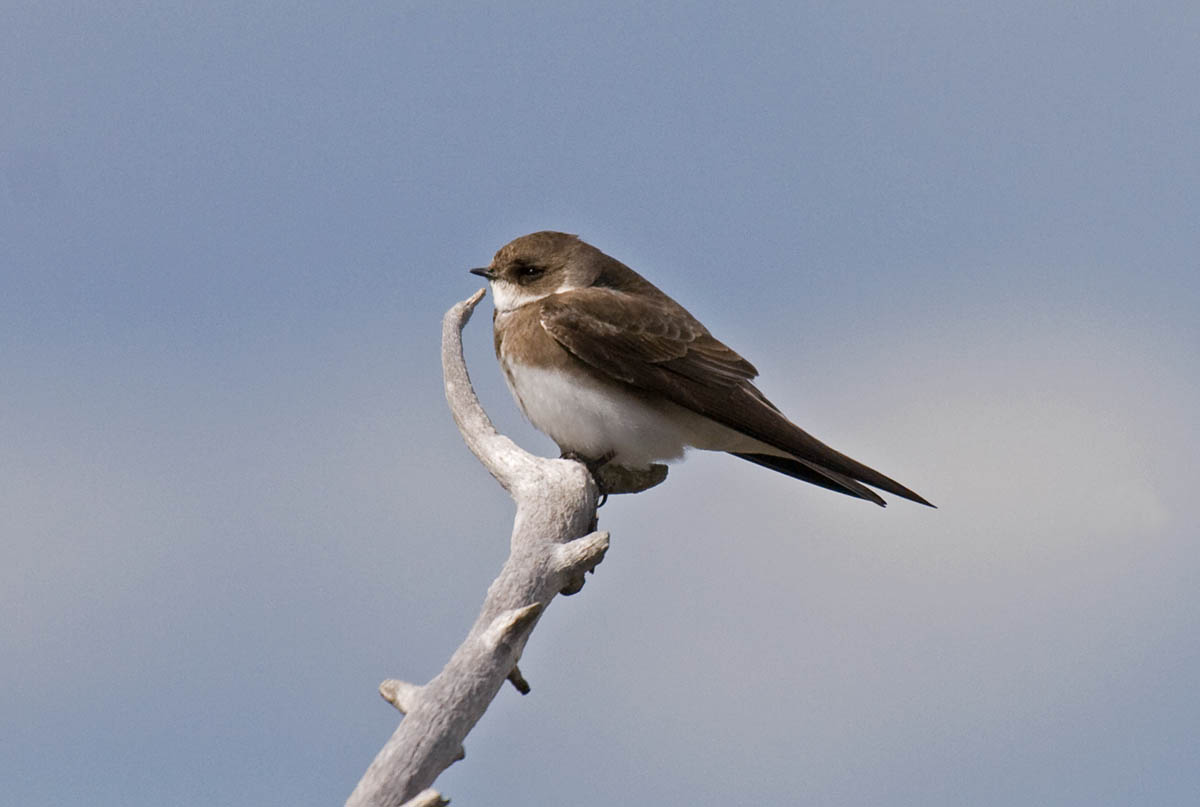
Brown back with contrastingly darker wings. Underparts, including throat, white. Dark, full brown neck collar, sometimes with a central "spike" going down the belly. A small swallow; wings shorter and more triangular. Flight more direct with rapid wing beats. Call is a rough buzz like electric line, "bzzzt," or "prit-prit." Nest in large colonies of burrows in sandy bank or cliff.

Bank Swallow
Bank Swallow, 29 May 2013, Malheur NWR, Oregon by Greg Gillson

Bank Swallow, 28 May 2013, Hines, Oregon by Greg Gillson.
Tree Swallow
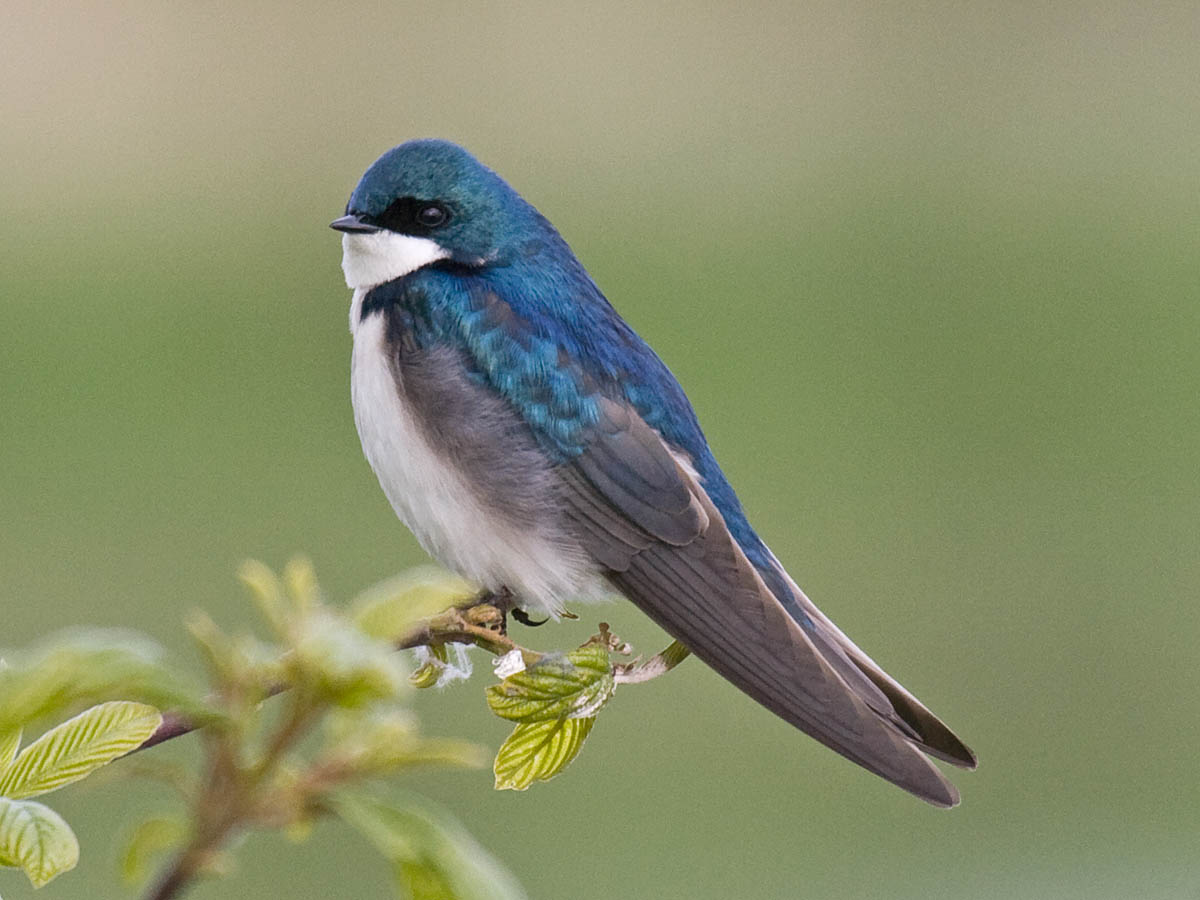
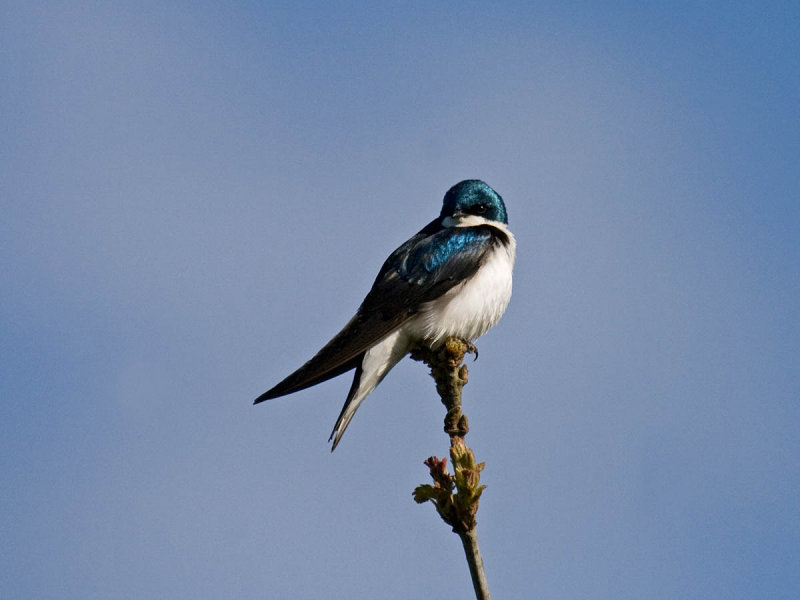
Adult males have metallic steel-blue back and wing coverts, black mask, gleaming white underparts. Females are duller. Some first-year females are brownish rather than blue, but usually have some blue feathers on the bend of the wing, at least. Juveniles are brownish with white throat and an indistinct (usually) grayish breast band. In flight the breast band can be conspicuous, but not as strong as Bank Swallows. Rather long wings and graceful flight. Calls are a liquid twittering. Nest in tree cavity or nest box.

juvenile Tree Swallow
Tree Swallow, juvenile showing Bank Swallow-like breast band, 10 July 2013, Hillsboro, Oregon by Greg Gillson.

female Tree Swallow
Tree Swallow, first year female, 17 April 2004, Forest Grove, Oregon by Greg Gillson.
Tree Swallow, male, 16 April 2010, Forest Grove, Oregon by Greg Gillson.

In 2008 Don Roberson wrote an article, Identification of brown swallows, on his Monterrey, California birding pages that provides additional ID tips.


Wednesday, June 26, 2013

Telling Swallows from Swifts

Tree Swallow
Tree Swallow, Beaverton, Oregon, 18 May 2011 by Greg Gillson.
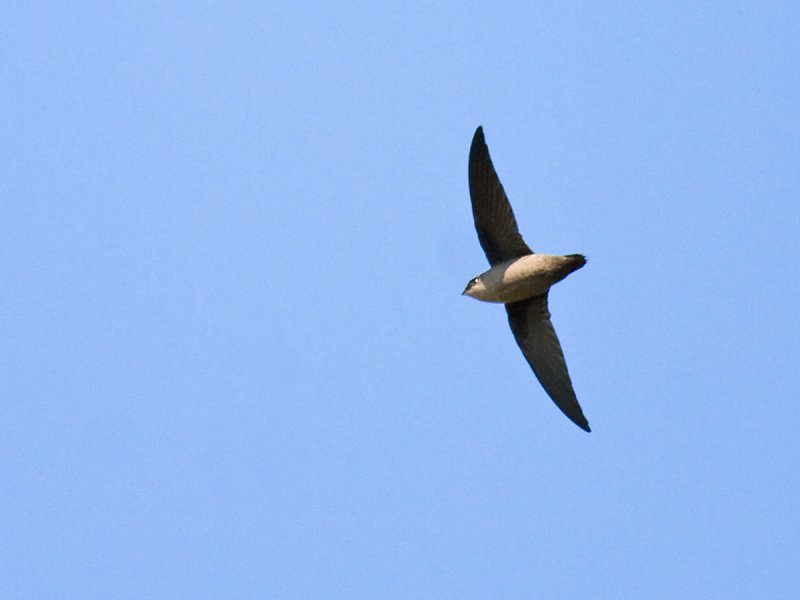
Many beginning birders struggle to differentiate swallows from swifts. Even separating the different swallows from each other is one of the first identification challenges a beginning birder faces. No doubt part of it is that both swallows and swifts are most-frequently seen darting rapidly through the air, backlit against the sky. If you can't follow them or even find them in your binoculars, how are you to identify them and see those subtle field marks?

As Kenn Kaufman says, in his new Field Guide to Advanced Birding (2011), it's not so much that swallows are misidentified, but "simply left unidentified."

But, then, how do some birders identify them nearly instantly as they fly high overhead, not even using binoculars? They differ subtly in behavior, habitat and niche, seasonality, and voice. Structurally, the wing bones are different so that the flight styles are notably different. Specifically, swallows flap more slowly and swoop gracefully, while swifts have more direct flight with rapid wing beats and brief glides.

Swallows

Behavior
Swallows are often seen flying through the air darting after insects, or seen sitting on wires.

Habitat and niche
Most swallows are usually found over open country or water. They can feed low to the ground or quite high in the sky, sometimes over cities or forests. They frequently perch on telephone wires, bare tree branches, fence lines. Most are cavity nesters in trees, nest boxes, cliffs, or banks, some creating enclosed mud nests on cliffs, barns, or porches.

Flight style
Feeding flight consists of graceful glides, banking, and turns interspersed irregularly with snappy, irregular deep flapping on flexible, broad-based, pointed wings. Commuting flight is more direct, interspersing several flaps with short pauses or brief glides with wings partially open (or nearly folded so that the tips of the wing are back near the tail).

Shape
Swallows have very short necks and very short, broad bills. They have rather short tails--look at the photo of the flying swallow below and note that the white undertail coverts (body feathers) come nearly to the end of the tail. Swallows have pointed wings. Look how far the flight feathers extend past the rump in the photo above. But notice that it is only the the outer part of the wing that is long. The inner arm part of the wing is exceedingly short compared to the outer "hand" portion of the wing--look how close the wrist is to the body! The base of the wing is quite wide, creating rather triangular shaped wings in flight.

Seasonality
In the Pacific NW, swallows are present in good numbers primarily from late March to early October, with some species arriving earlier (late January), with stragglers occasionally seen through the winter west of the Cascades.

Voice
Swallows have various chirping and grating calls, strung together into "songs" that can't be considered very musical!


Tree Swallow
Tree Swallow, Forest Grove, Oregon, 6 July 2007 by Greg Gillson.

Swifts

Behavior
Swifts are almost only seen flying through the air darting after insects. They have weak feet and are not able to perch on wires or tree limbs.

Habitat and niche
Depending upon species, swifts are found over open country, towns,  forests, or cliffs. They usually fly quite high in the sky. They fly into and cling to the insides of chimneys, cracks in cliffs, or hollow trees. During migration thousands may converge at dusk to roost for the night in old stone chimneys at favored locations.

Flight style
Direct flight with rapid wing beats interspersed with occasional set-winged glides.

Vaux's Swift
Vaux's Swift, Forest Grove, Oregon, 22 September 2009 by Greg Gillson.

Shape
The arm bones of swifts are so short that only the outer hand is present--very much like the wing of a hummingbird. Flight is thus twinkling with rapid wing beats on stiff, narrow pointed wings. The tail on Vaux's swifts are short to nearly absent; others have forked tails.

Seasonality
In the Pacific NW, swifts are present from mid-April to early October.

Voice
Swifts have squeaky, chipping calls.

Vaux's Swift
Vaux's Swift, Hillsboro, Oregon, 3 August 2008 by Greg Gillson.
Range in the Pacific Northwest

The following are the locations where swifts and swallows are most often encountered in the Pacific Northwest.

Tree Swallows are abundant over ponds. They use nest boxes placed very near water.

Violet-green Swallows are found in town and over forested lands. They nest in holes under eaves or nest boxes in yards.

Barn Swallows are found in country and towns, nesting in open barns and sheds.

Cliff Swallows nest under barn eaves and cliffs.

Banks Swallows nest in colonies in river banks. They are rather rare west of the Cascades.

Northern Rough-winged Swallows nest in river banks.

Purple Martins are rather rare and local in the Pacific Northwest, along the coast, Columbia River, and mountains.

Vaux's Swifts are regular over towns and forests.

White-throated Swifts are local over cliffs and rimrock in the Great Basin.

Black Swifts are rare in mountains.


Tuesday, January 22, 2013

Song Sparrow or Fox Sparrow?

Rusty Song Sparrow ID
Song Sparrow ("Rusty" form), Beaverton, Oregon. 21 January, 2013 by Greg Gillson.
The following discussion pertains to separating the Rusty Song Sparrow found west of the Cascades in the Pacific Northwest from the Sooty Fox Sparrow, a wintering species that breeds in coastal Alaska and southward through western British Columbia, sparsely to the Olympic Peninsula of Washington.

This discussion is less apt for Song Sparrows east of the Cascades, and does not apply to summer breeding Fox Sparrows--Thick-billed Fox Sparrows in the Oregon Cascades and southward into SW Oregon and NW California, nor the Slate-colored Fox Sparrow of the Washington Cascades, Great Basin ranges, and Rocky Mountains. [See footnote.]

Both Song Sparrow and Fox Sparrow are found across the North American continent and are highly variable. Beginners are often confused by sparrows, in general. Even experienced visitors from out of the region are frequently confused, as our Song and Fox Sparrows look quite different from these species elsewhere.

The identification of sparrows requires paying special attention to and learning the names of the feather tracts on the head. [See "Advanced birding means learning the basics."]

Sooty Fox Sparrow ID
Fox Sparrow ("Sooty" form), Forest Grove, Oregon. 8 December 2007 by Greg Gillson.
These are the two darkest and rusty-brown colored streak-breasted sparrows in the Pacific Northwest. Here's a quick-glance way of separating them. The head of Song Sparrow (photo below) is gray with rusty brown stripes. The bill is dark gray. This is in contrast to the evenly chocolate brown head of Fox Sparrow (photo above) that only shows a hint of stripes, if any. The lower mandible is bright yellow, in contrast to the dark upper half of the bill. The Fox Sparrow is large with ample square tail, towhee-sized; the Song Sparrow is smaller with rounded tail.

There are other field marks, but the marks just mentioned are easy to remember to get you started.

Song Sparrow ("Rusty" form), Forest Grove, Oregon. 27 November 2008 by Greg Gillson.
For practice in naming the markings of the Song Sparrow's head above, we'll start at the top of the head and work down through the eye to the throat. Here goes. The very center of the crown has a thin gray stripe from the bill over the top of the head. See it? That's the median crown stripe. It goes right over the middle (median) of the crown. Next is a wide brown lateral crown stripe. Lateral is "on the side" and above the broad gray eyebrow stripe. Actually most of the face is gray. There is brown eyestripe through the eye back over the top of the ear coverts. The ear coverts (behind and below the eye) are gray, the lower border of the ear coverts is brown. That's the mustache line and it starts from the gape of the bill ("corner of the mouth"). The submustachial stripe ("below the mustache") is white. There is a broad flaring brown lateral throat stripe.The throat is white. These terms are illustrated in the introduction to most field guides.

Across the continent, despite large variations in darkness or paleness of plumage and overall size, all Song Sparrows have the same basic face pattern.

If you compare with the Fox Sparrow photo above, you'll see that you can't easily see any patterns that you can name. The whole head is rather dark gray brown. The crown (general top of the head) is more dark brown and the sides of the head are more gray. There is some white mixed with brown on the throat, and brown and white unpatterned streaks on the lower face and ear coverts. But, again, nothing that you could name with the clear facial markings terms like in the Song Sparrow.

Both sparrows are found in dense blackberry tangles and brush. The Song Sparrow also likes wetlands and marshes; the Fox Sparrow is more common in clearcuts in the foothills, but there is complete overlap. The Rusty Song Sparrows are resident west of Cascades, though other paler forms may occur in winter. Other, slightly paler and grayer Song Sparrows breed east of the Cascades. The main bulk of wintering Sooty Fox Sparrows in the Pacific Northwest arrive in October and remain until April.

Song Sparrows respond immediately and excitedly to pishing. [For more on pishing, see "The secret to my birding success."] They fly right up to you, out in the open, often responding with their squeaky "chimp" call note. They stay with you as long as you keep pishing. Fox Sparrows, on the other hand, take a bit more coaxing. They take a while to respond. However, if you whistle a pygmy owl imitation or imitate their harsh "check" call note they usually come out into the open to respond with the same call. Again, they tend to stay in the open once they finally respond.

[Footnote: The Thick-billed and Slate-colored Fox Sparrows that summer in the Pacific NW tend to have almost entirely pale gray heads with brown marks on the ear coverts. Their wings and tail are redder than the Sooty Fox Sparrows. They arrive in April and depart in September. Their call notes are a sharp metalic "chink," similar to White-crowned Sparrow or California Towhee. Thick-billed Fox Sparrows like ceanothus and manzanita scrub among regrowing pine seedlings 5-10 years after a clearcut. Slate-colored Fox Sparrows tend to be found in damp mountain seeps and creek bottoms. Song Sparrows east of the Cascades are paler gray and brown, but the head pattern is same as the Song Sparrow described above.]

Thursday, November 29, 2012

Western Sandpiper or Dunlin? Winter ID challenge

Dunlin, October 3, 2004. Forest Grove, Oregon by Greg Gillson.

Both Western Sandpipers and Dunlins can be abundant at times in the Pacific Northwest. In breeding plumage you would never mistake one for the other. From late fall through early spring, however, when both species are in drab non-breeding plumage, with long drooping bill and black legs, many birders have trouble separating them.

A very general statement of status in the Pacific NW follows. Western Sandpipers are abundant spring and early fall migrants throughout, with a few wintering along the immediate coastline and Puget Sound. Dunlins are abundant spring and late fall migrants, and common winter visitors wherever there is open water and wetland shores coastally or inland.

The problem with mistaken identification occurs from November through March when primarily only Dunlin are expected inland. Even in larger bays on the coast and the shores of Puget Sound, where a few Western Sandpipers may be found in winter, Dunlin are far more numerous than Western Sandpipers, November through March. Reports of large flocks of Western Sandpipers inland during the winter are likely in error, though singles do occur from time to time, west of the Cascades. There are going to be occasional exceptions to the status stated, but this warning is one to follow: be careful identifying Western Sandpipers after early October (and until early April) in the Pacific Northwest--they are much more likely to be Dunlin.


Western Sandpiper non-breeding plumage
Western Sandpiper, September 6, 2008. Forest Grove, Oregon by Greg Gillson.

The accompanying photos show juvenile Dunlin and Western Sandpiper mostly molted into their nonbreeding plumage. Now Dunlin are bigger, 8-1/2 inches long compared to 6-1/2 for Westerns, but that's not always apparent if there is nothing to compare with. Least Sandpipers are barely smaller than Westerns, and may be found more regularly in late fall and winter. So if there are any of those present, Dunlin will look much larger. Killdeer should appear approximately twice the size of Western Sandpipers, while Dunlins should be about 2/3 the size of a Killdeer.

Dunlin appear rather smooth brownish-gray throughout, including the head and across the breast. They appear almost hooded.

Western Sandpipers are paler gray and a bit more streaky and contrasty on the crown and back, with white throat and breast with perhaps a few streaks coming down from the shoulder. The pale eyebrow and face contrasts with darker ear coverts.

In flight both are similar in appearance with thin white wing stripe on the tips of the greater secondary coverts, and drooping bill. The voices aren't so different that you'd notice right away and remember. So pay special attention to the throat and breast. And remember... Dunlin are more likely in winter than Western Sandpipers, especially inland.

Sunday, January 1, 2012

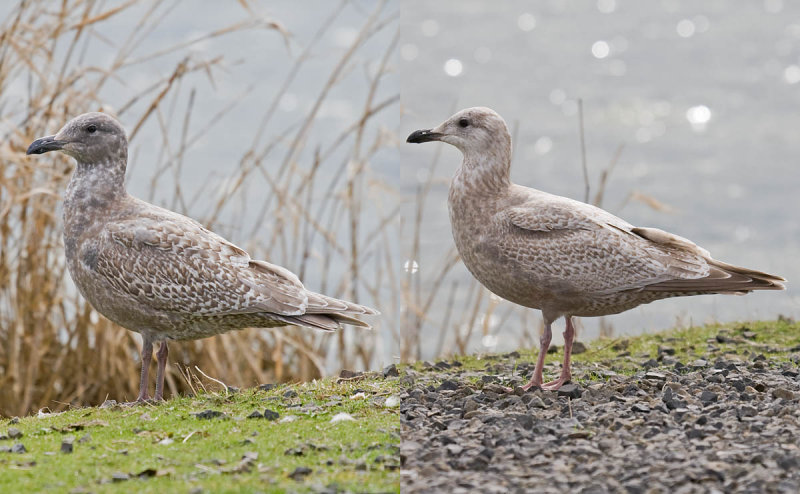
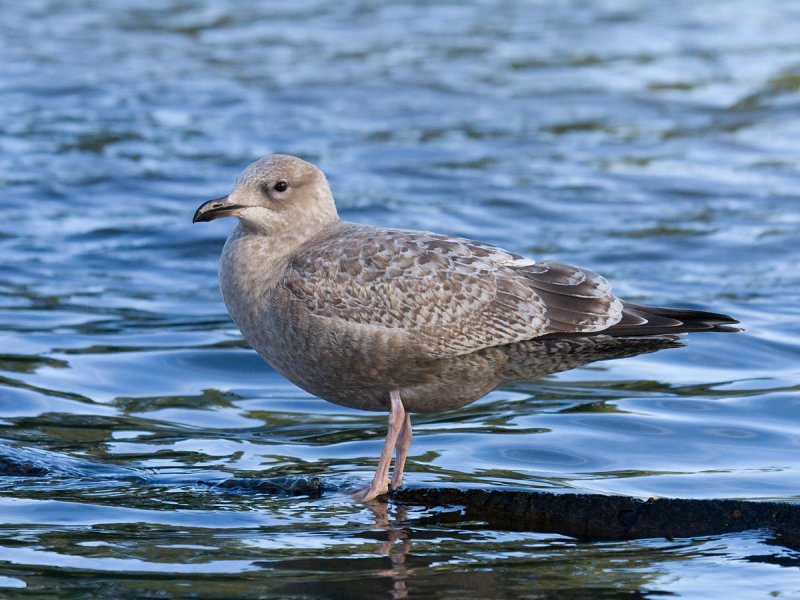
Separating first winter Thayer's Gull from "Olympic" Gull

gullsFirst year Olympic Gull and Thayer's Gull. Which is which? Forest Grove, Oregon, 23 March 2011 by Greg Gillson.


Right here in the Pacific Northwest we have one of the most confusing arrays of winter gulls in the world.

As if the 13 regular gull species weren't enough, we have numerous rarities and hybrids. In fact, in many locations on the Oregon and Washington coast, the hybrids between Western and Glaucous-winged Gull may be more common than the pure parent species. But we also have hybrids between Herring and Glaucous-winged, Herring and Glaucous, and Glaucous and Glaucous-winged!

The larger gulls take 4 years to reach adult plumage and change appearance twice each year as they do so. No wonder many birders never get comfortable identifying immature gulls--truly one of the more difficult topics of bird identification!

Olympic Gull
Western Gulls breed along the Washington coastline southward. Glaucous-winged Gulls breed from the central Oregon coast northward. Thus, their breeding ranges overlap for about 200 miles, centered at the mouth of the Columbia River. In this area of overlap there is considerable hybridization. Due to backcrosses, there is complete clinal variation from one end of the spectrum to the other. South of the Columbia River birds looking more like Western Gulls become more common. To the north, gulls that appear more like Glaucous-winged Gulls become more prevalent. This swarm of Western, Glaucous-winged, and hybrid Western x Glaucous-winged gulls is called the "Olympic Gull."

In winter, these coastal breeding hybrid gulls are found also inland in the Puget Sound and the Willamette Valley, and south along the coast regularly to at least San Francisco. Pure Western Gulls are rare inland; most adult "Western Gulls" reported inland show some evidence of past hybridization if you look closely at winter head streaking and intensity of black in the wingtips.

Hybrids, especially those tending toward Glaucous-winged Gulls in appearance, are easily confused with Thayer's Gulls. This post discusses these birds in the first year only. However structural features are consistent across various age groups.

First, correctly age the gull by looking at the back
First year gulls are rather brown-barred throughout. In the second year the upper back feathers become smooth gray similar to the adult coloration. Thus, on first year gulls the back is barred brownish. Most first year gulls have blackish bills and pink legs, so the color of these important adult ID field marks are of little to no use during the first year or two.

Look at the size and shape of the bill
Because there is so much plumage variation with hybrids, look next at the bill. Western Gulls and Glaucous-winged Gulls (and, thus, hybrids between the two species) have very large, thick bills. There is considerable size variation between the sexes (males are larger) but, even so, the bills are thicker than all regular Pacific NW gulls, and average longer than all gulls except the largest Glaucous Gulls. The bills are widest on the gonys. This is the point on the lower mandible where the right and left halves fuse together and angle up sharply to the bill tip, as shown on the adult Glaucous-winged Gull head photo, below.

The bills of Thayer's Gulls are shorter and thinner than the Olympic Gull. The female Thayer's Gull has an especially small bill, often described as "petite." The angle of the gonys is not as sharp as the Olympic Gull--the lower mandible of Thayer's Gull appears straighter.


Look at the primary/tertial/rest-of-wing contrast
Now turn your attention to the other end of the gull. It is important to be able to identify correctly the back, the scapulars, wing coverts, secondaries, tertials, primaries, and tail.

In the photo below, the tertials, primaries, and tail are identified. Most first year gulls have back, scapulars, wing coverts and secondaries very similar in color and pattern, as below. It is the contrast (or lack thereof) between the primaries, tertials, and the rest of the folded wing, that provides the final clues to reaching an accurate identification.


Most of the larger white-headed gulls in first winter plumage (Mew, Ring-billed, California, Herring, Western) have blackish primaries and tertials, contrasting with the rest of the wing which is barred brownish and pale.

Pure Glaucous-winged Gulls have matching colors to the primaries, tertials, and barring of the rest of the wing on a first year bird. Often the color is a very pale gray-brown.

First year Thayer's Gulls are the only pure gulls that show medium-brown primaries, contrasting with a paler wing panel.

Hybrids--the Olympic Gulls--show a similar pattern to pure Glaucous-wingeds. There will be little contrast between the various wing feathers, but they are often much darker brown than pure Glaucous-winged Gulls, especially on the primaries.

If the primaries on a first year gull are brown, you are probably looking at a Glaucous-winged hybrid (most-likely an Olympic Gull) or a Thayer's Gull.

The key is in the contrast of the primaries, tertials, and rest of wing. These match in coloration on Glaucous-winged hybrids. Thayer's Gulls show a unique difference--three shades. The tertials are darker than the secondaries and wing coverts, and the primaries are darker than the tertials.

Are you ready to identify these gulls? What do you see on the next photo? Big and thick bill or smaller and slight? Do the primaries, tertials, and rest-of-wing all contrast strongly with each other and get paler with each feather group?

Olympic GullHybrid Western x Glaucous-winged Gull ("Olympic Gull"), Forest Grove, Oregon, 7 February 2009 by Greg Gillson.


How about the next photo? Same questions. Big and thick bill or smaller and slight? Do the primaries, tertials, and rest-of-wing all contrast strongly with each other and get paler with each feather group?

Thayer's GullThayer's Gull, Portland, Oregon, 19 February 2011 by Greg Gillson.


Now you are ready to go back to the top photo and puzzle it out.

Wednesday, September 7, 2011

Rare Bird Report: Red-necked Stint

Red-necked StintImage 7573: Red-necked Stint, New River, Coos County, Oregon, 27 August 2011 by Greg Gillson.


On July 12, 2011, Dave Lauten and Kathy Castelein discovered a small sandpiper that they initially identified as a Semipalmated Sandpiper (Calidris pusilla), a rather rare, but regular migrant through the Pacific NW. One oddity, though, it lacked partial webbing between the toes. In other words, the supposed Semipalmated Sandpiper was not semipalmated! With some prompting by Shawneen Finnegan, Dave and Kathy re-identified the bird as a Red-necked Stint (Calidris ruficollis) in non-breeding plumage.

If a Semipalmated Sandpiper without semipalmations raised eyebrows, the new identification even more so! There are very few North American records south of Alaska of Red-necked Stint (primarily an Asian Arctic breeder that winters in Australia). Most records are either juveniles or breeding-plumaged adults. The plain non-breeding, or "winter," plumage is very difficult to identify.

The Oregon Shorebird Festival in Charleston, Oregon, gave me an opportunity to see this bird. To do so required a 3 mile hike on loose sand and for me to remove my shoes and role up my pants legs to wade a creek!

Even then, the bird was no slam-dunk to identify. I observed carefully and took notes--even though I also took photos. Photos alone are often not enough to document a rare bird. Sometimes the photos don't show the salient identification features. Worse yet, sometimes shadows or odd angles or exposure or color settings can misrepresent the actual appearance in the field! And this bird didn't let me get close and the wind was making my shots unsteady and a bit blurry.

The following is an edited version of my report to the Oregon Rare Bird Records Committee. Such a rare bird report needs to describe the bird so that others can "see" it in their mind and identify it themselves based on the description of the bird alone, and not the reputation of the birder.


Rare Bird Report
Red-necked Stint
End of Fourmile Road, south of Bandon, then north on New River to nearly due west of Hoffer Lane.
New River, Coos Co.
27 August 2011
3:30 PM

In view about 30 minutes from 50 to 150 feet, with 8x binoculars, Canon Xti with 100-400 zoom (through the lens magnification of about 12x), borrowed Russ's 40x scope for 5 minutes.

With Tim Rodenkirk, Tim Shelmerdine, and Russ Namitz after pelagic trip.

General: Obvious Calidris sandpiper: compact body, rounded head on short neck, wings to the end of short tail. Bill short for a sandpiper, legs black. Approximately 6-7 inches from bill tip to tail tip. Gray above, white below, non-breeding plumage.

Habitat and behavior: Shallow tidal river behind ocean dunes. Spent most of time with Western Sandpipers (all 350 were juveniles) foraging in an inch or less of water, with entire bill submerged, or resting on small sandstone ridge of about 8 inches in height with small potholes of water, where it may have been able to get out of the wind. Consistently was the aggressor against all juvenile Western Sandpipers of both sexes.

Image 7542: Red-necked Stint (second from right) amid juvenile Western Sandpipers. Note size equal to Western Sandpiper, neckless and humpbacked. [click all photos for larger views]

Size and shape: Appeared as large as Western Sandpipers with which it associated. It was consistently differently-shaped, however, so it was difficult to compare overall length. The bird appeared pot-bellied and neckless, accentuated by a humpbacked look that gave it a very round appearing body [Image 7542 and 7578]. Thus, the bird was fatter, belly to upper back, than the Western Sandpipers, but not as long. On the few occasions when it moved near Least Sandpipers it was significantly larger and bulkier.

Image 7578: neckless, hunchbacked, good angle to judge tapered bill shape

Head and bill: Eye dark, entire head very pale gray and without strong contrasting patterns. The eyebrow stripe was faint but fairly wide, and appeared to go over the bill, barely contrasting with a slightly darker (brownish tinged or faintly streaked?) crown and darker lores. Ear coverts generally pale but a small post-ocular brownish feather or two in the center of the ear coverts at some angles. Bill short, as shortest Western Sandpiper male (shorter than >95% of male Western Sandpipers). Bill tapered (more so than typical Semipalmated Sandpiper and similar to Western Sandpiper), with a slight constriction just before the tip and slight droop. [Image 7578 is a bit soft in focus but shows the bill length and shape best. Image 7574 best shows the ear coverts.]

Image 7574: ear coverts, breast collar

Underparts: White and unmarked from chin to vent except for a blurry patch on the sides of the upper breast and, at certain angles, photos [Image 7574] reveal a narrow very faint gray (complete?) collar across the breast.

Image 7570: P9 molted?

Underwing: The bird stretched and raised its wings once and I was able to get a photo [Image 7570. Note that bill tip is behind sandstone and appears blunt.]. The wing linings, including axillars, were entirely white and the flight feathers and tertials were silvery gray underneath with no pattern. I count only 9 primaries with perhaps a slight gap between the outer two primaries on both wings, perhaps indicating P9 is shed, if so then near the end of wing molt. Molt of the flight feathers would confirm the age as an adult.

Image 7573: good view of back, scapular, and tertial feather patterns

Back and wings: The rounded back feathers appeared mostly gray with pale browner centers and thin white tips. The messy scapulars were gray with brownish shaft streaks becoming wider, grayer (less brown), and darker on the inner scapulars. The tertials were darker grayish-brown, darker toward the feather shaft, white on the edges, wider white on the tip. [Image 7573 shows mantle feathers clearly, but dark shadow in water makes bill tip appear odd.]

My photos are ambiguous as to length of primaries compared to the tail. In many of the photos the tertials cover the primaries completely, and the tail is not clearly visible in any photo (except when wings raised). The primaries certainly do not fall short of the tail tip. In one photo [7559] it appears as if the tail end and wing tips are equal.

Image 7559: compare end of tail to wing tips.

Legs and feet: Black. Exposed tibia noticeably short compared to Western Sandpipers. Often only the tarsus emerged from the feathers of the round fat belly. The toes were clearly unwebbed in several scope views. Photos didn't really catch the toes at an advantageous angle, though webbing can clearly be seen on accompanying Western Sandpipers with no hint of such on any photo of the stint.

Voice: I heard the bird call as it flushed once. It was clearly different than Western's “jeet” call or Least's raspier “kreet” call. I described it as a rather smooth, drawn out “churrr.” On all of the Macaulay Library recordings I found only one call of Semipalmated Sandpiper that is similar (http://macaulaylibrary.org/audio/3124 time stamp 26-29 seconds). What I heard is NOT the short rough “chrrt” call of Semipalmated Sandpiper that is most common (http://macaulaylibrary.org/audio/3116 time stamp 50-54 seconds). The Red-necked Stint has a call similar to what I heard: http://macaulaylibrary.org/audio/63771 time stamp 37 and 48 seconds; and http://www.xeno-canto.org/recording.php?XC=61957 the very first call. Thus, the call I heard could match either Semipalmated or Red-necked Stint.

Similar species: Western Sandpiper, Semipalmated Sandpiper, and Little Stint in non-breeding plumage are the only contenders.

Most (>95% of males in my experience) Western Sandpipers have longer bills. Westerns show longer legs, longer neck. Non-breeding plumaged Westerns show more streaking and contrast on the crown and sides of the breast. Westerns have obvious partial webs that this bird clearly did not. Voice does not match.

The observed bird was much larger than Least Sandpiper, thus also Little Stint. The bill on the observed bird is probably thicker than any Little Stint. Voice does not match.

Image 7549: blunter looking bill shape in this photo compared to other photos

I believe that the bill on the observed bird is more tapered than Semipalmated Sandpiper. Several of my photos seem to show blunter bill [Image 7549]. But I also have a couple other photos with more pointed looking bills [7553, 7578]. The posture of the observed bird is extremely different than the taller aspect with longer legs and neck that I associate with Semipalmated Sandpiper. The non-breeding plumage photos I have seen of Semipalmated Sandpiper do not show the strongly contrasting shaft streaks and white feather edges to mantle feathers. The observed bird clearly did not have webbed toes. However, at least one recording of Semipalmated Sandpiper has a call similar to calls of Red-necked Stint, and similar to what I heard.

Semiplamated Sandpiper is variable, but differs with the observed bird in plumage color and contrast of the mantle, bill thickness and shape, webbing between toes, neckless, humpbacked, and pot-bellied aspect of the observed bird, and apparent length of tibia.

Image 7553: tapered bill


You may find a previous article, ID Challenge: Western Sandpiper and Semipalmated Sandpiper, of interest.

Friday, July 1, 2011

Mystery Gull

Mystery Gull. 26 June 2011 at Newport, Oregon by Chet Conklin.


Every summer a few very white gulls--similar to the one photographed above and sent to me by Chet Conklin--show up and really confuse birders. [Thank you, Chet, for allowing me to use your photos.]

Gulls like this with a bit more pink on the bill are often reported as first-year Glaucous Gulls on the West Coast in summer. But with the dark bill, one may be tempted to match this with an illustration of a juvenile Iceland Gull!

This is not a Glaucous Gull nor is it an Iceland Gull. Here is why.

Ignore the bright white feather color for a minute and look at other field marks, especially shape. This fairly stocky gull has wings that extend barely beyond the tail (it is “short-winged”). The eye is dark, but I do see a paler iris than pupil in one photo. The forehead is rather flat and sloping. Legs and feet are pink. The bill is nearly entirely black, with pink gape (the corners of the mouth on the face) and a bit of paleness at the base of the lower mandible. The bill is heavy and thick, “swollen” at the gonys (where the red spot would be on the lower mandible, if this was an adult of one of the larger species of gulls). The bill is strongly hooked.

The body shape of Iceland Gull is long and thin, with long wings. The bill is small and petite on Iceland Gull, and doesn’t show such a strong hook. The head should be quite round. The Iceland Gull as a whole is “petite.” The bird in the photo is stocky.

The body shape is all right for Glaucous Gull, but the bill is wrong. The bill of Glaucous Gull is stout, but not overly wide at the gonys. The bill shape is not a good fit. More importantly, the bill of young Glaucous Gull is 3/4 to 4/5 pink with the outer 1/4 (or 1/5) of the bill sharply black.


Now go back to the color. Only the Ivory Gull is this all-over-white in normal plumage. Other white gulls will show darker gray or brown bars on the body plumage. So this gull is not in “normal” plumage.

One condition that could explain the white coloration is leucism, a condition where the feathers are unnaturally pale or even white. This is not albinism, as that condition is the lack of all color, which would include pale legs and bill, with an eye with a colorless iris—blood in the vessels making the eye appear pink. I learned recently it was incorrect to call a bird a “partial albino.” But this bird is not leucistic, either, as a close examination of the feathers will reveal.

Take a look at the top photo. Click it to bring up a larger view. Can you make out any nice-looking individual feathers?

Not really. The feathers are shaggy and many look more like hair. This bird is extremely worn. The feather vanes are mostly worn away and only the feather shafts remain. White feathers are weaker than dark feathers; they wear away more quickly. Even though this bird did get new head and breast feathers in April or May, this bird is in desperate need of new feathers again. But it’s not going to get any soon. Gulls go through a complete molt of all their feathers in fall, September through November.

Because this bird has a mostly black bill, we can say it was hatched 1 year ago, probably June 2010. After a few weeks in a downy state, it grew its first set of feathers. But juvenile birds do NOT turn around and molt right away again in the fall. Thus it keeps its first feathers (wing and tail) for over a year. (Body feathers—head, neck, breast, belly, back—are replaced also in spring.) Such one-year old gulls can become very worn and sun-bleached by summer—especially the wings and tail. Thus, this is a very worn and bleached gull.

Now that we know this vital piece of information we can go on to ask: "what species is this?" Well, the angled head and “monster” bill, as well as short wings and stocky body, point to the common West Coast gulls: Glaucous-winged Gull or Western Gull. Since the bird is so pale and worn—and paler feathers wear faster than dark feathers—we can say that this bird was originally quite pale. That makes this a first cycle Glaucous-winged Gull (some plumage descriptions of the past may call this a “first summer” plumage, in the sequence of downy, juvenile, first-winter, first-summer, second-winter, etc. until it becomes an adult in the 4th winter).

As noted earlier, many Glaucous-winged Gulls of this age have a much paler pink base to the bill (though uneven) and are reported as Glaucous Gulls.

There. More, I’m sure, than you ever wanted to know.

But in case you're not satiated yet, here is more:

A previous post on Glaucous-winged Gulls.

My pBase photo album images of Glaucous-winged Gulls.

Tuesday, June 21, 2011

The bird that shouldn't be

Northwestern CrowIf there really is such a thing, you should be able to call these crows in Victoria, British Columbia, Northwestern Crows. 16 September 2007 by Greg Gillson.


Regular readers of this blog know that on occasion I like to discuss field identifiable forms, or subspecies, of our Pacific Northwest birds. Such forms look and sound different than the "same" species elsewhere, and might be raised to full species status in the future.

However, this time, I'd like to discuss a species that is in your field guide that probably should not be there.

No, I'm not talking about the Pacific-slope/Cordilleran Flycatcher mess, or the 10 types of Red Crossbills proposed by call. I'm going to discuss the elephant in the room--the bird problem no one wants to acknowledge--the supposed "Northwestern Crow."

The range of Northwestern Crow (Corvus caurinus) is usually defined as along the immediate coastline from SE Alaska through British Columbia. Then its range is less well-defined, but into the Puget Sound region and northwestern Olympic Peninsula of Washington. You may find reference of birds to Long Beach and Vancouver, Washington, and even along the Columbia River from Astoria to Portland in Oregon.

As far as identification, it is supposed to be smaller than American Crow (Corvus brachyrhynchos) with faster wing beats and a deeper, raspier voice.

But guess what? There are pockets of crows along the Oregon coast, and even along the northern California coast, that are smaller than their counterparts 20 miles inland, and some are within the measurement range of Northwestern Crows (Measurements of Possible Northwestern Crows from Oregon. 1989. Range D. Bayer. Oregon Birds 15(4):281). They have more rapid wing beats and deeper calls. Are these, then, Northwestern Crows? This question has been asked for decades, with the usually accepted answer being "no."

The question of the status of Northwestern Crow in Oregon is somewhat of a template for discussing whether Northwestern Crow exists at all.

Northwestern Crows have been reported in Oregon since the time of Lewis and Clark. But Gabrielson and Jewett in their 1940 book Birds of Oregon had this to say: "Lewis and Clark... found crows abundant on November 30, 1805, at the mouth of the Columbia and listed them as Northwestern Crows, but unless the distribution of the two species has radically changed since that time, the Western Crow... was the more abundant species." Gabrielson and Jewett considered only 4 of the numerous crow skins taken in Oregon prior to 1936, and labeled Northwestern Crow, to actually be that species.

Subsequent evaluation of crow specimens from Oregon found none that could be clearly assigned to Northwestern Crow, and many were definitely female and juvenile American Crows. The book, Birds of Oregon: a general reference (2003, page 620-621, Marshall, Hunter, Contreras, editors) summed it up: "Given the lack of reliable specimen evidence, it cannot be shown that the Northwestern Crow has ever occurred in Oregon."

A study by D. W. Johnston in 1961 (The biosystematics of American Crows) found that Northwestern and American Crows were very closely related and may be conspecific (the same species).

The National Geographic book, Complete Birds of North America (2006, Jonathan Alderfer, editor) has this to say about the ID of Northwestern Crow: "Unfortunately, [C. b.] hesperis [Western American Crow] found in the Pacific Northwest is identical." That's pretty damning. As is: "Field identification within the suspected range of overlap in WA is probably impossible."

Thus, it is apparently only range that separates American Crows and Northwestern Crows. If you are in SE Alaska or the coastal slope of British Columbia and Queen Charlotte and Vancouver Islands, the crows are Northwestern. Inland in British Columbia and the rest of the West, including Oregon and California, they are American Crows. If you are in Puget Sound or on the Olympic Peninsula of Washington, well, then, I guess you can call them whatever you want.

That doesn't sound like a "good" species to me. Does it to you?

Monday, April 11, 2011

Not a Slate-colored Junco! The Cassiar Junco

Cassiar Junco
Adult male Dark-eyed (Cassiar) Junco, Beaverton, Oregon, 7 April 2011 by Greg Gillson.
The bird above showed up at my feeder this week. Many birders might call this form of Dark-eyed Junco a Slate-colored Junco and not give it another thought. Technically, though, this is not correct.

Male Slate-colored Juncos are evenly dark gray above, with no contrast between head and back. This bird has an obviously darker gray head contrasting sharply with a paler gray back that is washed with a touch of brown.

The junco above is a Cassiar Junco. This was described as a subspecies of Slate-colored Junco when Slate-colored Juncos were considered separate species from Oregon Juncos. But in the Great Lumping of 1983 1973*, most of the juncos formerly considered separate species were lumped into "Dark-eyed Junco." Thus birders "lost" Oregon Juncos, Slate-colored Juncos, White-winged Juncos, and Gray-headed Juncos from their lists.

So if you saw a bird like this before 1973 it would have been considered a subspecies of Slate-colored Junco, and you could accurately call it such. However, since then, Oregon Juncos, Slate-colored Juncos and this Cassiar Junco are all subspecies of Dark-eyed Junco. So, technically, it is not a Slate-colored Junco. It is a Dark-eyed Junco or Cassiar Junco, but it is not a Slate-colored Junco.

I know, only 8 people in all of North America care. What? Not that many?

Looking at this level of detail will help you become a better birder--and you can do it in your own backyard.

Cassiar Junco
Immature (probably female) Cassiar Junco, Beaverton, Oregon, 28 March 2011 by Greg Gillson.
The male Cassiar Junco joined a first winter female that had been hanging around for a couple of weeks. Female and first-year Cassiar Juncos are much more difficult to separate from Slate-colored Juncos, so I was glad to spot the adult male.

The scientific name of Cassiar Junco is Junco hyemalis henshawi (=cismontanus of AOU 1957).

Cassiar Juncos breed in the Rocky Mountains of Canada. In winter they regularly are found from southern British Columbia east to Michigan and from there southward from Arizona to Texas. Scattered individuals wander widely in winter outside this main area.

Both Slate-colored and Cassiar Juncos can be found in small numbers throughout the Pacific Northwest in winter. They aren't too unusual at backyard feeders--most feeders will host a couple during the winter. But next time you see a "Slate-colored Junco" I bet you'll be taking a second, closer, look!

- - - - - - -
* The Great Lumping of 1983 1973: Besides the juncos, other species lumped in 1973 were Myrtle and Audubon's Warblers into Yellow-rumped Warbler; Red-shafted, Yellow-shafted, and Gilded Flicker into Common Flicker, but Gilded Flicker subsequently given back its status as a species and the other two called Northern Flicker; Baltimore and Bullock's Oriole lumped into Northern Oriole, but this decision was later reversed. Finally, Gray-crowned, Black, and Brown-capped Rosy Finches were all lumped into Rosy-Finch, but then this was reversed later, too, but with "Rosy Finch" altered to "Rosy-Finch." ...And I hear rumors of Yellow-rumped Warblers being re-split in the near future. -- We may get most of the pre-1973 species back, but the damage to birders' psyches from that period will never be repaired.

Wednesday, March 16, 2011

Odd coot in Washington gets mention by David Sibley

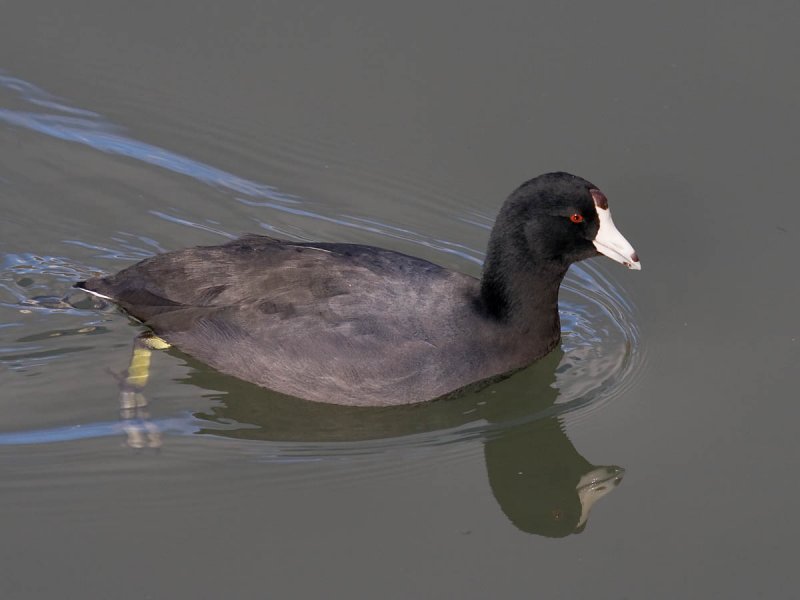
Dark-eyed JuncoTypical American Coot, Commonwealth Park, Beaverton, Oregon, 22 January 2011 by Greg Gillson.


On March 13, Lyn Topinga reported to OBOL (Oregon Birders OnLine email list) that she had photographed an odd American Coot in Vancouver, Washington. It lacked the dark red spot on the top of the bill's frontal shield and, therefore, resembles the Caribbean Coot.

Click for Lyn's photos

David Sibley picked up news of this bird and wrote an article on this rare variant (~1% of all American Coots may appear as this bird): The 'Caribbean' Coot in North America. Lyn's photos and those of Scott Carpenter are listed in Sibley's references.

Sibley argues that without definitive DNA evidence to the contrary, the Caribbean Coot could very well simply be this variant, though more common in the West Indies.

You know, even birds that we usually ignore because of their ubiquitousness can surprise us.

Friday, February 18, 2011

Greg's white-cheeked goose rant... I mean, primer

Can you tell the difference? A pair of long-necked Canada geese with their chicks among short-necked Cackling geese. The Cackling geese are just getting started on their migration to the Arctic to breed, while these Canada geese have already had success locally! Fernhill Wetlands, Forest Grove, Oregon on 22 April 2006 by Greg Gillson.


Empidonax flycatchers, small sandpipers, immature gulls, female hummingbirds,... All these are notoriously difficult to identify. However, there is another abundant taxon that is proving to be surprisingly difficult for many birders to identify accurately on a day-to-day basis.

In 2004 the American Ornithologists' Union split Canada Goose into two species, creating the name Cackling Goose (Branta hutchinsii) for the smaller forms and keeping Canada Goose (Branta canadensis) for the larger forms.

As a reviewer for eBird, it seems that most birders still do not know how to separate them. What I see happening is that a birder will identify a few Cackling geese, and then lump all other geese they see that day into the catch-all "Canada Goose."

As you can see from the above photo, the larger resident Western Canada Goose is 45 inches long, while the smaller migrant Ridgway's Cackling Goose is only 25 inches long--barely larger than a Mallard. The Cackling Goose is named for its high-pitched yelping calls. The Canada Goose gives the stereotypical deep honking call.

I don't want to over-simplify (because this is a very complicated situation) but 80% of the time it is pretty much that easy. Big or little.

Yes, it is true that there are at least 3 races of Cackling and 4 races of Canada Goose in western Oregon. Yes, the largest Cackling (Taverner's) is very similar to the smallest Canada (Lesser). But, frankly, if you don't spend time with a spotting scope carefully analyzing these intermediate birds, then the proper label for eBird (and your personal list) is "Cackling/Canada Goose."


There is nothing wrong with listing 25 Cackling Goose, 50 Canada Goose, and 600 Cackling/Canada Goose on your list. In fact, such honesty and accuracy is praiseworthy.

In western Oregon it is unusual to see more than a couple hundred Canada geese at one location. Most of these will be the big resident honkers, the white-breasted Western Canada Goose. At the Willamette Valley goose refuges you may see 1000 of the dark-breasted Dusky Canada Goose, but the entire world population of this form is perhaps only 7000 individuals. There may be a few Lesser Canada Geese mixed in.

The tiny, dark-breasted Ridgway's Cackling Goose is an abundant migrant and common winter visitor in western Oregon. Taverner's Cackling Goose is common in winter.

As an eBird reviewer for northwestern Oregon, I expect to see perhaps 100 Canada Goose and 5000 Cackling Goose on your non-summer lists, as typical. At Finley NWR, near Corvallis, Oregon, maybe 1000 Canada Goose and 7000 Cackling. Do you see that, in general, I expect 7-50 times as many Cackling geese as Canada geese? How does that compare with what you are reporting?


Cackling GooseDo you recognize that these are Cackling geese, and not Canada geese? Forest Grove, Oregon, 10 October 2009 by Greg Gillson.


East of the Cascades, in the Great Basin, I expect more Western and Lesser Canada geese and fewer Cackling. But I am uncertain of the exact ratios and seasonality there. But don't expect eBird to help, as the reports of these two species is all mixed up. And reports before 2005 will all be Canada Goose.

The big challenge is Taverner's Cackling Goose and Lesser Canada Goose. I think that Sauvie Island, Oregon and Ridgefield refuge, Washington, are probably the locations where these similar forms are most equally-common. Perhaps also Klamath Falls area. If anyone of you knows, please leave a comment.

Here are the scientific names of the white-cheeked goose forms mentioned in this post. These are the most-likely forms to be found in the Pacific NW. They are listed generally from largest to smallest:
Western Canada Goose (Branta canadensis moffitti)
Dusky Canada Goose (Branta canadensis occidentalis)
Lesser Canada Goose (Branta canadensis parvipes)
Taverner's Cackling Goose (Branta hutchinsii taverneri)
Ridgway's Cackling Goose (Branta hutchinsii minima)


Cackling GooseCackling geese have short necks, the dark breast indicates these are the abundant Ridgway's form, Forest Grove, Oregon, 17 October 2008 by Greg Gillson.


Largest and smallest, and both most-likely of all the forms: Western Canada Goose facing left, Ridgway's Cackling Goose facing right. Notice how the wing tips extend far past the tail on the Cackling Goose, but the wings are shorter on the Canada Goose. Hillsboro, Oregon, 31 December 2010 by Greg Gillson.


Ridgway's Cackling Goose are barely larger than Mallards. The rightmost goose is slightly larger with more sloping forehead and longer bill and paler breast and may be Taverner's Cackling Goose, Hillsboro, Oregon, 31 December 2010 by Greg Gillson.


I hate not being able to put a name on a bird. But, frankly, I still don't know whether this flock of 300 geese are Taverner's Cackling Geese or Lesser Canada Geese (or something else, or both). They go down on my list as "Cackling/Canada Goose" or "white-cheeked goose (species)" or "Canada-type Goose," but not "Canada Goose." The small out-of-focus goose in the back with purplish-brown breast facing left is Ridgway's Cackling Goose, Hillsboro, Oregon, 31 December 2010 by Greg Gillson.


If you are interested in pursuing this more thoroughly, you may start with Harry Kruger's page.

We've discussed these geese previously in At the pond... Canada Goose and At the pond... Cackling Goose

Monday, February 7, 2011

Dabbling duck silhouette quiz: Answers


Last week's photo quiz was very popular! We had over 230 visitors check out the quiz on both Monday and Tuesday (we average about 100 visitors per day). This blog post even got mention on the ABA Blog!

If you haven't taken the quiz yet, I have reproduced the silhouettes below. So, go down there and really look at the shapes.

Many people said they were "just guessing" at some. However, since most guessed correctly, these birders actually were using shape to identify the ducks. They didn't know how they were using shape, they just did somehow. They were unable to put their identification technique into words.

Dave Irons posted a very revealing comment about this quiz on OBOL (Oregon Birders On-Line mailing list). Irons said that the quiz likely would have been "much more difficult" had I shown actual photos (such as above). Irons noted that the colored camouflage plumage was actually a "visual distraction" that prevented birders from seeing the shape of the birds. Once they were simple silhouettes, he found the identification "remarkably easy."

That was my point. Of course, if you've never used the paradigm of identifying birds by shape, then it might not be so "remarkably easy" for you, at least not yet. But with practice it can be.

Once you can identify these birds by silhouette, those camouflage-brown patterns aren't nearly as confusing. You'll be identifying those previously ignored hen dabbling ducks in no time!

Here, again, are the silhouettes, and below them are the answers.


The identification and description of birds by shape are often in comparison to some "standard." In this case, the familiar and common Mallard is the standard by which to compare other dabbling ducks.

A) Northern Shoveler.
The body is fairly long. The head is rounded. And that bill! It's longer than the rest of the head, and flattened at the tip like a spoon or shovel. Now you know where it got its name, shoveler, as well as another popular name, spoon-bill.

B) Northern Pintail.
This bird is long and elegant throughout. The bill is rather thin. The forehead is gently sloping. The neck is long and slender.

C) Cinnamon Teal. (Also Blue-winged Teal)
In life you may be able to compare this small duck to others around it to gauge size. Note that the bill is as long as the head and flattened--though not to the extent of the shoveler. The head is small compared to the body, and rounded. The bill of Cinnamon Teal averages longer and flatter than Blue-winged Teal, but I wouldn't use that as the only field mark.

D) Green-winged Teal.
This squat, compact little duck has a small, squarish head, with steep forehead, and small bill.

E) Gadwall.
At first blush this duck is quite similar to Mallard. However, note this duck's more compact shape, slightly taller and less flattened bill, and bump on the forehead forming a squarish head.

F) Mallard. (Also Black Duck and Mottled Duck, but not in the Pacific NW)
The prototypical duck. The largest of the dabbling ducks with a rather heavy body, medium neck, large rounded head, and large flat bill.

G) American Wigeon. (Also Eurasian Wigeon)
This compact duck has a square head on a short, thick neck and a short bill. The tail is rather long and pointed.

Practice with these silhouettes until you can name them at a glance. Then go out to your local pond and practice identifying the hen dabbling ducks by shape!

Monday, January 31, 2011

Dabbling duck silhouette quiz


The identification of hen ducks deserves more consideration than what is given in the field guides. Many birders identify hen ducks only by noting what drakes they are hanging out with.

The "Peterson System," where birds are identified primarily by field marks, is heavily weighted toward color and pattern. Yet the end plates in Peterson's field guides contain, not colorful birds with field marks pointed out, but silhouettes--in other words, shapes.

No one would mistake a wren for a sparrow if they birded by shape. Starlings and blackbirds are shaped nothing alike. A heron or crane? Please; they're nothing alike--just look at the shape!

Yet no field guides tell you how to bird by shape. Not that it can't be done, just that no one has sat down and created the vocabulary that would identify and explain the shapes. Well, actually, that's not entirely true. An ornithology manual would describe and define such bill shapes as spatulate, acute, pointed, recurved, etc. And then it would explain the terms long and short as it relates to bill length. Nevertheless, shape is used as an identification tool far too infrequently in field guides.

Dabbling, or puddle, ducks are those that tip up to feed and rarely dive. The males are colorful, but the females are camouflage patterned with various shades of brown. Nearly all ducks can be identified by shape alone, there are very few exceptions in the dabbling ducks or in the diving ducks--especially in the Pacific Northwest.

Here I present some hen dabbling duck silhouettes. They are created from photos I have taken, adjusted so they are all about the same size, and then turned to black.

So "forget" the patterns of buffs and browns, the color of the speculum, or the markings on the bill. Concentrate only on shape. Primarily look at the overall length--whether compact or long, the neck length and thickness, head shape, and bill shape.

Make your guesses in the comments section below. I'll give you the answers next week, with the silhouettes replaced with color photos. Sound fun?

Too hard? Then to help you get started here are your choices for the 7 dabbling ducks: American Wigeon, Cinnamon Teal, Gadwall, Green-winged Teal, Mallard, Northern Pintail, and Northern Shovleler.

Answers

Monday, January 24, 2011

Proposed split: Gambel's and Bailey's Chickadees

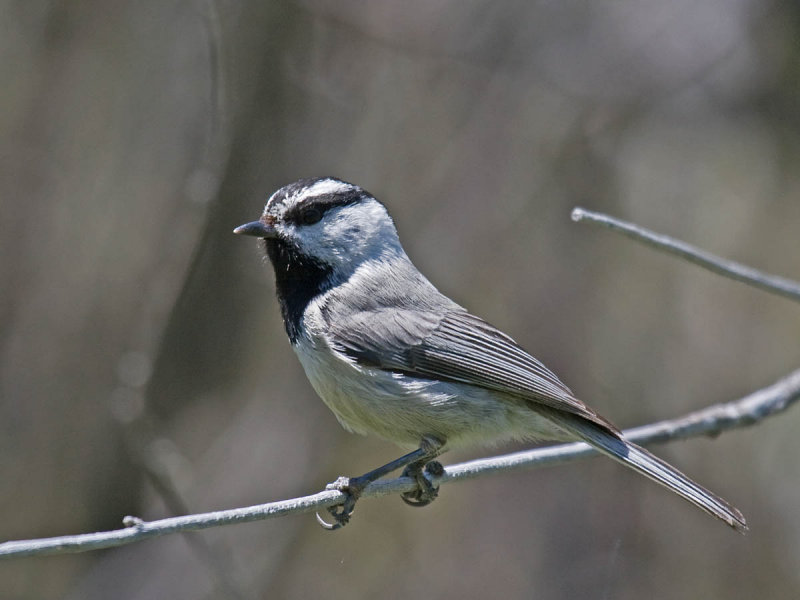
Mountain ChickadeeProposed Gambel's Chickadee, spp. grinnelli, King Mountain, Harney Co., Oregon, 26 May 2009 by Greg Gillson.


There is a recent proposal before the A.O.U. (American Ornithologists' Union, Committee on Classification and Nomenclature, North & Middle America) to split Mountain Chickadee, Poecile gambeli into two species. The new species would tentatively be called Gambel's Chickadee Poecile gambeli and Bailey's Chickadee Poecile baileyae.

Both of these forms of Mountain Chickadees are common in the Pacific Northwest.
As is the case for several recent splits of North American birds (Winter and Pacific Wren is a recent example), published research showing differences in songs and calls, together with supporting DNA evidence, were the primary deciding factors for recommending separation. They don't really look that much different.

Not all recommendations to the committee are passed. But if accepted, the A.O.U. could update its checklist in July 2011, making this split official.

Mountain Chickadees are found from the Rocky Mountains westward in drier pine forests to timberline.

The proposed Gambel’s Chickadee is found in the Great Basin and Rocky Mountains. In the Pacific NW it is found in mountain forests and juniper woodlands in interior British Columbia, northern Idaho, SE Washington, and NE Oregon (to the Ochoco Mountains in north central Oregon).

The proposed Bailey’s Chickadee is found in coastal California, Sierra Nevada, and the Cascades of Oregon and Washington. In the Pacific NW it is found in the Klamath Mountains of SW Oregon and northward primarily on the east slope of the Cascades to Mt. Rainier but, apparently, not in British Columbia (Birds of Canada. 1979. Godfrey).

There may be some areas in the Pacific NW where the two forms come together.

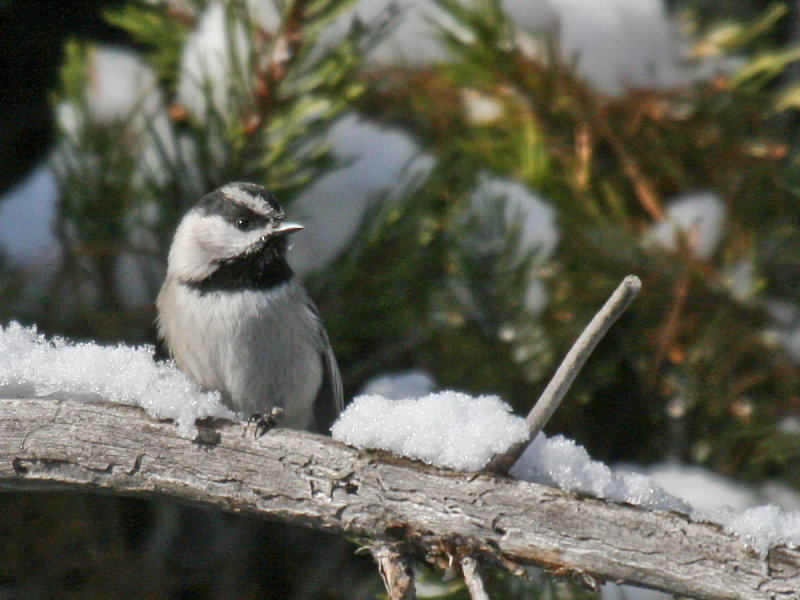
In the field, the primary separation of these forms is range (they are non-migratory) and breeding song. In-hand measurements can be used to identify captured birds or specimens. On average Gambel's is tinged buffier below with a wider white eyestripe and perhaps more white on the lores. But a comparison of the two photos here shows how difficult this identification would be based only on plumage. Both the Sibley and the National Geographic guides illustrate the two forms of Mountain Chickadees.

Gambel's Chickadee reportedly has a wider range of pitch between song notes than Bailey's Chickadee. If this split goes forward birders will need to really listen to the songs. Listen to Mountain Chickadee songs.


Mountain ChickadeeProposed Bailey's Chickadee, spp. abbreviatus, Sunriver, Deschutes Co., Oregon, 3 February 2008 by Greg Gillson.