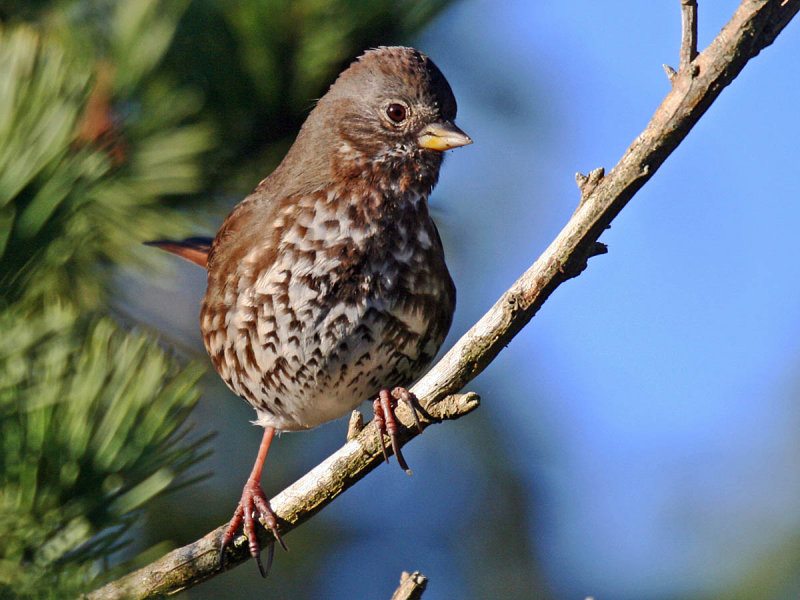
Showing posts with label Fox Sparrow. Show all posts

Tuesday, January 22, 2013

Song Sparrow or Fox Sparrow?

Rusty Song Sparrow ID
Song Sparrow ("Rusty" form), Beaverton, Oregon. 21 January, 2013 by Greg Gillson.
The following discussion pertains to separating the Rusty Song Sparrow found west of the Cascades in the Pacific Northwest from the Sooty Fox Sparrow, a wintering species that breeds in coastal Alaska and southward through western British Columbia, sparsely to the Olympic Peninsula of Washington.

This discussion is less apt for Song Sparrows east of the Cascades, and does not apply to summer breeding Fox Sparrows--Thick-billed Fox Sparrows in the Oregon Cascades and southward into SW Oregon and NW California, nor the Slate-colored Fox Sparrow of the Washington Cascades, Great Basin ranges, and Rocky Mountains. [See footnote.]

Both Song Sparrow and Fox Sparrow are found across the North American continent and are highly variable. Beginners are often confused by sparrows, in general. Even experienced visitors from out of the region are frequently confused, as our Song and Fox Sparrows look quite different from these species elsewhere.

The identification of sparrows requires paying special attention to and learning the names of the feather tracts on the head. [See "Advanced birding means learning the basics."]

Sooty Fox Sparrow ID
Fox Sparrow ("Sooty" form), Forest Grove, Oregon. 8 December 2007 by Greg Gillson.
These are the two darkest and rusty-brown colored streak-breasted sparrows in the Pacific Northwest. Here's a quick-glance way of separating them. The head of Song Sparrow (photo below) is gray with rusty brown stripes. The bill is dark gray. This is in contrast to the evenly chocolate brown head of Fox Sparrow (photo above) that only shows a hint of stripes, if any. The lower mandible is bright yellow, in contrast to the dark upper half of the bill. The Fox Sparrow is large with ample square tail, towhee-sized; the Song Sparrow is smaller with rounded tail.

There are other field marks, but the marks just mentioned are easy to remember to get you started.

Song Sparrow ("Rusty" form), Forest Grove, Oregon. 27 November 2008 by Greg Gillson.
For practice in naming the markings of the Song Sparrow's head above, we'll start at the top of the head and work down through the eye to the throat. Here goes. The very center of the crown has a thin gray stripe from the bill over the top of the head. See it? That's the median crown stripe. It goes right over the middle (median) of the crown. Next is a wide brown lateral crown stripe. Lateral is "on the side" and above the broad gray eyebrow stripe. Actually most of the face is gray. There is brown eyestripe through the eye back over the top of the ear coverts. The ear coverts (behind and below the eye) are gray, the lower border of the ear coverts is brown. That's the mustache line and it starts from the gape of the bill ("corner of the mouth"). The submustachial stripe ("below the mustache") is white. There is a broad flaring brown lateral throat stripe.The throat is white. These terms are illustrated in the introduction to most field guides.

Across the continent, despite large variations in darkness or paleness of plumage and overall size, all Song Sparrows have the same basic face pattern.

If you compare with the Fox Sparrow photo above, you'll see that you can't easily see any patterns that you can name. The whole head is rather dark gray brown. The crown (general top of the head) is more dark brown and the sides of the head are more gray. There is some white mixed with brown on the throat, and brown and white unpatterned streaks on the lower face and ear coverts. But, again, nothing that you could name with the clear facial markings terms like in the Song Sparrow.

Both sparrows are found in dense blackberry tangles and brush. The Song Sparrow also likes wetlands and marshes; the Fox Sparrow is more common in clearcuts in the foothills, but there is complete overlap. The Rusty Song Sparrows are resident west of Cascades, though other paler forms may occur in winter. Other, slightly paler and grayer Song Sparrows breed east of the Cascades. The main bulk of wintering Sooty Fox Sparrows in the Pacific Northwest arrive in October and remain until April.

Song Sparrows respond immediately and excitedly to pishing. [For more on pishing, see "The secret to my birding success."] They fly right up to you, out in the open, often responding with their squeaky "chimp" call note. They stay with you as long as you keep pishing. Fox Sparrows, on the other hand, take a bit more coaxing. They take a while to respond. However, if you whistle a pygmy owl imitation or imitate their harsh "check" call note they usually come out into the open to respond with the same call. Again, they tend to stay in the open once they finally respond.

[Footnote: The Thick-billed and Slate-colored Fox Sparrows that summer in the Pacific NW tend to have almost entirely pale gray heads with brown marks on the ear coverts. Their wings and tail are redder than the Sooty Fox Sparrows. They arrive in April and depart in September. Their call notes are a sharp metalic "chink," similar to White-crowned Sparrow or California Towhee. Thick-billed Fox Sparrows like ceanothus and manzanita scrub among regrowing pine seedlings 5-10 years after a clearcut. Slate-colored Fox Sparrows tend to be found in damp mountain seeps and creek bottoms. Song Sparrows east of the Cascades are paler gray and brown, but the head pattern is same as the Song Sparrow described above.]

Monday, January 18, 2010

In the backyard... Fox Sparrow

Fox SparrowFox Sparrow, Tillamook Bay, Oregon on 17 January 2009 by Greg Gillson.


Fox Sparrows are a highly variable group of sparrows across North America. Throughout most of the North and East the Red Fox Sparrow truly is a foxy-orange striped larger sparrow with bright rusty wings and tail, and reddish-brown streaks on the breast.

In coastal Alaska and along the coast to northwestern Washington lives the very dark, and more solid chocolate-brown, Sooty Fox Sparrow, as photographed above. It has wide dark brown breast streaks that merge together on the breast. The tail is brownish, slightly rusty on the rump.

In the northern Rocky Mountains and isolated ranges in the Great Basin, lives the gray-headed Slate-colored Fox Sparrow with sparse, dark breast streaks. The tail and rump are rusty.

In California and the southern Cascades of Oregon the Fox Sparrows breeding there are also gray-headed with sparse black breast streaks and reddish-brown rump and tail. The bill on some of these is very large and wide. These are the Thick-billed Fox Sparrows.

All forms migrate southward in winter. The more northerly breeding forms leap-frog the southern breeders, wintering the farthest south. Several types of Sooty, Slate-colored, and Thick-billed Fox Sparrows winter in southern California.

Many birders, not just beginners, are not very interested in subspecies, or regional population differences. And certainly these differences can be subtle between the 16-19 races, or subspecies, of Fox Sparrows. However, with these Fox Sparrows, not only do the four groups described above look somewhat different, they also have different songs and calls. Hmm... they look different and have different calls and songs. That sounds like different species to me. Indeed, there has been talk for several years of splitting Fox Sparrow into 3 or 4 species.

In the Pacific NW, especially west of the Cascades to the coast, the Sooty Fox Sparrow is a common winter visitor. It also breeds locally on the Olympic Peninsula of Washington State and northward. Slate-colored Fox Sparrows breed from the Washington Cascade crest eastward through the Great Basin ranges and into the Rocky Mountains in montane manzanita scrub and creek bottoms. Thick-billed Fox Sparrows breed in the Oregon Cascades and Klamath Mountains of SW Oregon and into California. The Red Fox Sparrow is a vagrant in the Pacific NW.

The local bird most similar to Fox Sparrow is the Song Sparrow. The Song Sparrow, as previously discussed, is common and widespread in the Pacific NW and is rather rusty here, compared to elsewhere in North America. It has more prominent striping on the head than Fox Sparrow. The lower mandible of Fox Sparrow is noticeably pale, yellow or flesh-colored. The upper and lower mandibles of Song Sparrow are usually evenly dark.

To find a Sooty Fox Sparrow west of the Cascades in winter, pish persistently in heavy blackberry cover and intersperse whistled imitations of pygmy owl calls. After all the Song Sparrows have popped up excitedly and are inches from your face, a Fox Sparrow or two will likely come forward with a loud husky "chap" or "check" call.

In the Cascades of Washington, mountain ranges in the Great Basin, and Rocky Mountains, you may find the Slate-colored Fox Sparrow in summer. Look for these in brushy burns and recently replanted forests in the Cascades and especially in willow-lined creeks in mountains eastward.

In the Cascades and Klamath Mountains of Oregon, you may find the Thick-billed Fox Sparrow in summer. They have a sharp "pink" call, similar to White-crowned Sparrow. Look for brushy areas amid clear cuts or burns. Look especially for Snowbrush Ceanothus or Greenleaf Manzanita with ponderosa pine saplings. You often find these in this habitat together with Green-tailed Towhees and, interestingly, they have very similar songs!

Fox Sparrows aren't common at most bird feeders. They are ground feeders and will scratch around like towhees under your feeder, never venturing far from heavy cover. They will eat black oil sunflowers from tray feeders near the ground.

Saturday, June 20, 2009

Backyard birds of... Campbell River, British Columbia

Fox SparrowA muddy Sooty Fox Sparrow, Forest Grove, Oregon on 8 December 2007 by Greg Gillson.


The following common yardbirds are found in Campbell River, British Columbia.

The seasons listed are those when most common, though some individuals may occur at other seasons.

Band-tailed Pigeon, spring, summer, fall
Rufous Hummingbird, spring, summer
Red-breasted Sapsucker, year round
Downy Woodpecker, year round
Hairy Woodpecker, year round
Pileated Woodpecker, year round
Northern Flicker, year round
Olive-sided Flycatcher, spring, summer
Steller's Jay, year round
Northwestern Crow, year round
Common Raven, year round
Barn Swallow, spring, summer
Chestnut-backed Chickadee, year round
Bushtit, year round
Red-breasted Nuthatch, year round
Brown Creeper, year round
Winter Wren, year round
Golden-crowned Kinglet, year round
Ruby-crowned Kinglet, fall, winter, spring
Swainson's Thrush, spring, summer
American Robin, year round
Varied Thrush, year round
Cedar Waxwing, spring, summer
European Starling, year round
Orange-crowned Warbler, spring, summer
Wilson's Warbler, spring, summer
Common Yellowthroat, spring, summer
Western Tanager, spring, summer
Black-headed Grosbeak, spring, summer, fall
Spotted Towhee, year round
Chipping Sparrow, spring, summer
Savannah Sparrow, spring, summer, fall
Dark-eyed Junco, year round
White-crowned Sparrow, year round
Golden-crowned Sparrow, fall, winter, spring
Fox Sparrow, fall, winter, spring
Lincoln Sparrow, fall, winter, spring
Song Sparrow, year round
Red-winged Blackbird, year round
Brewer's Blackbird, year round
Brown-headed Cowbird, spring, summer, fall
Bullock's Oriole, spring, summer
House Finch, year round
Purple Finch, year round
Red Crossbill, fall, winter, spring
American Goldfinch, spring, summer, fall
Pine Siskin, year round
Evening Grosbeak, fall, winter, spring

This checklist is based on information provided in the
Checklist of Campbell River area birds by Narrow Escape Vacation Rental.