Showing posts with label journal. Show all posts

Monday, July 30, 2012

A Tale of Two Nests

Nests of Brandt's Cormorant and Double-crested Cormorant
Nesting cormorants--upper left Double-crested; lower right Brandt's.
Photographed at Newport, Oregon on July 21, 2012 by Greg Gillson


Take a close look at the cormorant's nests. Do you note that they are constructed differently?

According to The Audubon Encyclopedia of North American Birds, the Brandt's Cormorant (lower right in front) builds a nest of marine plants, mosses, and grasses in a circular nest. On the right hand side of the upper piling are two fuzzy brown Brandt's Cormorant chicks.

On the left side of the upper piling is a nest of Double-crested Cormorant. Notice that is is built of "sticks and weed stems, lined with leafy twigs and grass."

There is actually a third species, Pelagic Cormorant in this photo. See the dark form up on the bridge just above the upper right hand Brandt's Cormorant? That's where they build their nests. On natural substrates they build nests on "remote and precipitous cliffs" of seaweed, grass, and rubbish.

Monday, February 6, 2012

VOE and taking notes

San Diego Co., California, 4 November 2008 by Greg Gillson.


"Gray back. Yellow-green breast. Light under tail and belly. Throat and side of head yellow. Head olive with yellow eyebrow and central crown stripe. Pink legs. Short tail. Bill straw with dark-ridged upper mandible. Dark eye."

Does the description above sound like it fits the bird in the photo? The California Bird Records Committee thought it did. Unfortunately, I wasn't submitting a report of the bird in the photograph. My report of a rare bird was rejected. Fortunately, I had VOE (verifiable objective evidence) in the form of a rough sketch made soon after seeing the bird that allowed the record to be accepted upon resubmission. But I'm getting ahead of myself.

In my previous post (VOE and reports of rare birds) I discussed including a brief description when reporting a rare bird to your online email list.

But there is good reason to make such notes in your birding notebook each time you see a rare bird. I know, few birders keep a field notebook of bird sightings. And most are nothing more than a list of birds seen during the day. My note taking took on added meaning after reading Van Remsen's article ("On taking field notes" American Birds, 1977). But my dedication to note taking and the amount of effort I put into it varied greatly over the years.

Lately I've been copying my historical bird records into eBird. I have entered checklists from 1972-1982 now. That was some time ago. And my enthusiasm sometimes exceeded my expertise. So, when I came across my own notebook report of a rare species, I wanted to have VOE (Verifiable Objective Evidence)--a description whereby I could judge the accuracy of my own sightings over 30 years ago. What did I have? Well, in accord with Van Remsen's suggestions, I had underlined unusual birds in my notebook. Rare birds? They were double-underlined. Descriptive notes? Rarely. And usually incomplete.

Sometimes my notes confirmed the bird I claimed. Other times my descriptions indicated I had seen a different bird than I had claimed. Most times, though, I had no description. Was I correct or not? Who knows? Those records don't go into eBird.

So what about the bird and description above? Well the bird in the photo is a female Red Bishop, a native of Africa that escaped their cages and established populations in southern California. That's what the Records Committee thought my bird might be. If I had included a copy of my notes for that day in October 1983 that included the head sketch I made, it would have been accepted right away.


My field notes do accurately describe a Worm-eating Warbler, but NOT ONLY a Worm-eating Warbler. As you can see, my notes could also describe a female Red Bishop! My description didn't have anything about shape of the bill that would have cleared up the ambiguity. Rare bird descriptions always first need to answer the question "why was it a warbler?" before going to the eyebrow and central crown stripe that would separate one warbler from another. This is true whether one is submitting a report to the Rare Bird Records Committee or writing your own notes that you might question 30 years later.

Monday, March 21, 2011

Watch out for those pincers!

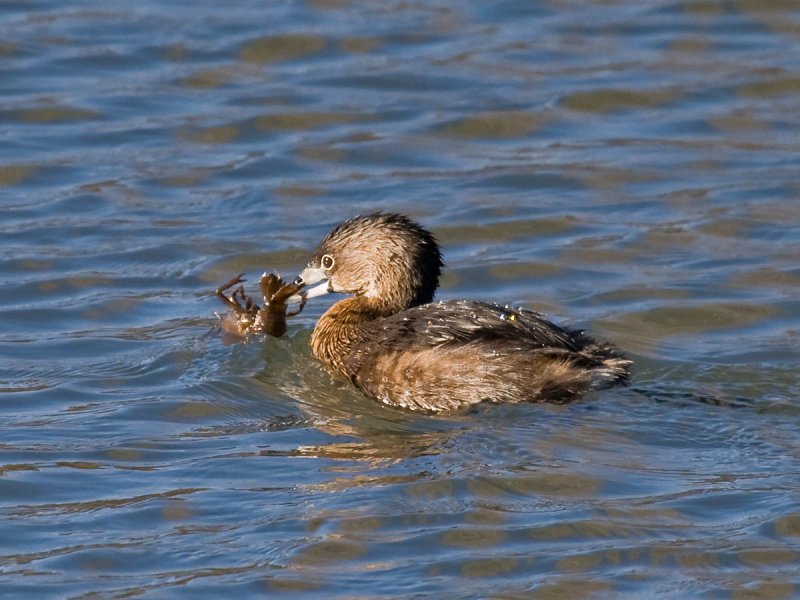
Pied-billed GrebePied-billed Grebe, Commonwealth Lake, Beaverton, Oregon, 2 February 2011 by Greg Gillson.


The Pied-billed Grebe above has a tiger by the tail! Well, actually, it's a crayfish, but still... it better be careful!

In one study in the East, crustaceans such as crayfish made up about 20% of the diet of Pied-billed Grebes, fish 20%, and aquatic insects most of the rest. However, crayfish were consumed primarily in the winter.

Crayfish are not tolerant of polluted water so, evidently, the water in this small lake in a busy city park is not too bad.

Crayfish are also called crawfish or crawdads. Though it's been quite a while since I've been to a crawdad feed, I remember liking them better than lobster, crab, and many kinds of shrimp.

Suddenly I have this craving for grilled shrimp....

I must find the behavior of Pied-billed Grebes interesting, or at least photogenic, as my previous posts on this bird discuss sinking and feather shuffling.

Monday, December 27, 2010

Wing-flicking: Ruby-crowned Kinglet

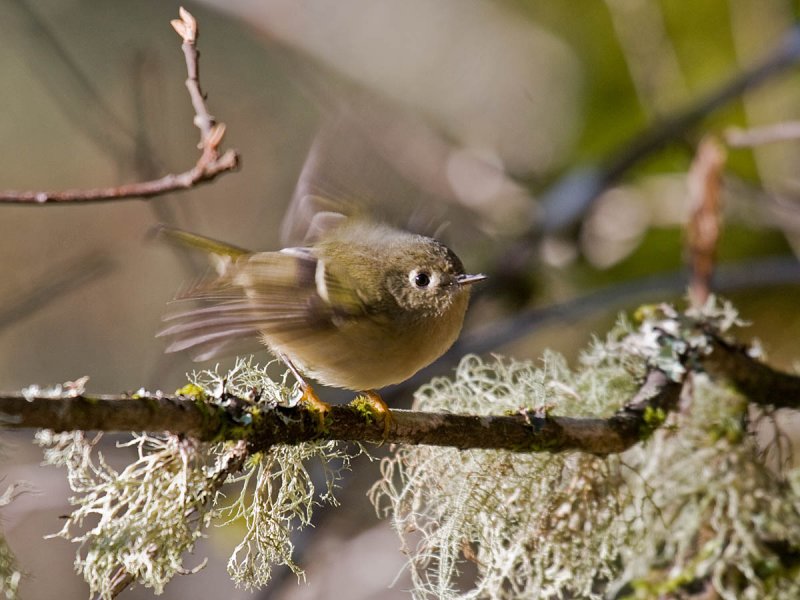
Ruby-crowned KingletThe constant wing-flickinging of Ruby-crowned Kinglet is a characteristic behavior. Photographed at Hagg Lake, Washington Co., Oregon on 17 December, 2010 by Greg Gillson.


"Tiny active birds of tree branches,... with a characteristic habit of nervously flicking the wings."
-- The Birds of Canada, 1979 by Earl Godfrey.


In our previous identification post about the separation of Ruby-crowned Kinglet and Hutton's Vireo we concentrated on the color and shape of feathers, bill, legs, and feet.

Birds also have many interesting behaviors that help separate them. These are rarely mentioned in the field guides--unless conspicuously obvious. Thus field guides typically mention the bobbing and teetering of Spotted Sandpipers, the hovering of Rough-legged Hawks, and the plunge-diving of Belted Kingfishers.

The nervous wing-flicking of Ruby-crowned Kinglet also is mentioned in most field guides.

This innate (instinctive) behavior is like a constant tic. Every couple of seconds the kinglet flicks its wings, as in the photo above. When agitated, it may flick its wings twice in a second. Combined with its constant movement--rarely does a kinglet sit on a branch more then 4-5 seconds--this tiny bird gives the impression of being in a constant state of nervous hyperactivity.

This isn't to say that the look-a-like Hutton's Vireos never flicks their wings, because they do--many small birds do--just not anywhere near the same degree as the kinglets.

Tuesday, November 23, 2010

Feeding habits of the Northern Shoveler

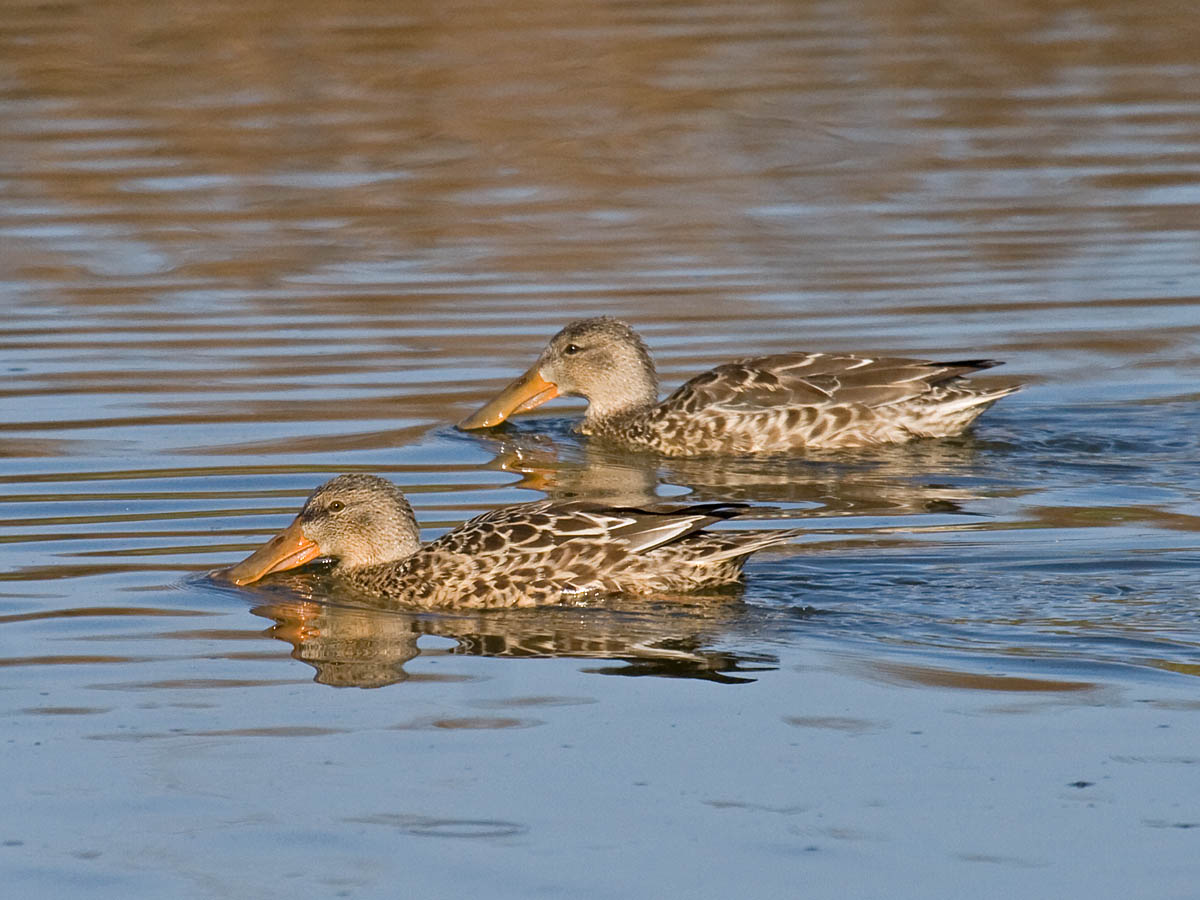
Northern ShovelerFemale Northern Shovelers, Fernhill Wetlands, Forest Grove, Oregon on 19 October 2010 by Greg Gillson.


Many birders are a bit hesitant when it comes to identifying female ducks. The hen's plumage is camouflaged browns. Clues from the brightly-colored wing are often concealed, folded up and covered by the scapulars and breast feathers. It doesn't help, either, that they frequently keep their bills hidden, tucked away in the scapulars as they rest.

But what's this? All those ducks swimming around seem to be feeding with their head half way under the water! Looking around, it doesn't take long to spot plenty of drakes feeding in the same manner--Northern Shovelers all.

Called "spoonbills" by hunters, for their long spatulate bills, Northern Shovelers are the 4th most abundant duck on the Pacific Flyway, following Northern Pintail, Mallard, and American Wigeon.

Shovelers are included in the "puddle ducks" or "dabblers" that primarily feed by upending--head under the water and tail and legs in the air. But not so the Northern Shovelers. They feed more on the surface, pushing their bills through the water, straining out food with the sieve-like lamellae--a comb-like structure on the edges of the bill. All ducks have lamellae, but on the Northern Shoveler it is especially well-developed.

These ducks commonly feed in small groups that circle about, stirring up mud with their feet. They take more animal matter than most puddle ducks, about 65% animals to 35% plants. Snails and water boatmen seem to be favorites, according to John K. Terres in his 1980 reference work, The Audubon Society Encyclopedia of North American Birds.

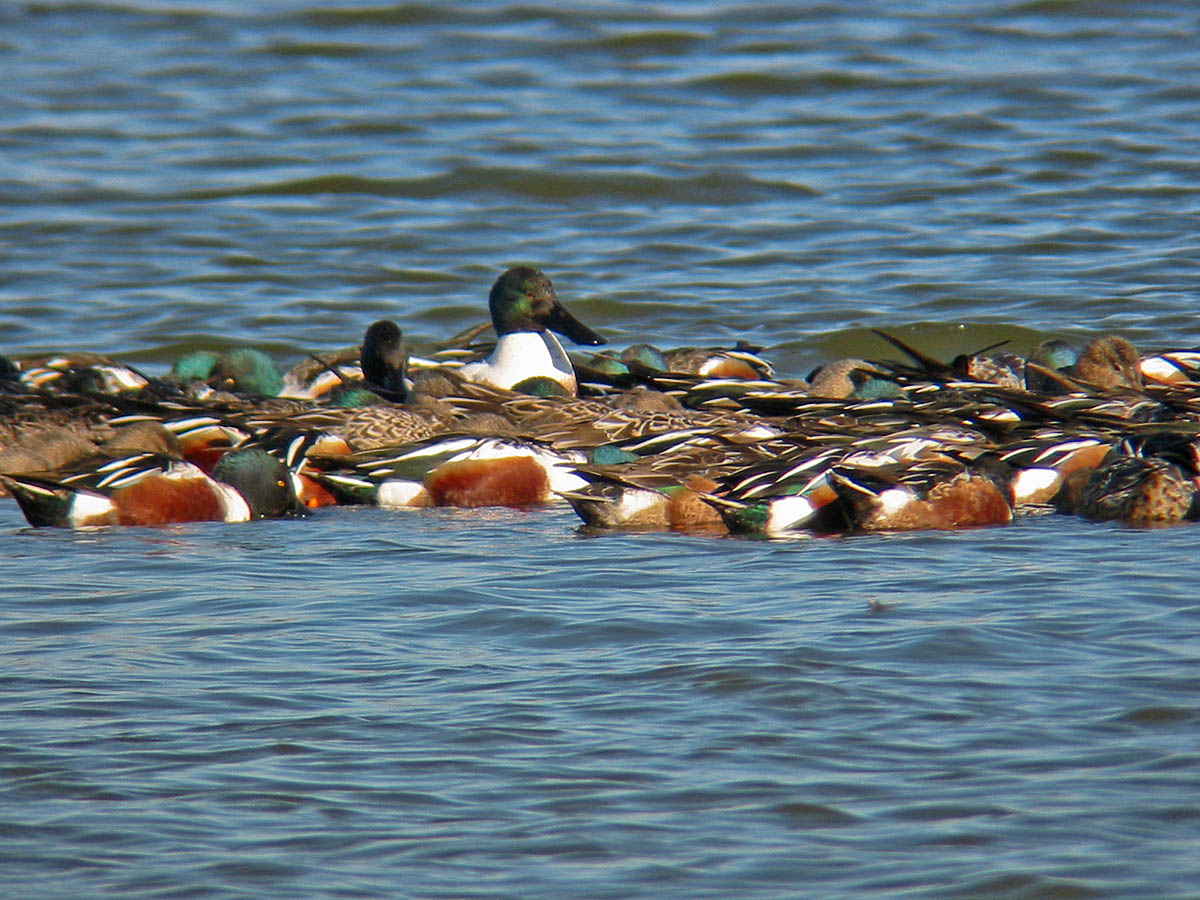
However, whereas Terres indicated that the feeding groups are "three or four" in size, I have often noted groups of a hundred or more in a tightly packed raft, circling and circling as they feed. As they feed, the males (only?) constantly grunt a mechanical chug-kuk chug-kuk chug-kuk....


Northern ShovelerA whole raft of nearly headless ducks! Feeding Northern Shovelers, Fernhill Wetlands, Forest Grove, Oregon on 19 February 2006 by Greg Gillson.

Wednesday, August 25, 2010

Do the Shuffle!

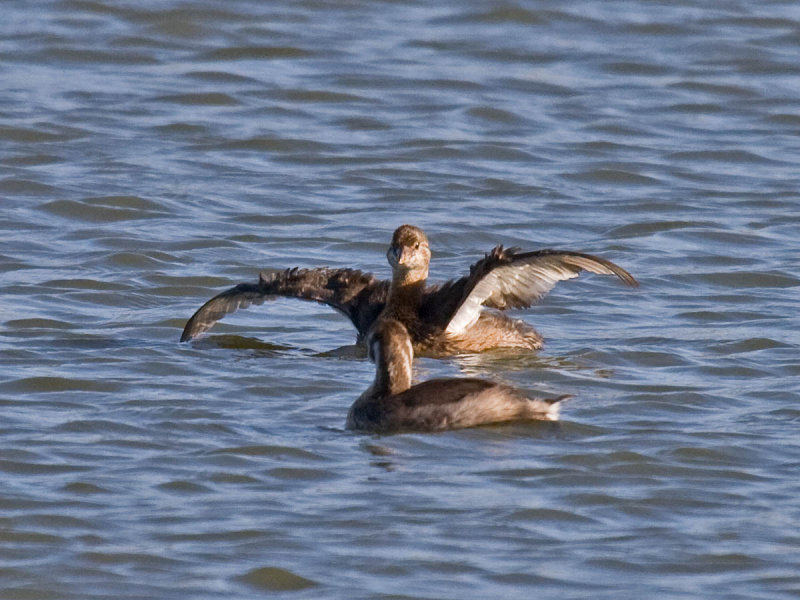
Pied-billed GrebeJuvenile Pied-billed Grebes, Fernhill Wetlands, Forest Grove, Oregon on 19 August 2010 by Greg Gillson.


Last month I photographed the sinking dives of a Pied-billed Grebe at Fernhill Wetlands, in Forest Grove, Oregon. This week I photographed two birds there, one of which is probably the same individual.

These two birds have been hanging around the ponds there. From a distance I noted that they were regularly holding out their wings. So I walked closer to investigate, obtaining the photo above.

I observed that the grebe (the bird farthest back) holds its wings out about 3 seconds, fluffs its back feathers and shakes its back and tail, as in the next photo below, taken 6 seconds after the top photo. [Click photo for larger view.]


This behavior is called "feather settling." It is one of a number of maintenance behaviors that presumably gives the bird comfort. Other comfort movements are yawning, stretching, and resting. Many behaviors in birds are innate--they are instinctively performed following a constant pattern. Feather settling is often performed by raising the feathers, shaking the body, flapping the wings, and finally depressing the feathers down into proper position.

This reshuffling of the feathers was performed several times alternately by both birds. In the photo below the other bird takes its turn (6 more seconds after the second photo above). [Click photo for larger view.]


I realized that I had seen this before, without really thinking about it. Rich Ditch recently photographed a Pied-billed Grebe with its wings out. Now I know what it was doing!

This also explains the bizarre "fuzzy gull" I photographed last week at the coast. The adult California Gull fluffed itself all up as you can see in the photo below. [Click photo for larger view.]


Then it shook itself and flapped its wings. [Click photo for larger view.]


This gull was very worn. The feathers of the tail has lost most of the vanes and the tips are just bare feather shafts. This bird needs to start its fall molt and replace its old feathers very soon!

Perhaps this gull is getting new feathers and they itch? That would explain a reason for feather settling, too. As a matter of fact, the juvenile Pied-billed Grebes are also going through body molt. Itchiness might explain the repeated feather settling they are doing.

Thursday, August 12, 2010

Nature Journal: Sunbathing Cliff Swallows

Cliff Swallows sunbathing on a roof, Jackson Bottom Wetlands Preserve, Hillsboro, Oregon on 7 July 2010 by Greg Gillson.


We had a rather cool and wet spring. Thus, when it finally warmed up just after Independence Day [Editor's note to visitors: it always rains on all holidays in western Oregon.], I went out on the trails at Jackson Bottom one hot morning and found these Cliff Swallows sprawled out and panting on the roof of this wildlife viewing stand.

Why?

I got out my trusty reference guide, The Audubon Encyclopedia of North American Birds (1980) by John Terres.

It turns out all sorts of birds sunbathe, fluffing up their feathers and panting. Some take it to the extreme by flopping their wings forward wildly, gasping for air, while lying prostrate.

That seemed to be the case for the birds observed here, many of which were in a dusky juvenal plumage.

Why do they do it?

Terres' sources indicate that sunbathing benefits birds in several possible ways. Heat is absorbed (they were just cold and wanted to warm up); Vitamin D is produced; skin and feather parasites may move off the back and to a place where the birds can remove them. Some birds apparently sunbathe during the time of molt--perhaps it stops the skin from itching?

Friday, August 6, 2010

Dragonflies

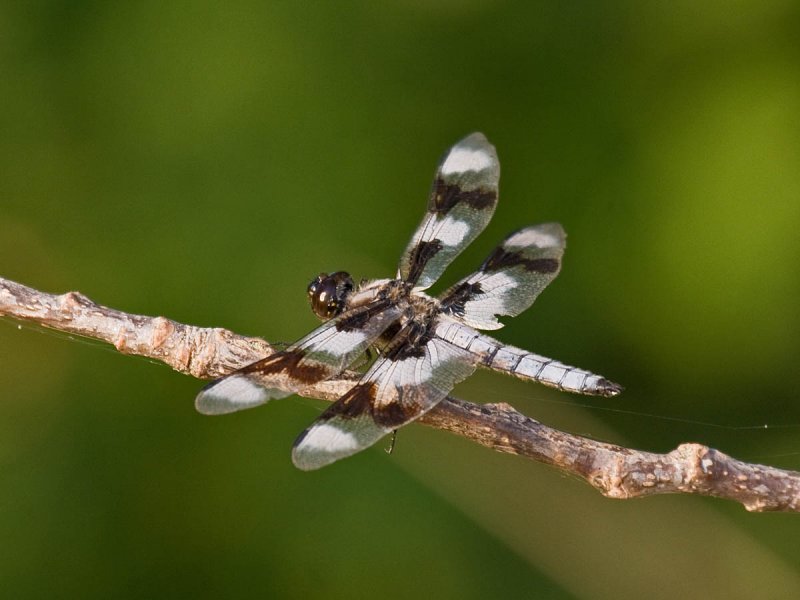
SkimmerEight-spotted Skimmer, Fernhill Wetlands, Forest Grove, Oregon on 5 August 2010 by Greg Gillson.


Yesterday the birding was rather slow, but I noticed several dragonflies. I should have a macro lens for close-ups, but since I don't, I stood with my 100-400 mm telephoto lens back about 7 feet from the insects.

Everything I know about dragonflies I learned 30 minutes ago from local fellow birder and blogger Stefan Schlick in a recent post to his Birdmeister blog.

The odonates of Emma Jones Natural Preserve in Hillsboro, OR (08/04/10, part1)

The odonates of Emma Jones Natural Preserve in Hillsboro, OR (08/04/10, part2)

I knew, or thought I knew, that the fat-bodied ones were dragonflies, and the thin-bodied ones were damselflies. Beyond that I knew nothing about these "bugs," except that some birders also liked identifying these and butterflies, as well as birds.

Photographing them yesterday I didn't know if the different-colored flies were males and females (seems they probably were) or whether I needed more than the abdomen color and wing pattern (probably do).

So, even though Stefan calls himself "quite a rookie" I used his photos and ID's of local dragonflies as the basis for my identifications.

So, here goes. The beautiful creature pictured above is likely Eight-spotted Skimmer.

Next are the two damselflies, probably a blue male and green female (or do I have this backwards?). Stefan's photo of a mating pair has me confused about dragonfly anatomy... (hey, no rude comments there!). Tule Bluet? Is that some kind of inside bug joke?


OK, on to the big blue and green dragonflies. Again, the blue is male and female green? These, I guess, are Western Pondhawks?


I found a nice website of dragonfly photos at Greg Lasely's Dragonflies and Damselflies.

Monday, August 2, 2010

Nature Journal: Separating Cedar Waxwings from European Starlings in flight

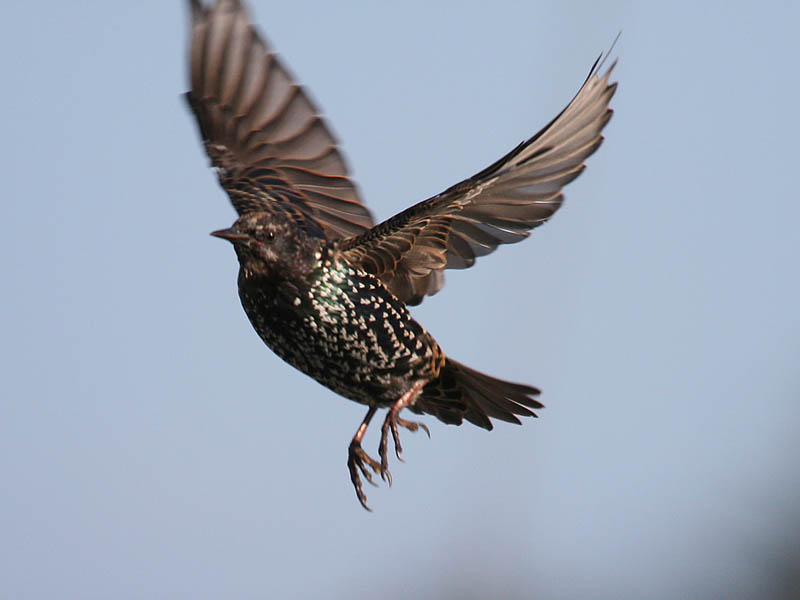
European StarlingEuropean Starling, Charleston, Oregon on 30 August 2008 by Greg Gillson.


Cedar Waxwings and European Starlings are one of the common summer birds from the mid-latitudes of Canada to the mid-latitudes of the US. In summer both species frequently fly around in smaller flocks, often flycatching on the wing.

In size, shape, flight style, and flocking behavior these two species are very similar. If one does not note the yellow band at the end of the tail, the pale undertail coverts, or the crest on the waxwing, there is not much to separate them. They are very similar in flight as a silhouette against the bright sky. Under the entry for Cedar Waxwing, Sibley simply says, "Compare European Starling in flight."

Yet even though they are so similar, somehow for years I've been able to accurately determine whether the chubby pointed-winged bird flying by was a waxwing or starling in about 3 seconds. How did I do it? I wasn't sure.

The human mind has a great ability to evaluate and recognize patterns. Thus, you can identify a relative when she is quite distant and you can't see any details of her face. Unfortunately, our pattern recognition ability works so well that we don't usually know how we're doing it! We're obviously using something, some field mark (or set of field marks) even if we don't know exactly how we know what we know.

So I've been spending time lately, really observing waxwings and starlings in flight, taking notes in the field. In a minute I'll tell you how to tell them apart in flight. But first I will describe the "flight style field marks," those non-plumage characters that identify silhouetted birds in flight.


Field sketch showing silhouette and wing shape of European Starling and Cedar Waxwing. July 5, 2010. Greg Gillson. Click for larger view.


Flight silhouette - We're looking for the overall structure and proportions and how the bird holds its head, neck, body, wings, and tail. For instance, though cranes and herons are superficially similar in their long neck and pointed beaks, they hold their necks much differently.

Wing shape - Differences in wing bones, feather tracts, and feather length account for the differences in wing shape. Birders would do well to study an ornithology manual to better appreciate wing shape. As an example, albatrosses and swifts both have pointed wings, but the albatross may have 25-40 secondary feathers and the swift only 6-7, while both have exactly 10 primaries.

Flapping - How many beats per second? What is the angle the wings travel above and below the plane of the body? Is there a pattern of flaps and pauses? How stiff are the wings?

Flight path - Is the flight progression undulating, swooping, erratic, or straight? What is the general height above ground and speed?

Flocking flight characteristics - Geese may fly in 'V' formation. Other birds fly in flocks that are disorganized and constantly changing. Many birds don't fly in flocks at all.

Flight type (or purpose) - Birds fly differently depending upon what they are doing (or even how fast the wind is blowing). If they are fleeing, then they will flap more deeply and quickly than if in standard commuting flight. Other birds soar and glide, or even hover.


Notes and field sketch of Cedar Waxwing flight path. July 7, 2010. Greg Gillson. Click for larger view.


So how do starlings and waxwings differ in flight?

Both species have pointed wings. The arm (inner portion of the wing between body and wrist) of the waxwing is relatively longer than the starling. The wrist is held straighter on the waxwing, creating a straighter leading edge than on the starling (see my top sketch).

The actual measurements of the ratio of tail length to body length is nearly identical between the two species. However, the waxwing tail appears slightly relatively longer than the starling. This may be caused by a thinner wing, wing set farther forward, or optical illusion caused by pale vent on the waxwing.

In flight characters, both species flap several times and fold their wings. The starling flies relatively straight and level. The final flap or two of the waxwing, before the folded pause, propels the bird upward slightly, so that the flight is slightly undulating.

The starling head (crown) appears quite flat. The waxwing has a rounder head, accentuated by the much shorter bill. The head of the waxwing is often raised slightly above the plane of the neck.

The identification of birds in flight is not well-covered in the field guides. But it is worth the effort to observe and learn. After all, one of the unique features of birds is that they have wings, and most can fly. It only makes sense to be able to identify them when they are flying.

Sunday, July 25, 2010

Nature Journal: That sinking feeling

Juvenile Pied-billed Grebe, Fernhill Wetlands, Forest Grove, Oregon on 13 July 2010 by Greg Gillson.


Two weeks ago I observed this juvenile Pied-billed Grebe at the local wetlands. To submerge, grebes either lunge forward and dive head-first, or simply sink. This bird used this latter method.

It actually happens quite quickly. The bird starts submerging at the breast, then the body goes under, and finally the head. Here are two submerging sequences.


Here's another set...


Thursday, July 15, 2010

Nature Journal: Nest box double-take

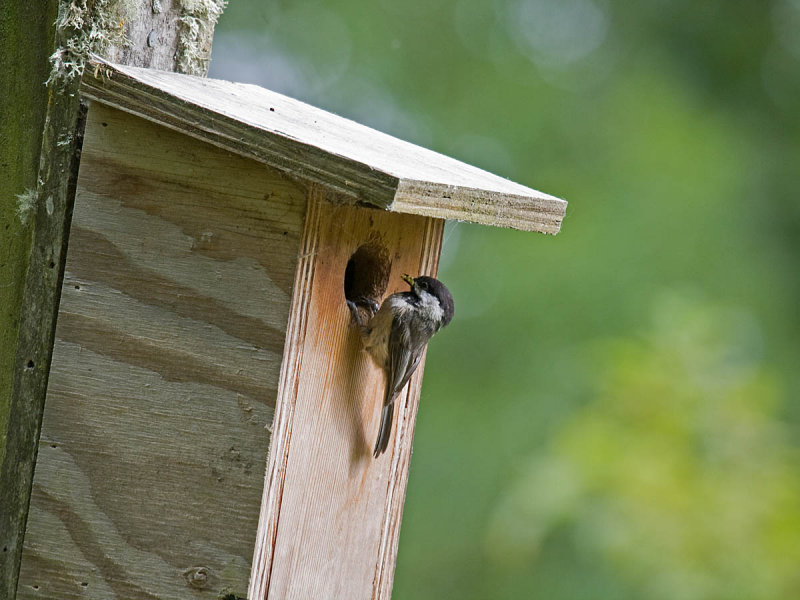
Black-capped ChickadeeBlack-capped Chickadee, Jackson Bottom Wetlands, Hillsboro, Oregon on 13 July 2010 by Greg Gillson.


There is nothing unusual in the above photo. On the free Wednesday morning bird walk I lead, we encountered this Black-capped Chickadee feeding nestlings at a nest box at Hillsboro, Oregon's Jackson Bottom Wetlands Preserve. The nestlings were grown enough to meet the parents at the nest entrance to receive food.

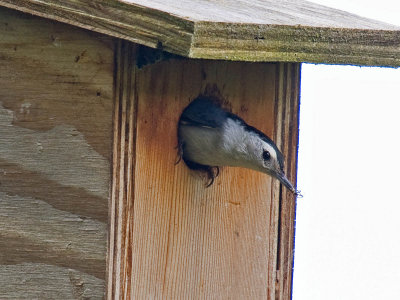
What is unusual, is that White-breasted Nuthatches were feeding nestlings at this same nest box 68 days earlier (see photo below)!

White-breasted NuthatchWhite-breasted Nuthatch, Jackson Bottom Wetlands, Hillsboro, Oregon on 6 May 2010 by Greg Gillson. Click on photo for larger views.


Here is what John K. Terres has to say about Black-capped Chickadee nesting in his book The Audubon Society Encyclopedia of North American Birds. He says that incubation is by both parents, 11-13 days and that the young leave the nest when 14-18 days old. The incubation and fledgling period is nearly the same for White-breasted Nuthatch (12 and 14 days, respectively).

It appears that the nest box might have been unoccupied approximately 42 days between the nesting of the nuthatch and chickadee.

Friday, July 9, 2010

Spotted Towhee in the rain

Spotted TowheeSpotted Towhee in the rain at Cooper Mountain Nature Park, Beaverton, Oregon on 15 June 2010 by Greg Gillson.


Since we're in the second day of above-90 degree temperatures, my mind began to drift back to the cool rainy days of spring when we thought summer would never come. In other words, just two weeks ago.

I was birding up at the new Cooper Mountain Nature Park on a hill south of Beaverton, Oregon. During our hike it started sprinkling a bit. The towhees didn't seem to mind, singing away. [Click for previous blog posts on Spotted Towhees.]

In this photo you can see the raindrops, as streaks, frozen in time. Exactly 1/160th of a second, to be precise, according to the camera settings. OK, my mind churns, the towhee is about 8 inches long and the raindrop streak looks to be approximately one inch long. Distance divided by Time equals Rate, according to algebra learned some time between the 5th and 8th grade. Thus, 1 inch divided by 1/160th of a second equals 160 inches per second, or... 9.1 miles per hour!

A quick Google! search for "how fast does rain fall?" leads me to several sites where I learn that a raindrop falls 5 to 18 miles per hour. Any faster and the raindrop breaks apart and slows down. File that trivia away for the next time conversation drags at your party!

[This post has been rewritten on 12 July 2010. Thanks to Mike Patterson for helping me correct my math errors on the earlier post.]

Friday, June 25, 2010

Summer birds in the Oregon Coast Range

Gray JayGray Jay, Timber, Washington Co., Oregon on 22 June 2010 by Greg Gillson.


This past week I led a half-day birding field trip into the Oregon Coast Range about 40 miles west of Portland, Oregon. The trip was sponsored by the Jackson Bottom Wetlands Preserve.

The five of us spent the morning primarily at Reeher Forest Camp in the Tillamook State Forest about 2 miles west of the small hamlet of Timber.

We left the parking lot at Jackson Bottom in Hillsboro about 7:30 am and arrived at Timber about 45 minutes later. At Reeher Camp we chased around some singing birds, including SWAINSON'S THRUSHES, HERMIT WARBLERS, VARIED THRUSHES, and PACIFIC-SLOPE FLYCATCHERS, though we enjoyed more of their songs than much actual observations in the thick and tall forest. A family group of COMMON RAVENS were making quite a racket and allowed us to get good views at surprisingly close range.

From the horse camp we took the trail down along the river and enjoyed more birds down to the bridge over the Nehalem River. There we enjoyed a pair of AMERICAN DIPPERS bringing food to their mud and moss nest under the bridge.

Returning to the day use parking area we walked up Wheeler Road about 1/2 mile. We enjoyed looks at WESTERN TANAGERS, WILLOW FLYCATCHERS, RED-BREASTED SAPSUCKERS, CHESTNUT-BACKED CHICKADEES, and an EVENING GROSBEAK feeding his fledged young. A family group of HAMMOND'S FLYCATCHERS cavorted about high up in one tree, providing less than ideal views.

Birders at Timber, Oregon on 22 June 2010 by Greg Gillson.


For the final hour of our field experience, before driving back to Hillsboro, we drove closer to the summit of Round Top Mountain. On the steep north slope we heard the deep booming calls of SOOTY GROUSE, but did not see these shy forest chickens.

We stopped in a ravine and were able to call up a group of about 7 GRAY JAYS, who glided in through the trees for delightfully close views and one usable photo (above).

The following is the list of birds seen or heard, from Timber west to Round Top. You might want to compare this list with a similar trip last week.

Sooty Grouse 3
Band-tailed Pigeon 1
Rufous Hummingbird 3
Belted Kingfisher 1
Red-breasted Sapsucker 5
Downy Woodpecker 3
Hairy Woodpecker 1
Northern Flicker 1
Olive-sided Flycatcher 6
Willow Flycatcher 2
Hammond's Flycatcher 5
Pacific-slope Flycatcher 15
Warbling Vireo 8
Gray Jay 9
Steller's Jay 2
Common Raven 7
Violet-green Swallow 2
Chestnut-backed Chickadee 12
Red-breasted Nuthatch 6
Brown Creeper 1
Winter Wren 4
American Dipper 2
Golden-crowned Kinglet 3
Swainson's Thrush 20
American Robin 8
Varied Thrush 3
Orange-crowned Warbler 2
Black-throated Gray Warbler 2
Hermit Warbler 6
MacGillivray's Warbler 3
Wilson's Warbler 20
Western Tanager 4
Spotted Towhee 5
Song Sparrow 2
White-crowned Sparrow 1
Black-headed Grosbeak 2
Purple Finch 2
Red Crossbill 2
American Goldfinch 4
Evening Grosbeak 14

Saturday, June 12, 2010

"Seen only" -- bad photos, great birds in the forest

Pacific-slope Flycatcher The magic of digital photography allows me to brighten the shadows and darken the highlights in order to better see this Pacific-slope Flycatcher. Like most flycatchers, it is easier to identify this bird by its song and calls than by its visual field marks. Photographed near Timber, Oregon on 12 June, 2010 by Greg Gillson.


Today I visited Reeher Forest Camp near the town of Timber in the Coast Range west of Portland, Oregon.

I love birding in the forests of the Pacific NW--especially during the breeding season when nearly every bird is singing. Non-stop.

Because it is so hard to see in the deep forest--dark with blinding shafts of golden light piercing through--more birds are heard than seen. Many more. Photography is just about impossible in harsh light and deep shadows with most birds high above you in the canopy backlit. I have one flycatcher photo to share, but most will go in the digital trash bin.

Some people, when writing out their list of birds detected from their birding day in the field, mark some of their detections with the comment "heard only" to indicate they did not actually see the bird. On my trip today I kept track and have just the opposite to report. Most of my birds were heard and identified first and seen later, if at all.

To see what I mean, here is today's list, broken out.

Saturday, June 12, 2010
Timber, Washington County.
Primarily Reeher Forest Camp, walking new 2 mile loop ("Triple C Trail") through forest and clear cut. Also drove to top of Round Top Mountain and birded road sides.

Seen only (not heard)
Turkey Vulture 1
Rufous Hummingbird 2
Violet-green Swallow 1

Identified optically first, then heard
American Robin 4
American Dipper 2

Identified by call or song first, then later saw at least one individual well enough to identify by sight
Sooty Grouse 2 (saw 1)
Red-tailed Hawk 1
Band-tailed Pigeon 50 (saw 35)
Northern Pygmy-Owl 1
Red-breasted Sapsucker 4 (saw 1)
Pacific-slope Flycatcher 25 (saw 1)
Gray Jay 2
Steller's Jay 4 (saw 2)
Common Raven 4
Chestnut-backed Chickadee 30 (saw 20)
Red-breasted Nuthatch 6 (saw 3)
Brown Creeper 12 (saw 2)
House Wren 8 (saw 3)
Golden-crowned Kinglet 6 (saw 1)
Orange-crowned Warbler 8 (saw 4)
Hermit Warbler 15 (saw 4)
MacGillivray's Warbler 7 (saw 2)
Willson's Warbler 10 (saw 6)
Western Tanager 8 (saw 3)
Spotted Towhee 7 (saw 2)
Song Sparrow 6 (saw 3)
White-crowned Sparrow 12 (saw 7)
Dark-eyed Junco 10 (saw 7)
Black-headed Grosbeak 8 (saw 3)
Evening Grosbeak 15 (saw 8)

Identified by call or song and not seen, or not seen well enough to identify by sight alone
Common Nighthawk 1
Hairy Woodpecker 1
Pileated Woodpecker 1
Olive-sided Flycatcher 6
Willow Flycatcher 8
Hammond's Flycatcher 3
Warbling Vireo 35
Bewick's Wren 1
Winter Wren 4
Swainson's Thrush 20
Varied Thrush 5
Brown-headed Cowbird 2
Purple Finch 2
Red Crossbill 25
American Goldfinch 1

Notice above that some of the most abundant birds were "heard only." Even when I did see birds, I heard far more than I saw.

See how many birds I would have missed if songs and calls weren't part of the "field marks" I have memorized?

What an empty place the forest would appear if I couldn't identify the birds I heard.

How do you go about learning calls and songs? Anyone who can hear can learn bird calls and songs. Go birding in the forest more. Track down any unfamiliar song or call you hear. Watch it sing and remember. Use mnemonics or whatever works best for you. Start small. You already know crow and killdeer and several others, right? Learn one or two a day--don't confuse yourself with too many. Start in your own backyard. Review. Have fun!

Saturday, May 15, 2010

Birding report: Hagg Lake, Washington County, Oregon

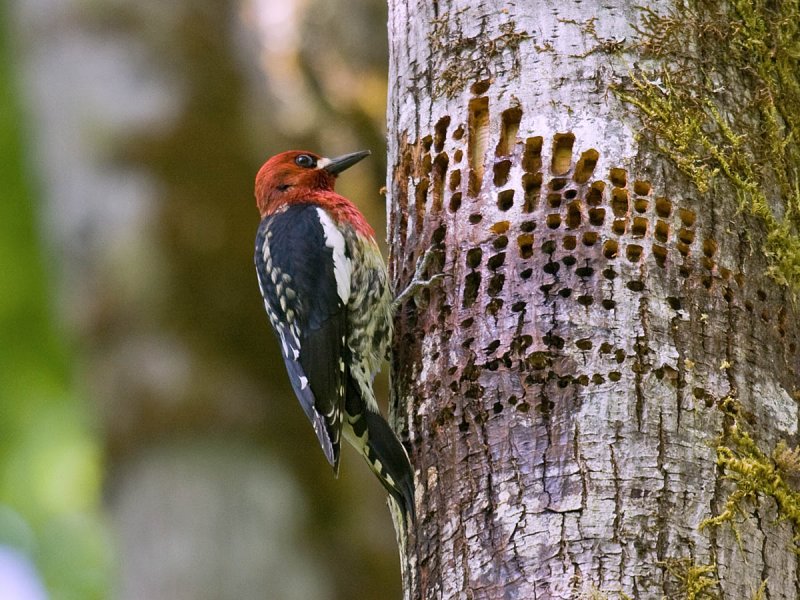
Red-breasted SapsuckerRed-breasted Sapsucker, Hagg Lake, Washington Co., Oregon on 15 May 2010 by Greg Gillson.


Next weekend I am leading a birding trip to Hagg Lake in the Coast Range west of Portland, Oregon. Today I did some scouting to make sure trails were open and passable. There are still spaces left on the trip next Saturday, May 22. We'll take a van from Jackson Bottom Wetlands Preserve in Hillsboro, Oregon. If you wish to join, select trip #24783 and call 503-681-5397 to sign up with Hillsboro Parks & Rec. Dept. Other birding field trips are listed on the Jackson Bottom Wetlands web site.

There are 12 miles of trails around the lake and lots of birds. The most common bird today was EVENING GROSBEAK. The second most common bird was ORANGE-CROWNED WARBLER. Other warblers were quite conspicuous, too--at least in song. WILSON'S WARBLERS, BLACK-THROATED GRAY WARBLERS, MACGILLIVRAY'S WARBLERS, and COMMON YELLOWTHROATS sang from many areas around the lake. I heard, but did not see, 2 YELLOW-BREASTED CHATS. They should become more common next week.
A few flycatchers were in. I heard one WESTERN WOOD-PEWEE and heard many PACIFIC-SLOPE FLYCATCHERS, though seeing them was difficult. Equally shy, several SWAINSON'S THRUSHES were heard, but not seen.

At Scoggins Creek about 35 BAND-TAILED PIGEONS were drinking from the spring there. Several SPOTTED SANDPIPERS were bobbing on the rocks. A RED-BREASTED SAPSUCKER allowed photos.

All in all, a good morning of bird watching.

Here is the list of birds seen...

Mallard 2
Osprey 1
Red-tailed Hawk 4
Band-tailed Pigeon 35
Mourning Dove 2
Rufous Hummingbird 4
Belted Kingfisher 1
Red-breasted Sapsucker 1
Downy Woodpecker 3
Hairy Woodpecker 2
Northern Flicker 2
Pileated Woodpecker 1
Western Wood-Pewee 1
Pacific-slope Flycatcher 7
Hutton's Vireo 3
Warbling Vireo 3
Steller's Jay 5
Western Scrub-Jay 7
American Crow 8
Violet-green Swallow 12
Northern Rough-winged Swallow 3
Barn Swallow 1
Black-capped Chickadee 6
Chestnut-backed Chickadee 10
Red-breasted Nuthatch 3
Brown Creeper 2
Bewick's Wren 4
House Wren 8
Winter Wren 3
Golden-crowned Kinglet 2
Swainson's Thrush 4
American Robin 8
European Starling 6
Orange-crowned Warbler 40
Black-throated Gray Warbler 7
MacGillivray's Warbler 6
Common Yellowthroat 8
Wilson's Warbler 10
Yellow-breasted Chat 2
Western Tanager 7
Spotted Towhee 8
Song Sparrow 6
Dark-eyed Junco 8
Black-headed Grosbeak 20
Red-winged Blackbird 3
Brown-headed Cowbird 15
Purple Finch 2
Red Crossbill 2
Pine Siskin 3
American Goldfinch 5
Evening Grosbeak 85

Friday, April 16, 2010

A tale of two White-crowned Sparrows

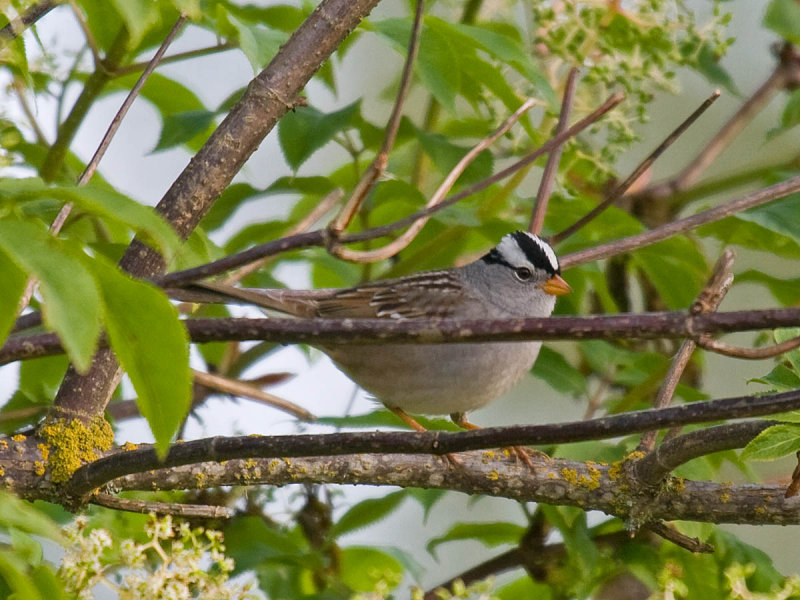
White-crowned SparrowGambel's White-crowned Sparrow, Fernhill Wetlands, Forest Grove, Oregon on 16 April 2010 by Greg Gillson. Notice bright white head stripes, pale stripes on back, orange bill, clean gray underparts.


White-crowned Sparrows are moving through the Pacific Northwest right now. I photographed this bird recently in NW Oregon.

As discussed last year (In the backyard... White-crowned Sparrow), there are 5 populations across North America.

West of the Cascades, from SW British Columbia to NW California, these represent two populations. The Puget Sound White-crowned Sparrow nests in this area and is now moving into breeding habitats--coastal headlands, valley pastures, and western Cascade clear-cuts.

On a broad band across the west, the Gambel's White-crowned Sparrow is also migrating north now. It will breed in interior British Columbia, western Alberta, and Alaska.

These birds sing during migration. The songs of the various populations across North America are different. Indeed, songs can be slightly different even within populations, as young birds learn to sing whatever local dialect they hear.


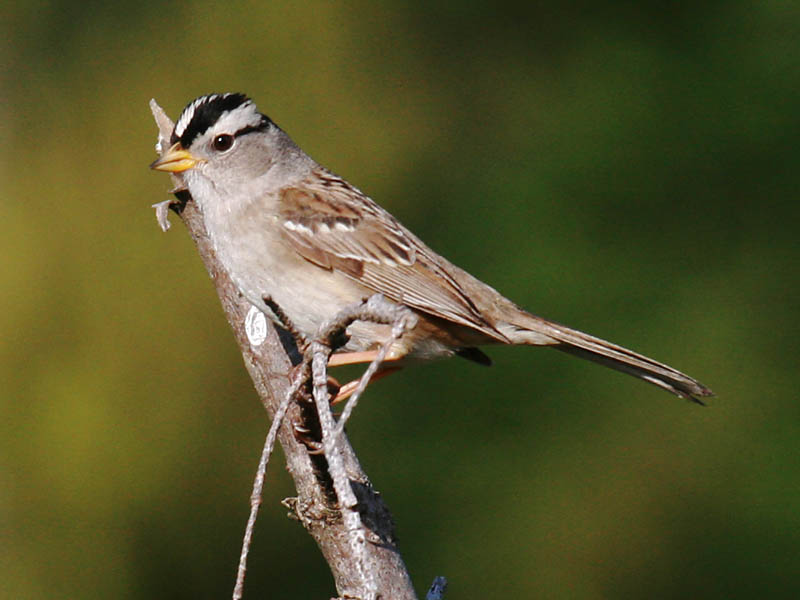
White-crowned SparrowPuget Sound White-crowned Sparrow, Hayward, Oregon on 16 May 2008 by Greg Gillson. Notice dingy white head stripes, dull two-tone brown back, yellow bill, brownish sides.


If you want to practice separating songs, now is the time.

I transcribe the "typical" song of Puget Sound White-crowned Sparrow as a lively and sweet:

wee SWEE chilly-chilly-SWEEE cheer-cher-er

On the other hand, the song of the Gambel's White-crowned Sparrow is more mournful, with downward-sliding emphasized notes:

WEE chur chilly-chilly-CHUR

The White-crownd Sparrow songs on the Cornell Lab's online field guide are not exactly the songs I usually hear in NW Oregon, but close enough.

The song marked as "Alaska August 2006 by Geritt Vyn" is a Gambel's.

The song marked as "Oregon June 1988 Geoffery A. Keller" is a Puget Sound.

A note on field guides.

Sibley has a "Pacific" form that includes Puget Sound White-crown and the non-migratory Nuttall's form of the central California coast. The "Interior West" is the Mountain White-crown. "West Taiga" is Gambel's. "East Taiga" is the nominate leucophrys subspecies.

The National Geographic guide shows the dark-lored, pink-billed as leucophrys (includes Mountain White-crown). The pale-lored birds are split between the bright Gambel's with orange bill and the duller and browner Nuttall's with yellow bill (includes Puget Sound White-crown).

Confused? I hope not. But you can practice again in September when the birds migrate south.... Or, eastward from the Cascades practice looking for the dark-lored Mountain White-crowned among the more abundant Gambel's....

Thursday, April 8, 2010

Quest for the Mountain Quail

clear cut

My boss, Sarah, expressed a desire to see Mountain Quail. A few days later we had a field trip set up through Jackson Bottom Wetlands Preserve. A week later we had enough participants signed up for the van trip.

Mountain Quail are sneaky and very difficult to observe generally, and rather uncommon in NW Oregon. Some people who live in forested areas told me "they come to my feeder fairly regularly." However these persons live quite far from Hillsboro, Oregon, our base of operations.

Quail seekersI contacted Lars Norgren who has Mountain Quail near his home at Hayward. He went out one morning to look for quail but did not hear any.

On April 1st I spent a couple of hours hiking a logging road west of Forest Grove where I saw Mountain Quail "dust baths" in the road... last fall. It was very scenic, but the road was as steep as I remembered. I got drenched in a sudden rain from a black cloud that appeared over the Coast Range while the towns below enjoyed sunny weather. Most importantly, I found no sign of quail.

Thus, we remained true to our original intent of visiting Johnson Road near Vernonia. This area is not somewhere I would send people on their own. Target shooters, illegal trash dumpers, and noisy ATV'ers are possible. On our visit today, however, all seemed pristine and quiet. The road was recently graveled and in good condition.

The forecast was horrible, though, with rain and wind predicted. As typcial for Oregon weather forecasts, such conditions did not appear. There was no wind and the showers in the valley below turned to a light dusting of snow, interspersed with brief periods of sun in the hills, much to our delight... and relief.

searching for Mountain QuailWe walked a side road up a hill where I had seen Mountain Quail in previous years (see photo below). However, the re-growing trees are now 12-15 years old. They are perhaps too large now for Mountain Quail.

We did find Chestnut-backed and Black-capped Chickadees, Red-breasted Nuthatches, Purple Finches, American Robins, and both Ruby-crowned and Golden-crowned Kinglets. Even though it was fairly cold with a bit of off-and-on sleet or hail here, there were several Orange-crowned Warblers and Rufous Hummingbirds on our hike. Spotted Towhees, Bewick's Wrens, Song Sparrows, and Dark-eyed Juncos filled out the rest of the bird species detected.

We drove up a mile to where a new logging road skirted the ridgetop between two valleys. We got out and walked again. We had not gotten far when a a startling flurry of wings errupted along side us. A Mountain Quail burst into flight from under a small fir tree about 4 feet tall! I got a decent view as it flew away, with all blue-gray back, wings, and tail. Jeremy saw the chestnut undertail as he had a view a bit more from the side. Sarah and Diana heard, but did not see, the bird as it rocketed low down the hill and out of sight.

Mountain Quail
A long time ago and from a camera far, far away.... Mountain Quail in May 2005 near Vernonia, Oregon. Digiscoped by Greg Gillson.
We continued walking another mile of muddy logging roads but did not see or hear any more Mountain Quail. But now each member of the group knows how and where to search for this elusive species.

We saw or heard additional birds, including Steller's Jay, Common Raven, American Crow, Northern Flicker, and Red-breasted Sapsucker. Oddly, a pair of Northern Harriers were acting very territorial in the Douglas-fir and western hemlock woods, screaming and circling and landing, miles from any marshes or meadows.

A bonus bird was a huge Northern Goshawk that winged slowly up the valley providing good views for all.

So, success, but still room for better future sightings....

Monday, June 15, 2009

Butterflies!

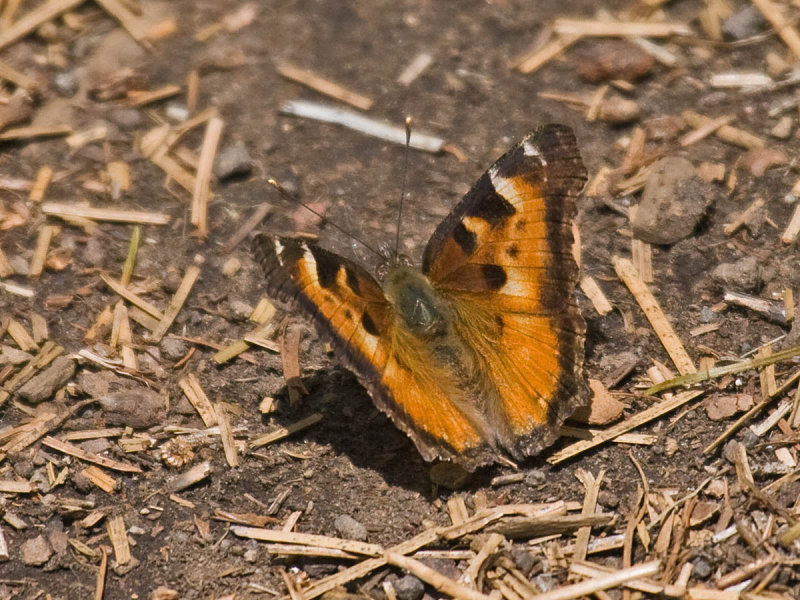
ButterflyButterfly #1 [California Tortoiseshell], Canyon Creek Campground, Jefferson Co., Oregon on 7 June 2007 by Greg Gillson.


Most birders have at least a passing interest in all forms of life. Many have become deeply immersed in butterfly and dragonfly identification. At this point, I have decided not to let my obsessions with birds extend to these colorful flying insects. But sometimes they demand attention. Such was the case on the Woodpecker Wonderland Bird Festival held last week at Camp Sherman, Oregon.

While leading bird tours in the Abbott Creek area of the now 6-year-old B&B Burn, I was impressed with the numbers of butterflies along the Metolius River at Canyon Creek Campground. So I took several photos of butterflies sunning themselves. Except for monarchs and swallowtail butterflies, I am pretty much ignorant of butterfly identification. In fact, I'm not sure what the differences really are between butterflies and moths.

So I present some photos here and hope that my readers will tell me what these are. For now, these are just "pretty butterflies" the same way that some people enjoy "pretty birds" without a strong need to name and chase them. If you know what these are, please use the "comments" link to post your response. Thank you.

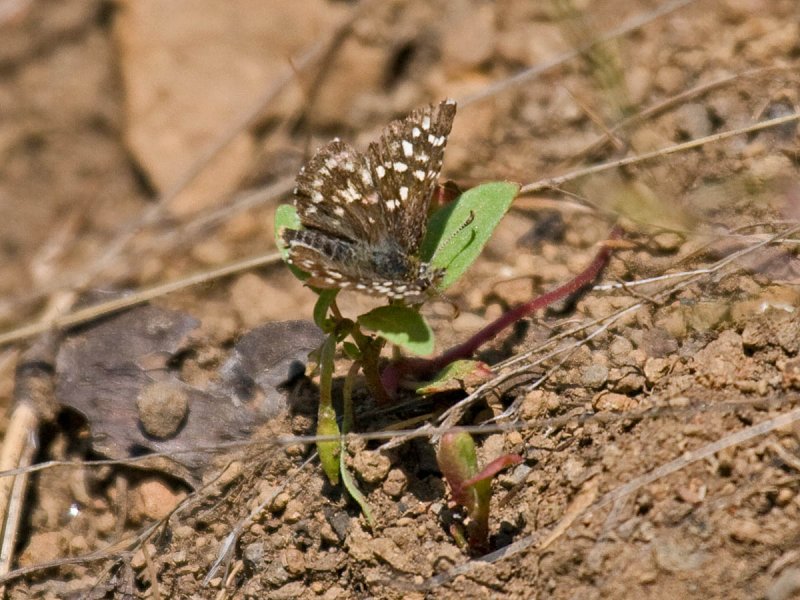
ButterflyTiny little blackish Butterfly #2 [Two-banded Checkered Skipper], Canyon Creek Campground, Jefferson Co., Oregon on 7 June 2007 by Greg Gillson.


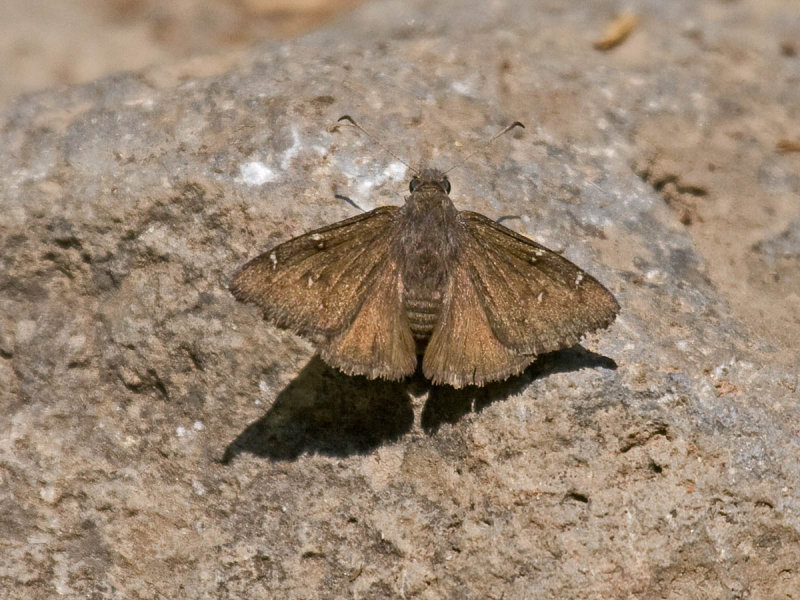
ButterflyAnother dark one, Butterfly #3 [Northern Cloudywing], Canyon Creek Campground, Jefferson Co., Oregon on 7 June 2007 by Greg Gillson.


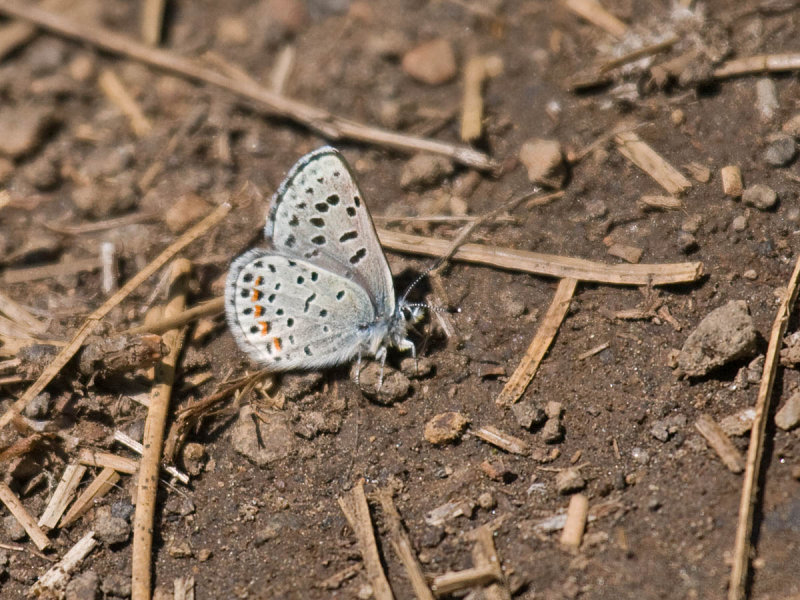
ButterflyThe undersides of the wings were pale with orange dots on this on, Butterfly #4A [Dotted Blue (sp.)], Canyon Creek Campground, Jefferson Co., Oregon on 7 June 2007 by Greg Gillson.


ButterflyThis same butterfly had blue wings when open, Butterfly #4B [Dotted Blue (sp.)], Canyon Creek Campground, Jefferson Co., Oregon on 7 June 2007 by Greg Gillson.