Showing posts with label rare bird. Show all posts

Wednesday, October 10, 2012

NW rarity: Tropical Kingbird

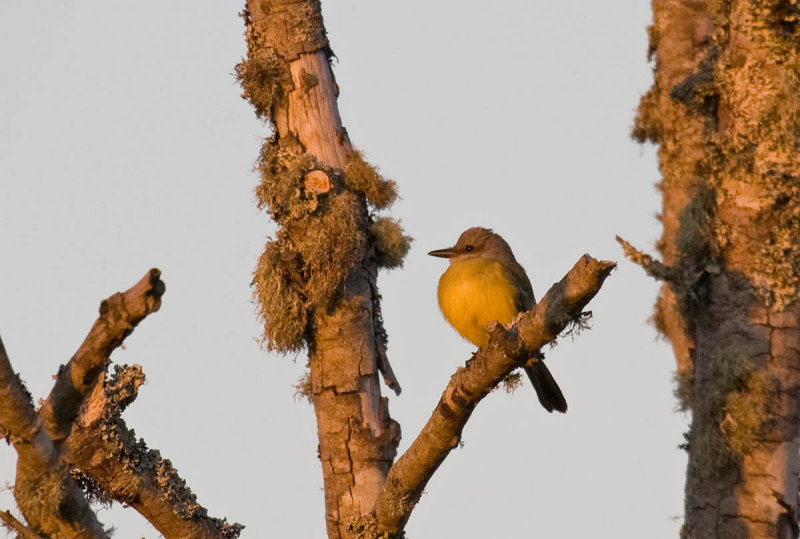
Tropical Kingbird
Tropical Kingbird. Newport, Oregon. October 6, 2012. Photo by Greg Gillson.
This past weekend I was along the coast when I received word of a nearby Tropical Kingbird. I arrived just before sunset as the last rays of the orange setting sun illuminated this bird.

A native of Mexico and Central America, breeding birds barely reach SE Arizona. Thus, many birders in the Pacific Northwest are surprised to learn that this bird is regular along the coast of the Pacific NW every October and November. Typically, a half dozen or more are reported from the Oregon coast every autumn.

Each year members of this species undertake a post-breeding dispersal that brings them along the coast of Texas, the Rio Grande, northern Baja, and the West Coast from California to British Columbia. A few birds then also winter in southern California.

To find these birds in the Northwest look in open areas along the immediate coastline. Estuary edges, golf courses, parks with open areas and scattered trees, and vacant lots in town are all habitats where you might find this rare bird. They perch in the open on wires and trees, often quite still for long periods, as in the accompanying photos.

In the Pacific NW they are similar to Western Kingbirds but the yellow breast extends higher and the head is not as pale gray down onto the upper breast as the Western Kingbird. Tropical Kingbird has a blackish notched tail, while Western Kingbird's square black tail has contrasting white outer tail feathers.

Tropical Kingbird
Tropical Kingbird. Newport, Oregon. October 6, 2012. Photo by Greg Gillson.


Thursday, July 12, 2012

Wrentits in northern Willamette Valley


This spring and summer there have been several scattered reports of Wrentits in NW Oregon outside their historic range. Could the sightings and heard-only reports be correct? Possibly. On the other hand some might just be weather balloons.

Reports have come from North Portland, Sauvie Island Wildlife Management Area, Hagg Lake, and Tualatin River National Wildlife Refuge. Thus far, all these reports from well-birded areas are unverified--descriptions are incomplete and others can't find them the same or next day. That's a problem for me. I'll tell you why.

Wrentits are sedentary to the extreme. Their home ranges are a tiny 2-1/2 acres--a few hundred feet across. Pairs of birds mate for life and are never far apart (Terres, 1980. The Audubon Encyclopedia of North American Birds). Both sexes sing throughout the year--a very loud and unique bouncing ball whistled trill. On the rare occasions when birds have been found pioneering new areas they are rather easily and repeatably detected.

The range of Wrentit in Oregon hasn't changed all that much in 200 years. Historically, they were found along the immediate coastline in salal bushes under the scrubby shore (lodgepole) pine, from California to the Columbia River. They have never crossed the Columbia into the state of Washington, even though regular on the Oregon side of the mouth of the river. In winter they sometimes can be found a few miles inland into clearcuts. They also occur in the SW area of the state near Medford in low-elevation chaparral of the Rogue Valley, and in low numbers into the Klamath Basin.

Recently (the past 50 years or so), their inland population has inched northward through the Umpqua Valley to the eastern edges of the southern Willamette Valley in Lane County. A population has also crawled northward on the western edge of the Willamette Valley, from Finely NWR near Corvallis in the 1970's to Grand Ronde of Yamhill County.

There are three known isolated outposts north and east of this range. Birds were detected in the late 1990's near Lebanon. Birds this century colonized the Sandy River delta near Gresham. Birds recently arrived at Minto Browns Island Park in Salem. Especially is this last location hard to fathom. Birds either hopped across miles of city streets or somehow crossed the Willamette River. This from a species that refuses to come out of cover and is loathe to cross a single lane dirt road!

Of course, birds had to get to these new outposts by crossing miles of unsuitable and even dangerous (for a Wrentit) habitat. Thus it is possible that some of this year's out-of-range reports may be correct. I take comfort in my present skepticism, knowing that if birds really are present at these new locations they won't stay undetected for long.

Monday, February 6, 2012

VOE and taking notes

San Diego Co., California, 4 November 2008 by Greg Gillson.


"Gray back. Yellow-green breast. Light under tail and belly. Throat and side of head yellow. Head olive with yellow eyebrow and central crown stripe. Pink legs. Short tail. Bill straw with dark-ridged upper mandible. Dark eye."

Does the description above sound like it fits the bird in the photo? The California Bird Records Committee thought it did. Unfortunately, I wasn't submitting a report of the bird in the photograph. My report of a rare bird was rejected. Fortunately, I had VOE (verifiable objective evidence) in the form of a rough sketch made soon after seeing the bird that allowed the record to be accepted upon resubmission. But I'm getting ahead of myself.

In my previous post (VOE and reports of rare birds) I discussed including a brief description when reporting a rare bird to your online email list.

But there is good reason to make such notes in your birding notebook each time you see a rare bird. I know, few birders keep a field notebook of bird sightings. And most are nothing more than a list of birds seen during the day. My note taking took on added meaning after reading Van Remsen's article ("On taking field notes" American Birds, 1977). But my dedication to note taking and the amount of effort I put into it varied greatly over the years.

Lately I've been copying my historical bird records into eBird. I have entered checklists from 1972-1982 now. That was some time ago. And my enthusiasm sometimes exceeded my expertise. So, when I came across my own notebook report of a rare species, I wanted to have VOE (Verifiable Objective Evidence)--a description whereby I could judge the accuracy of my own sightings over 30 years ago. What did I have? Well, in accord with Van Remsen's suggestions, I had underlined unusual birds in my notebook. Rare birds? They were double-underlined. Descriptive notes? Rarely. And usually incomplete.

Sometimes my notes confirmed the bird I claimed. Other times my descriptions indicated I had seen a different bird than I had claimed. Most times, though, I had no description. Was I correct or not? Who knows? Those records don't go into eBird.

So what about the bird and description above? Well the bird in the photo is a female Red Bishop, a native of Africa that escaped their cages and established populations in southern California. That's what the Records Committee thought my bird might be. If I had included a copy of my notes for that day in October 1983 that included the head sketch I made, it would have been accepted right away.


My field notes do accurately describe a Worm-eating Warbler, but NOT ONLY a Worm-eating Warbler. As you can see, my notes could also describe a female Red Bishop! My description didn't have anything about shape of the bill that would have cleared up the ambiguity. Rare bird descriptions always first need to answer the question "why was it a warbler?" before going to the eyebrow and central crown stripe that would separate one warbler from another. This is true whether one is submitting a report to the Rare Bird Records Committee or writing your own notes that you might question 30 years later.

Wednesday, February 1, 2012

VOE and reports of unusual birds

"May I see your license, registration, and proof of insurance, please?"

What does this officer want? Verifiable Objective Evidence. Business records verifying compliance to environmental regulations, tax statements for the last 7 years, proof of residence after moving to get your driver's license updated. All these are familiar situations that require VOE, some form of documentation that gives evidence of something.

Birding is the ultimate form of trust. I trust that you actually saw the bird you told me you saw. You trust that I didn't just make up a rare bird to get attention. In England (Bill Oddie's Little Black Bird Book), the term "stringer" is used to describe a birder who claims rare birds that no one else believes--untrustworthy, whether a deserved reputation or not.

Birding email lists are popular, with people of varying skill levels reporting common birds at their feeder or experts reporting the results of their latest rarity chase. When planning my precious birding time, I may want to look for rare birds that someone else found recently--perhaps a bird I've never seen before. If someone reports a "good" bird far away, I want to at least believe that the bird was identified correctly before I invest my time and fuel to go look for it.

So what do I make of a birding report from a birder I've never heard of, at a place rather distant, with 4 or 5 rare birds on it? An expert birder who just moved into the area? Or a beginner with more enthusiasm than accuracy?

It doesn't take much VOE to help me make up my mind. With the advent of excellent digital cameras, it'd be great to have a photo. But a simple description of the bird, written soon after the observation, would be nice. Don't tell me that you are very familiar with the species from somewhere else. Don't tell me you're positive of the identification. Tell me what you saw--not what you concluded. You don't have to write a Bird Records Committee-worthy description. Just tell me enough of what shape, color, field marks, calls, and behaviors you observed and let me draw a conclusion as to what the bird was.

The importance of writing descriptions of rare birds for my own personal records was brought to my attention recently. My next post (VOE and taking notes) will articulate.

Saturday, November 26, 2011

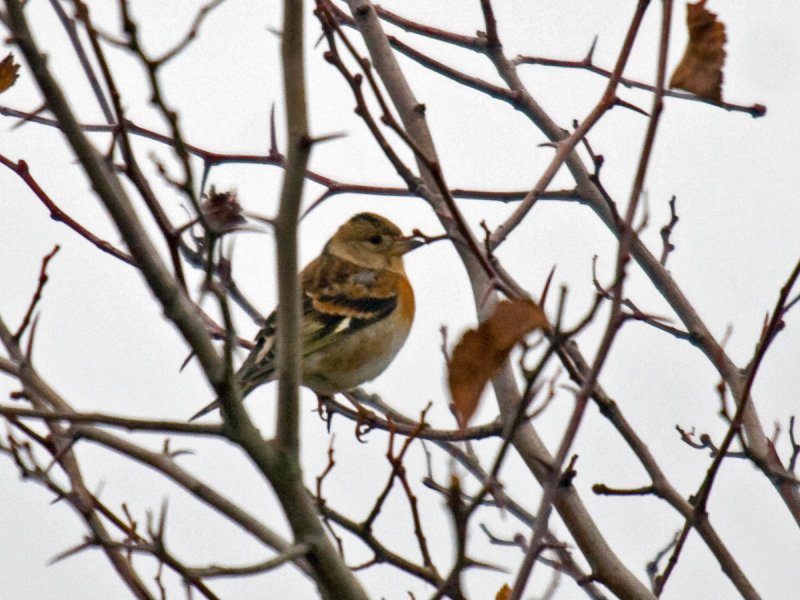
Brambling chase

BramblingBrambling, Scappoose, Oregon, 26 November 2011 by Greg Gillson.


It's been several years since I "chased" a rare bird outside of my home county. ('Chase' means to drop everything and try to go see a rare bird found by someone else, often far away.) Last year I worked on a County Big Year, setting a new record by seeing 199 species in tiny Washington County, Oregon. So I went looking for every unusual bird seen locally last year. This year I did more "relaxed" birding, with no numerical goals.

It took me a while to remember the last bird I chased outside of my local county. It was a Northern Wheatear on the coast in September 2009. I did get several good photos of this rare Eurasian (even rarely Alaskan-nesting) thrush-like bird.

When I heard of the Brambling (boldly-colored Eurasian finch) Friday afternoon in Scappoose, I was under the influence of cold medication and didn't really care. By evening I had convinced myself I felt better and would leave at dawn and join the chase! It was only 20 miles away, after all, and it was supposed to be sunny! There are only 11 previous Oregon records of Brambling. All prior records were birds that were found at residential feeders and most remained several days or longer. This one was in a wetlands with flocks of other sparrows, so would likely be more of a challenge to refind...

It was just starting to get light when I pulled into the parking lot at 7:20 AM. But it was a gloomy, cloudy day, not sunny as forecasted. For such a rare state bird I was surprised no one else was there yet. Where was Russ Namitz, who is working on a state Big Year this year?

I walked down the path toward the green shed where the bird was seen yesterday afternoon. There were 3 birders gathered near the shed. They had walked in from the other side. The three birders soon built to five. No joy. No bird. We were prepared for a long wait.

Photo above by Marlene Gillson just after we'd seen the bird!


At 8:10 AM, after we'd been waiting there by the shed about 30 minutes without success, a birder approached. It was Lona Pierce, who had discovered the bird yesterday. She didn't make it to us when she stopped and pointed and said, "There it is!"

True enough, we all got brief looks as it appeared in a hawthorn tree above the blackberries. I snapped off some quick photos, but none were very good. It was so dark that I tried flash, but that always makes birds look so horrible. Then it was gone.

Over the next hour and more, additional birders came. Some names I remembered, some I did not. Sadly, I am better at identifying birds than bird watchers. I think the following birders were present: John Gatchet, Bob Stites, Scott Carpenter, Don Wardwell, Henry Horvat, and Lona Pierce were the others I believe saw the bird. Birders that showed up later were Jay Withgott, Shawneen Finnegan, Dave Irons, Liz Gordon (wife of American Birding Association president, Jeff Gordon), Diana Byrne, Jim Danzenbaker, and several others. By the time I left, about 9:30 AM, the bird hadn't returned.

My other photos of the Brambling are linked here.

The complete area checklist from eBird.

Wednesday, September 7, 2011

Rare Bird Report: Red-necked Stint

Red-necked StintImage 7573: Red-necked Stint, New River, Coos County, Oregon, 27 August 2011 by Greg Gillson.


On July 12, 2011, Dave Lauten and Kathy Castelein discovered a small sandpiper that they initially identified as a Semipalmated Sandpiper (Calidris pusilla), a rather rare, but regular migrant through the Pacific NW. One oddity, though, it lacked partial webbing between the toes. In other words, the supposed Semipalmated Sandpiper was not semipalmated! With some prompting by Shawneen Finnegan, Dave and Kathy re-identified the bird as a Red-necked Stint (Calidris ruficollis) in non-breeding plumage.

If a Semipalmated Sandpiper without semipalmations raised eyebrows, the new identification even more so! There are very few North American records south of Alaska of Red-necked Stint (primarily an Asian Arctic breeder that winters in Australia). Most records are either juveniles or breeding-plumaged adults. The plain non-breeding, or "winter," plumage is very difficult to identify.

The Oregon Shorebird Festival in Charleston, Oregon, gave me an opportunity to see this bird. To do so required a 3 mile hike on loose sand and for me to remove my shoes and role up my pants legs to wade a creek!

Even then, the bird was no slam-dunk to identify. I observed carefully and took notes--even though I also took photos. Photos alone are often not enough to document a rare bird. Sometimes the photos don't show the salient identification features. Worse yet, sometimes shadows or odd angles or exposure or color settings can misrepresent the actual appearance in the field! And this bird didn't let me get close and the wind was making my shots unsteady and a bit blurry.

The following is an edited version of my report to the Oregon Rare Bird Records Committee. Such a rare bird report needs to describe the bird so that others can "see" it in their mind and identify it themselves based on the description of the bird alone, and not the reputation of the birder.


Rare Bird Report
Red-necked Stint
End of Fourmile Road, south of Bandon, then north on New River to nearly due west of Hoffer Lane.
New River, Coos Co.
27 August 2011
3:30 PM

In view about 30 minutes from 50 to 150 feet, with 8x binoculars, Canon Xti with 100-400 zoom (through the lens magnification of about 12x), borrowed Russ's 40x scope for 5 minutes.

With Tim Rodenkirk, Tim Shelmerdine, and Russ Namitz after pelagic trip.

General: Obvious Calidris sandpiper: compact body, rounded head on short neck, wings to the end of short tail. Bill short for a sandpiper, legs black. Approximately 6-7 inches from bill tip to tail tip. Gray above, white below, non-breeding plumage.

Habitat and behavior: Shallow tidal river behind ocean dunes. Spent most of time with Western Sandpipers (all 350 were juveniles) foraging in an inch or less of water, with entire bill submerged, or resting on small sandstone ridge of about 8 inches in height with small potholes of water, where it may have been able to get out of the wind. Consistently was the aggressor against all juvenile Western Sandpipers of both sexes.

Image 7542: Red-necked Stint (second from right) amid juvenile Western Sandpipers. Note size equal to Western Sandpiper, neckless and humpbacked. [click all photos for larger views]

Size and shape: Appeared as large as Western Sandpipers with which it associated. It was consistently differently-shaped, however, so it was difficult to compare overall length. The bird appeared pot-bellied and neckless, accentuated by a humpbacked look that gave it a very round appearing body [Image 7542 and 7578]. Thus, the bird was fatter, belly to upper back, than the Western Sandpipers, but not as long. On the few occasions when it moved near Least Sandpipers it was significantly larger and bulkier.

Image 7578: neckless, hunchbacked, good angle to judge tapered bill shape

Head and bill: Eye dark, entire head very pale gray and without strong contrasting patterns. The eyebrow stripe was faint but fairly wide, and appeared to go over the bill, barely contrasting with a slightly darker (brownish tinged or faintly streaked?) crown and darker lores. Ear coverts generally pale but a small post-ocular brownish feather or two in the center of the ear coverts at some angles. Bill short, as shortest Western Sandpiper male (shorter than >95% of male Western Sandpipers). Bill tapered (more so than typical Semipalmated Sandpiper and similar to Western Sandpiper), with a slight constriction just before the tip and slight droop. [Image 7578 is a bit soft in focus but shows the bill length and shape best. Image 7574 best shows the ear coverts.]

Image 7574: ear coverts, breast collar

Underparts: White and unmarked from chin to vent except for a blurry patch on the sides of the upper breast and, at certain angles, photos [Image 7574] reveal a narrow very faint gray (complete?) collar across the breast.

Image 7570: P9 molted?

Underwing: The bird stretched and raised its wings once and I was able to get a photo [Image 7570. Note that bill tip is behind sandstone and appears blunt.]. The wing linings, including axillars, were entirely white and the flight feathers and tertials were silvery gray underneath with no pattern. I count only 9 primaries with perhaps a slight gap between the outer two primaries on both wings, perhaps indicating P9 is shed, if so then near the end of wing molt. Molt of the flight feathers would confirm the age as an adult.

Image 7573: good view of back, scapular, and tertial feather patterns

Back and wings: The rounded back feathers appeared mostly gray with pale browner centers and thin white tips. The messy scapulars were gray with brownish shaft streaks becoming wider, grayer (less brown), and darker on the inner scapulars. The tertials were darker grayish-brown, darker toward the feather shaft, white on the edges, wider white on the tip. [Image 7573 shows mantle feathers clearly, but dark shadow in water makes bill tip appear odd.]

My photos are ambiguous as to length of primaries compared to the tail. In many of the photos the tertials cover the primaries completely, and the tail is not clearly visible in any photo (except when wings raised). The primaries certainly do not fall short of the tail tip. In one photo [7559] it appears as if the tail end and wing tips are equal.

Image 7559: compare end of tail to wing tips.

Legs and feet: Black. Exposed tibia noticeably short compared to Western Sandpipers. Often only the tarsus emerged from the feathers of the round fat belly. The toes were clearly unwebbed in several scope views. Photos didn't really catch the toes at an advantageous angle, though webbing can clearly be seen on accompanying Western Sandpipers with no hint of such on any photo of the stint.

Voice: I heard the bird call as it flushed once. It was clearly different than Western's “jeet” call or Least's raspier “kreet” call. I described it as a rather smooth, drawn out “churrr.” On all of the Macaulay Library recordings I found only one call of Semipalmated Sandpiper that is similar (http://macaulaylibrary.org/audio/3124 time stamp 26-29 seconds). What I heard is NOT the short rough “chrrt” call of Semipalmated Sandpiper that is most common (http://macaulaylibrary.org/audio/3116 time stamp 50-54 seconds). The Red-necked Stint has a call similar to what I heard: http://macaulaylibrary.org/audio/63771 time stamp 37 and 48 seconds; and http://www.xeno-canto.org/recording.php?XC=61957 the very first call. Thus, the call I heard could match either Semipalmated or Red-necked Stint.

Similar species: Western Sandpiper, Semipalmated Sandpiper, and Little Stint in non-breeding plumage are the only contenders.

Most (>95% of males in my experience) Western Sandpipers have longer bills. Westerns show longer legs, longer neck. Non-breeding plumaged Westerns show more streaking and contrast on the crown and sides of the breast. Westerns have obvious partial webs that this bird clearly did not. Voice does not match.

The observed bird was much larger than Least Sandpiper, thus also Little Stint. The bill on the observed bird is probably thicker than any Little Stint. Voice does not match.

Image 7549: blunter looking bill shape in this photo compared to other photos

I believe that the bill on the observed bird is more tapered than Semipalmated Sandpiper. Several of my photos seem to show blunter bill [Image 7549]. But I also have a couple other photos with more pointed looking bills [7553, 7578]. The posture of the observed bird is extremely different than the taller aspect with longer legs and neck that I associate with Semipalmated Sandpiper. The non-breeding plumage photos I have seen of Semipalmated Sandpiper do not show the strongly contrasting shaft streaks and white feather edges to mantle feathers. The observed bird clearly did not have webbed toes. However, at least one recording of Semipalmated Sandpiper has a call similar to calls of Red-necked Stint, and similar to what I heard.

Semiplamated Sandpiper is variable, but differs with the observed bird in plumage color and contrast of the mantle, bill thickness and shape, webbing between toes, neckless, humpbacked, and pot-bellied aspect of the observed bird, and apparent length of tibia.

Image 7553: tapered bill


You may find a previous article, ID Challenge: Western Sandpiper and Semipalmated Sandpiper, of interest.

Wednesday, November 17, 2010

Photo Quiz

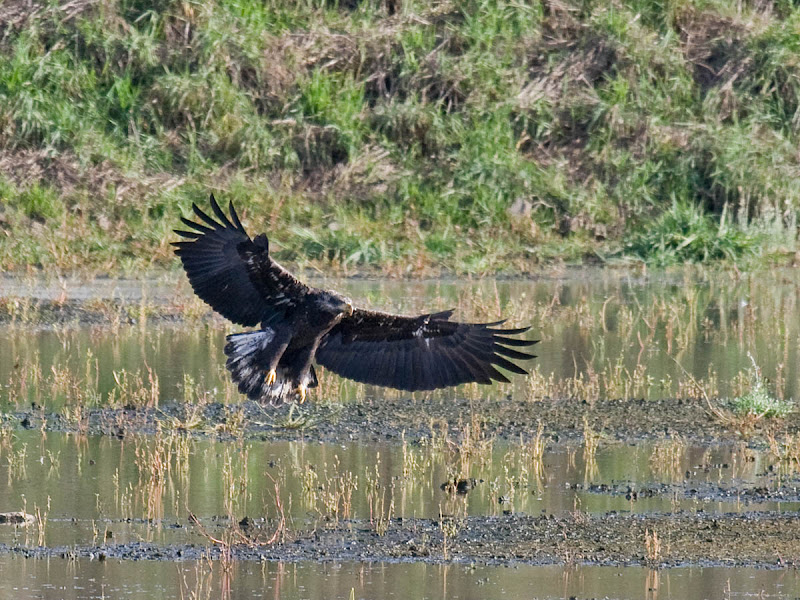
QuizQuiz bird, Jackson Bottom Wetlands, Hillsboro, Oregon on 15 November 2010 by Greg Gillson.


Do you know the species pictured here? Are you sure? Can you tell what age? Can you find it in your field guide?

Certain birds can be highly variable in their plumage appearance. An individual may not match exactly the illustration in the field guide. Most field guides show an "average" plumage; some show certain variations, but not all. The plumage above does not appear exactly in any of my field guides.

This is obviously a bird of prey. It has large, broad wings with "fingers" formed by emarginated (notched) primaries. Large yellow feet with sharp black talons, and a short curved bill complete the raptor characters visible.

The mostly black plumage with white base to the tail probably has most people immediately guessing eagle--either Golden or Bald. But which one?

If we only had a view of the upperside....

Well, we do. And it is immediately below. However, if you want to stop here and get your field guide out and make a guess, this is the place to do it. Because immediately after the photo below I will start giving the answer...

[Microsoft Windows tip: Right-click on each photo and "open in a new window" to get the larger image. Then you won't have to wait so long to reload the blog page as you do when you left-click and hit the "back" button to return.]


So, is it Bald Eagle or Golden Eagle? And what age? Why do we care about the age? We get more clues about the ID if we can determine age.

Let's start with what it is not, shall we?

It is not a juvenile Golden Eagle. Such a bird would have a brighter and cleaner white base to the tail and big white wing patches.

It is not an adult Golden Eagle. They have darker tails and less white on the face.

In fact, the white on the face and yellow on the bill eliminate any age of Golden Eagle. It must be a Bald Eagle. But what age?

The dusky banded tail, dark underparts, and dark back looks a lot like the juvenile Bald Eagle illustrated in Sibley's guide. However, the white on the face and yellow bill are wrong for a juvenile.

Second and third year birds have white wing linings and belly and a white triangle on the back. That doesn't fit. That's odd. And fourth year birds reach adult plumage with white head and tail.

I don't see any plumage age that matches the quiz bird.

Let's try the National Geographic Guide and... oh my God!   It looks just like the juvenile White-tailed Eagle!


Wait! Slow down just a minute. While it is possible that I've actually found a rare bird--in fact, I have found several rare birds over the years--it is more likely this is an unfamiliar plumage of a common bird. After all, White-tailed Eagle from Eurasia is not just a rare bird in North America, it is extremely rare with only a few records from Alaska (mostly the Aleutians) and a record or two from the East Coast.

Let's age this bird more accurately to help with the ID.

Juveniles of many species, including eagles have more pointed feathers than older birds. Look at the wings--the primaries and secondaries on the trailing edge of the wing. The trailing edge is rather smooth and even. If this bird was a juvenile each feather would be obviously pointed, the trailing edge would appear saw-toothed.

Unlike smaller songbirds, the wings are so long on eagles that not all the flight feathers are replaced every year. It takes at least 2 years to replace the flight feathers. During this time the longer and more pointed juvenile feathers would contrast obviously with shorter and broader replacement feathers. There would be obvious "steps" (molt limits) every 3-5 feathers on the trailing edge. Such is not the case in this quiz bird.

Based on the state of molt on the wings (none visible) and no juvenile feathers, this bird must be at least 2-1/2 years old. As discussed, 2 and 3 year old Bald Eagles have white wing linings and often a white belly (especially 2-year olds), and a white triangle on the back. This bird does not. It has a more adult-like blackish body.

Not all Bald Eagles reach full adult plumage in 4 years, some birds take 5 years. It is possible, then, that our quiz bird is 3-1/2 (assuming hatched in May, and it is now November), with extensive dark mottling remaining on the tail and head feathers. I do note some white spotting throughout the body and wings.

A paper on aging eagles by Mark McCoullough would seem to indicate the bird I saw was in Basic III plumage.

However, everything we've said for Bald Eagle is also true of its sister species, the White-tailed Eagle. How do we know this is not a 3-1/2 year old White-tailed Eagle?

There are 3 remaining features to separate Bald Eagle from White-tailed Eagle. Rarely does one have to resort to these "supporting" field marks. But in this case it seems necessary.

For comparison, look at this album of White-tailed Eagle photos from Lithuania (isn't the Internet wonderful?). Bird 7 is a juvenile, looking superficially like our quiz bird. However, note the saw-toothed trailing edge of the wing?

Remember that we said that raptors show emarginated primaries? Bald Eagle has notches in the outer 6 primaries, White-tailed Eagle shows 7. On my photos I can only clearly see 6 notched primaries. The 7th? Well, it's hard to tell. Nothing conclusive.

The tail of White-tailed Eagle is short and pointed. My dorsal (back-side) photo above does not show an obvious pointed tail. Perhaps still not conclusive, but this mark seems to favor Bald Eagle.

Finally, Bald Eagles have white undertail coverts and White-tailed Eagles have dark undertail coverts. My ventral (under-side) photo definitely shows extensive dark undertail coverts. There appears to be a couple white feathers on the bird's right-hand side of the undertail coverts--maybe. If we assume this is a 3-1/2 year old bird, when all Bald Eagles should have extensively white undertail coverts, this mark definitely favors White-tailed Eagle.

A mark not mentioned in my meager references on White-tailed Eagles is the upper tail coverts. The uppertail coverts are white on Bald Eagle and mostly dark on White-tailed Eagle. My dorsal photo above shows 2 white uppertail covert feathers over the middle 2 tail feathers. This is exactly like this photo of White-tailed Eagle. This mark favors White-tailed Eagle.

That's it then. I can go no further based on my knowledge and references. Here is a bird that doesn't really match any plumage that I can find of either Bald Eagle or White-tailed Eagle. I believe it is in Basic III plumage, 3-1/2 years old.

Such an inconclusive outcome may happen anytime when we're bird watching. Sometimes birds are too far away, in bad light, or not seen long enough for us to be sure. In such a case it is best to let it go. Odds favor a common bird over a rare bird by, literally, millions to one. The odds are still the same even when photographed. And sometimes photographs--even fairly good ones--aren't diagnostic.

Unless someone can prove otherwise, with additional knowledge and experience I don't have, I have to go with Bald Eagle. But,... okay, take my own advice and let it go....

Oh, and by the way, that bird is probably still around...
Thursday, September 2, 2010

Oh, oh... Molt again

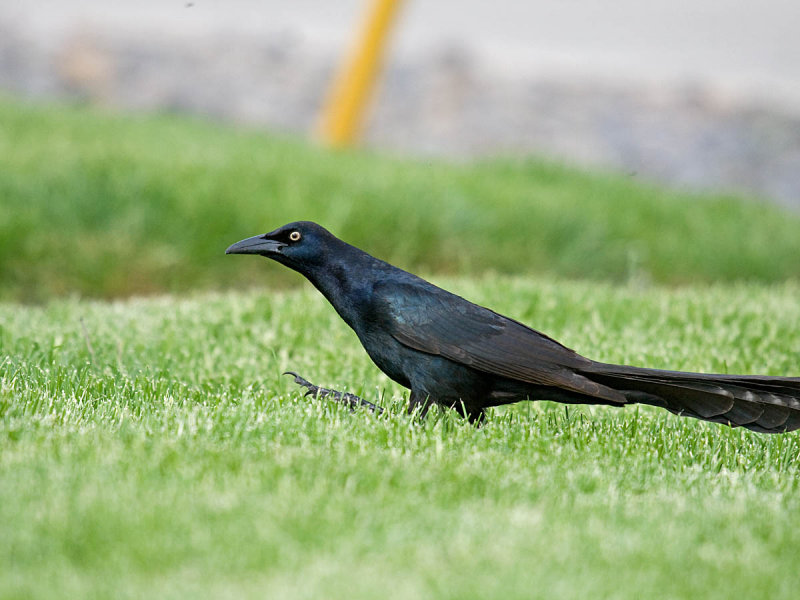
Great-tailed GrackleGreat-tailed Grackle, Hines, Oregon on 23 May 2009 by Greg Gillson.


Recently I was working through some photos from last year. Usually, after a photo shoot, I will immediately turn the best RAW shots into jpeg's and post those. Then, as I have time, I will work on the other shots and delete the (numerous) bad ones.

So, for instance, when I photographed this vagrant Great-tailed Grackle in the parking lot of a restaurant in Hines, Oregon, 15 months ago, I uploaded the best shot immediately. That left me with some shots like this one, above, that I am finally getting back to.

Even though I pulled the lens in from 400mm to 340mm it was not enough, as the bird was so close. As a result, the entire tail didn't quite make it into the frame. And there's this distracting yellow "something" pointing right at the bird's head. So, it is not a very artistic photo.

However, it shows something that I didn't realize at the time. This bird is almost exactly one year old. How can I tell? Molt limits.

Now I've been birding 38 years, and am just "getting into" understanding molt. So I sympathize completely if you don't find this as interesting as I do right now.

For most birders,... the brain fogs over at the mention of molt. -- Alderfer and Dunn, National Geographic Birding Essentials, 2007.


Last month I discussed this topic using a photo of a juvenile Brewer's Blackbird in molt. Today's post continues that discussion.

Even though this is a black bird, it is not completely one solid black color. Much of the plumage is rich black with glossy purple and green iridescence. However, many feathers on the wing and tail are dull brown.

Those dull brown feathers are retained juvenile feathers. Those are the first feathers this bird ever grew, probably in June of the previous year. Now, in the month of May, 12 months later, those original wing and tail feathers are quite worn. They contrast quite nicely with the glossy black feathers that were part of the pre-basic molt in the previous September.

In the next fall (2009) this bird will molt in new wing and tail feathers (and all feathers, actually) and be in definitive basic plumage. From then on, all through its life, it will undergo a complete molt each fall. Only during this first year and a half, can the age of this species be determined using molt limits.

Knowing the age of the bird tells us something about this vagrant. Even though this species is expanding its range, this young bird wasn't likely to be breeding this year. If it survives, it will likely migrate back south for the winter and possibly remain south to breed the next year (spring 2010).