Showing posts with label In the backyard. Show all posts

Monday, July 4, 2011

In the backyard... Rock Pigeon

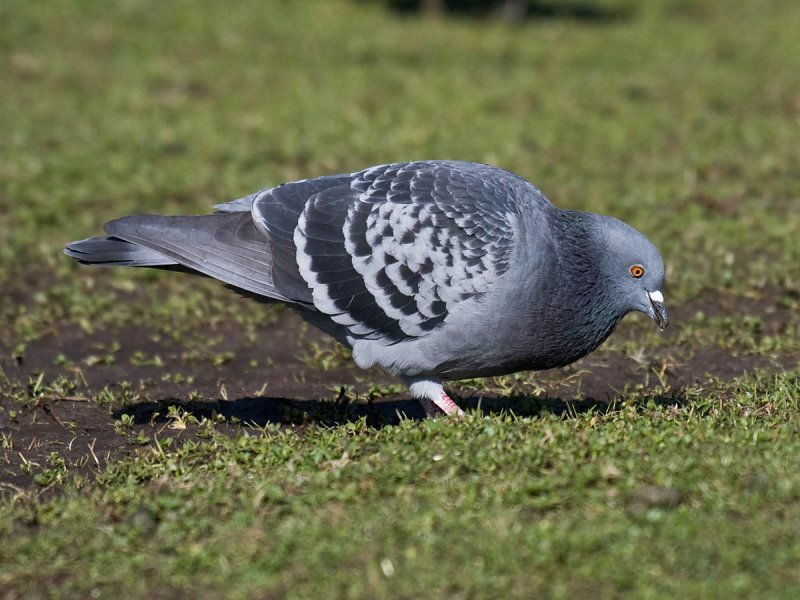
Rock PigeonRock Pigeon, Portland, Oregon, 19 February 2011 by Greg Gillson.


You may find the Rock Pigeon in older field guides listed as Rock Dove. Their name was recently changed.

Regardless, this is the common domestic pigeon. They are widely raised as free-flying "pets." However, they are also widely distributed as wild birds, breeding on highway overpasses, large bridges, and tall city buildings. You can find them in city parks in nearly every city in the world. They also breed on cliffs in remote settings.

The typical, "natural," plumage is blue-gray with wide dark wing bars and white rump--as in the photo above. They have been bred to be various colors and patterns, and even with feathered legs or odd neck ruffles or crests.

Though many people view these birds as dirty city birds, I can't help feeling a bit of attachment as they fly by--thanks to my favorite childhood movie, Mary Poppins!

Now where did I put my tuppence?

Monday, June 27, 2011

Brown-headed Cowbird:
"North America's most reviled native bird"

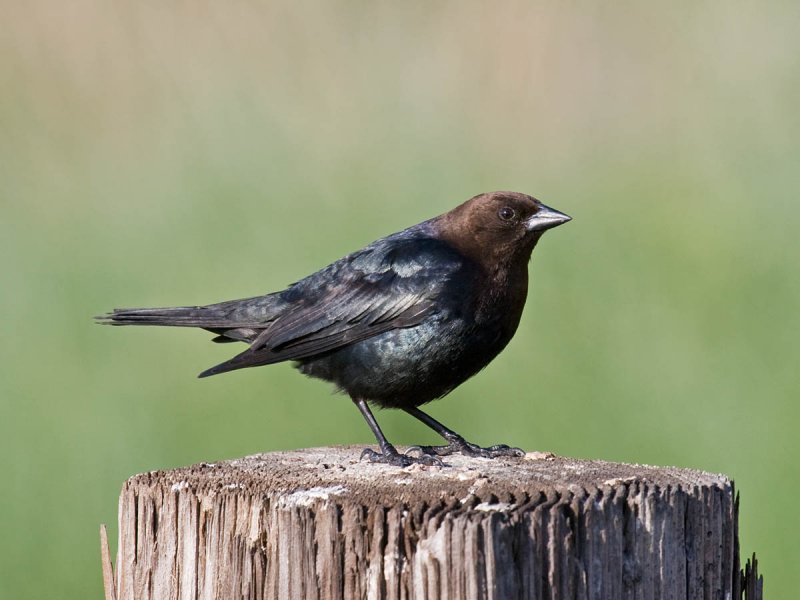
Brown-headed CowbirdBrown-headed Cowbird, Hines, Oregon, 24 May 2009 by Greg Gillson.


Brood parasite: "Organisms that use the strategy... involving the... use of host individuals... to raise the young of the brood-parasite." -- Wikipedia.

The Brown-headed Cowbird does not build its own nest. Instead, it lays its eggs in nests of other birds. In fact, at least 221 known bird species have been hosts to Brown-headed Cowbirds. They usually only lay one egg per host nest. The host parent, often a much smaller species of bird, raises the cowbirds' young, usually to the detriment of its own young.

In "Brown-headed Cowbird: Villain or Scapegoat?" Birding 31:448–451, August 2004, author Stephen I. Rothstein argues that widespread population declines of host species by cowbirds is not scientifically supported. He believes that "North America's most reviled native bird" is unfairly blamed for declines in bird populations largely caused by habitat loss. Of course, we know who is responsible for altering and destroying the established natural landscape, now don't we?

So let's take a step back for a moment and view this bird without prejudice.

The Brown-headed Cowbird is a migratory blackbird. It arrives in the Pacific NW in April and remains into October. A few birds may be found in winter mixed in flocks with other blackbirds at cattle feedlots and similar concentration points.

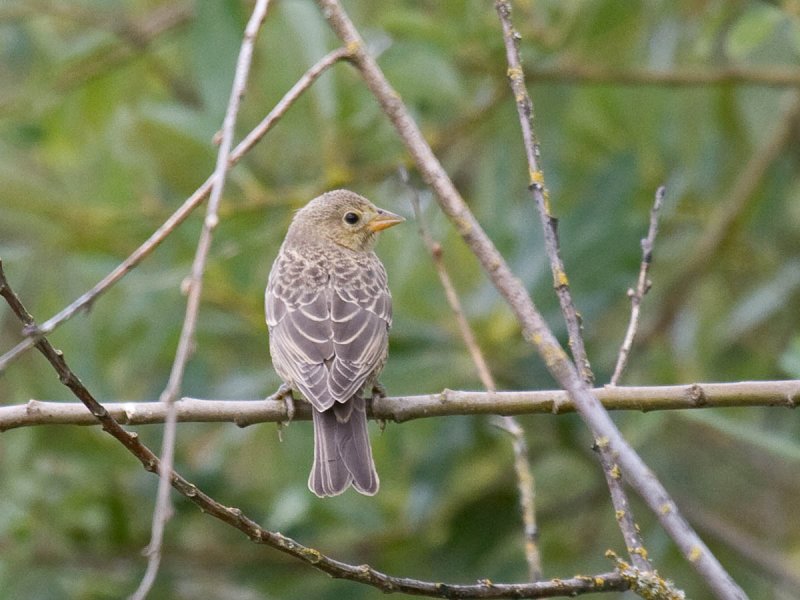
The male has a black body and brown head; the female is slate-colored gray-brown. The young birds are brownish-gray with paler feather edgings. The bill is pointed and rather thick. Thus, as with female Red-winged Blackbirds, this combination causes some confusion with beginners in thinking juvenile cowbirds might be a sparrow or bunting.


Brown-headed CowbirdJuvenile Brown-headed Cowbird, Hillsboro, Oregon, 13 July 2010 by Greg Gillson.


Two hundred years ago, this bird was restricted to the Great Plains. They followed great herds of American bison as they traveled, eating the insects kicked up as the huge mammals walked through the grass. Because of the nomadic lifestyle of the bison, cowbirds couldn't stay in one place to raise their young. Thus, the strategy formed of laying its eggs in other bird's nests.

With the subsequent cutting of forests, both in the East and West, the cowbird substantially increased its range. Cowbirds became common west of the Cascades only in the 1960's. In the past 50 years they have increased tremendously in the Pacific Northwest.

Male cowbirds give a rising squeaking call (starling-like) as they chase females in courtship. They also give a bubbly rattle call, similar to Bullock's Oriole.

Besides insects, cowbirds eat seeds. So, you may host cowbirds at your bird feeder--especially, it seems, east of the Cascades.


Note: I write some of my "natural history" articles weeks in advance and have them published on a schedule. As sometimes happens in blogging about birds, another blogger posted an article on cowbirds while mine was in the queue (in news parlance, I was scooped!). Please read Dave Iron's account on Brown-headed Cowbirds that appeared on the BirdFellow blog on June 18.

Monday, June 20, 2011

Pacific NW specialty... Varied Thrush

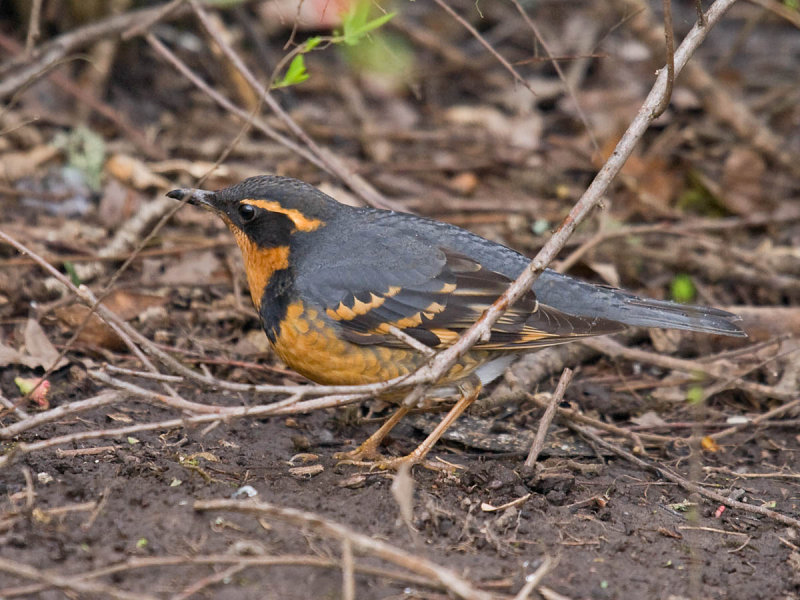
Varied ThrushVaried Thrush, Beaverton, Oregon, 27 March 2011 by Greg Gillson.


Visiting birders to the Pacific Northwest often have Varied Thrush on their "target list" of bird species to see. Fortunately, this species is not rare, and are not difficult to find, if one knows where to look.

When I think of Varied Thrush habitat, my search image is of damp, dark, moss-covered Sitka spruce forests on steep, foggy hillsides overlooking the ocean in the Pacific Northwest. I know! My search image is something like this photo I took at Cape Perpetua on the central Oregon coast way back in August 2003:


Likewise, Varied Thrushes find their home in similar dense, damp high-elevation old-growth forests in mountains from Alaska to extreme NW California. Periodically, in winter, vagrant birds will be found far to the south, and even to the East Coast.

In winter, birds from the north or higher elevations move into the lowlands west of the Cascades. A winter snow storm will bring these birds out of cover and into backyard feeders and landscaping, where they favor fallen apples. As soon as the snow melts they disappear back into the dense brush. The bird photographed above spent the winter in my backyard in Beaverton, Oregon. But it never ventured out far from cover.

These birds eat berries, seeds, acorns, insects, and invertebrates that they forage from on or near the ground.

Their eerie songs are single hummed whistled notes, each given with a pause of about 3 seconds between them. Each note is a different pitch, first higher, then lower, but each far apart from each other. For instance, if they give a note in the middle of their frequency range, the next will be at the extreme end. This is very typical of thrush songs, even though this song is nothing like the flutelike, ethereal and very complex songs of that master singer, the Hermit Thrush.

Varied Thrushes appear similar to American Robins, also a thrush. They differ in the orange eyestripe and orange patterning in the wings, and black necklace across the chest. Males, such as the one in the photo, are darker gray-black above and deeper orange below than females.

Monday, June 13, 2011

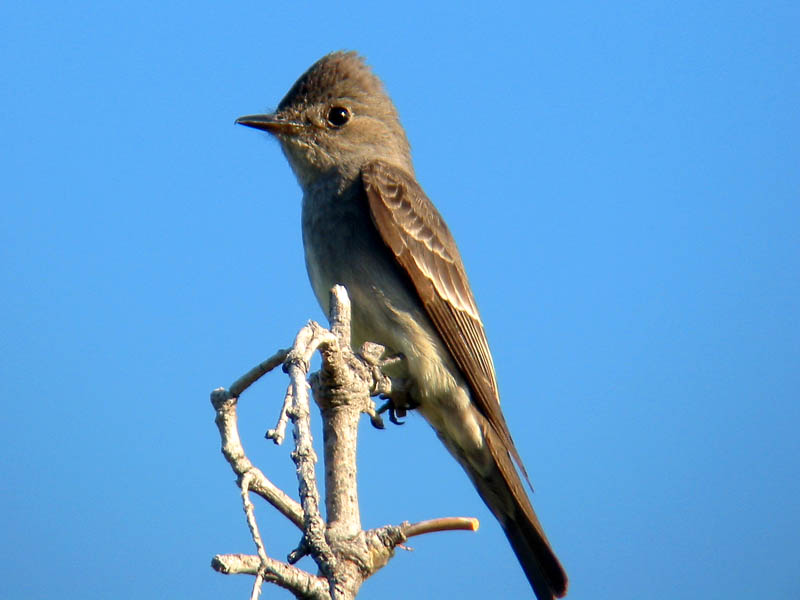
In the backyard... Western Wood-Pewee

Western Wood-PeweeWestern Wood-Pewee, Trout Creek, Deschutes Co., Oregon, 5 August 2005 by Greg Gillson.


The Western Wood-Pewee is widespread throughout the West.

As with most flycatchers, it sits upright and motionless on an exposed twig. When an insect flies by, the bird sallies out and chases it, often clicking its bill several times during the chase. Once it catches its prey, it often returns back to the same or nearby perch.

It has the prototypical flycatcher shape--the head is large and slightly crested. The bill is quite wide and flat, but this is only obvious when viewed from directly below.

On a perched pewee the primaries are very long and pointed. The tail also looks quite long. This flycatcher has wide buffy wing bars, but lacks an eye ring. Smaller Empidonax flycatchers (Willow, Dusky, etc.) have both eye rings and wing bars. Even though larger than these other flycatchers, it is only 6-1/4 inches long--the length of a junco. It is much smaller than than some other flycatchers, such as Say's Phoebes and Western Kingbirds, for instance.

These birds arrive in the Pacific NW in mid-May, after there are many larger flying insects to eat. They remain into late September before migrating south. They winter farther south than most Neotropical migrants in the West, to Colombia and Venezuela.

These flycatchers are found in open woods, preferably deciduous trees, thus most likely to be found in mature trees in residential areas. They avoid breeding in sage, grasslands, and dense conifers.

Their voice is loud: a plaintive, drawn out, slightly buzzy descending pee-year and a similarly burry rising weep.

Wednesday, April 27, 2011

How did Townsend get away with it?

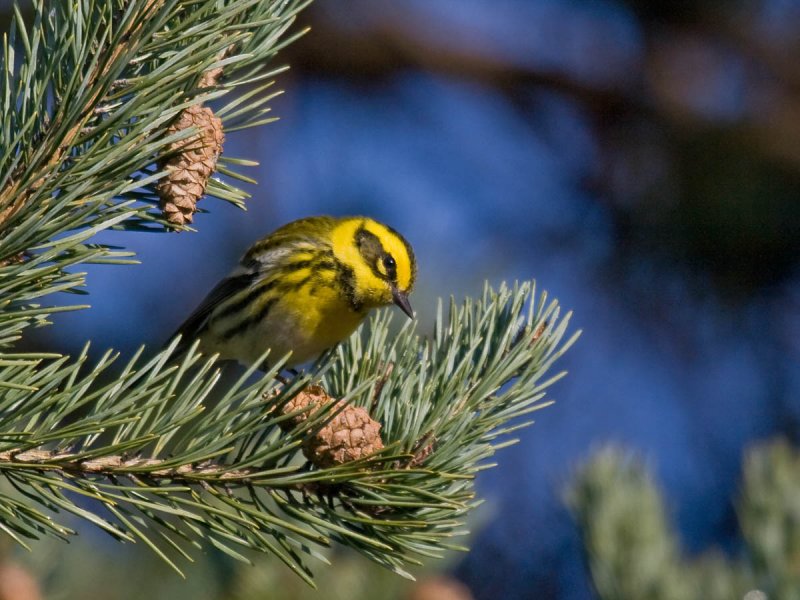
Townsend's WarblerTownsend's Warbler, Beaverton, Oregon, 22 January 2011 by Greg Gillson.


Townsend's Warbler Dendroica townsendi (Townsend, 1837)

The above reference is the scientific listing of Townsend's Warbler. Let's analyse this further.

Townsend's Warbler is the common English name as established by the American Ornithologists' Union (AOU).

The binomial is a Latinized set of words, the genus name first and species name second (always non-capitalized). The person who describes a new species to science (by being the first to publish the description in a scientific journal) gets to choose this name. This bird is named townsendi, for John Kirk Townsend.

The final part (in parentheses) is the person who described the bird to science and the year of publication. Seems simple enough. It was John Kirk Townsend in 1837 in the Journal of the Academy of Natural Sciences of Philadelphia.

Now wait just a minute!

There aren't too many rules about naming a species. But I do know that you can't name a species after yourself!

How did Townsend get away with it?

John Kirk Townsend was born 200 years ago, in 1809. As a young man he distinguished himself in medicine and natural history, especially bird collecting (shooting and stuffing). He was asked by botanist Thomas Nuttall to join him on Nathaniel Wyeth's second expedition to the Oregon Territory from 1835-1837. The expedition was a failed business venture on Wyeth's part, but was scientifically rewarding.

Townsend wrote about his adventures in the 1839 book: "Narrative of a Journey Across the Rocky Mountains."

It turns out, though, that the article in the Journal of the Academy of Natural Sciences of Philadelphia was actually written by Thomas Nuttall in Townsend's name.

Thus, Nuttall named Townsend's Warbler in a journal using Townsend's name as author. Confusing? Yes. Sneaky? Perhaps. But certainly interesting!

This new species of warbler wasn't the only new bird described to science that Townsend collected. He also collected Mountain Plover, Vaux's Swift, Chestnut-collared Longspur, Sage Thrasher, and Black-throated Gray Warbler.

Several birds and mammals are named after Townsend, including Townsend's Solitaire, Townsend's Chipmunk, etc. [The Townsend's Shearwater was named after Charles Haskins Townsend (1859-1944) an ornithologist and ichthyologist.]

Being a doctor, you'd think Townsend would have been more careful. But he died of arsenic poisoning in 1851 when only 41 years old. Arsenic was the main preservative in bird specimens. So birding was the direct cause of his death!

More images and history of Townsend's Warbler:

Audubon's Birds of America

Columbia River Images

Monday, April 25, 2011

Townsend's Warbler

Townsend's WarblerTownsend's Warbler, Beaverton, Oregon, 22 January 2011 by Greg Gillson.


A rare sunny day this winter enticed me outside, camera in hand. At a nearby park I came across this feathered ray of sunshine.

Townsend's Warblers nest in mountains from SE Alaska, western and southern British Columbia, Vancouver Island, Olympic Peninsula, Cascades south to central Oregon, northeastern Oregon, northern Idaho, western Montana.

In winter, a coastal population is found from Vancouver, British Columbia (rarely), western Washington and western Oregon south along the coast to southern California, and into Baja California (a few). A large population winters in the Central Valley of California.

Surprisingly, there is an inland wintering population found from northern Mexico to Panama.

Though there are no named subspecies, the coastal wintering birds average shorter wings and larger bill and tarsus, and may breed mainly on the Queen Charlotte Islands to SE Alaska. A good reference on these birds is the Peterson Field Guides series book from 1997: Warblers by Jon Dunn and Kimball Garrett.


Is the bird in the photo above a female, as one might deduce from the field guides? Perhaps not.

There is an interesting note in the Sibley Guide about warblers. In the "Big Sibley," page 437, under the heading of "Warbler Plumages" he states that there is quite a bit of variation and overlap in plumage between males, females, immature, breeding, and non-breeding birds. He cautions: "field observers should not attempt to label individual birds without experience and reference to detailed literature on determining the age and sex of birds."

Never one to worry about blundering in over my head, I suggest that this bird is likely a first year male. I base this on the blackish (rather than greenish) facial mask, along with what appears to be worn outer primaries (brownish) on another photo I have of this bird. I could be wrong.

There is more to be said about the Townsend's Warbler, but I'll save that for the next post...

Monday, March 14, 2011

Attract birds to your backyard: Part 4: Bird foods

A Purple Finch and Black-headed Grosbeak join two American Goldfinches on this huge feeder at Hagg Lake, Washington County, Oregon, 7 July 2007 by Greg Gillson.


In the previous post we discussed bird feeder styles. Certain birds prefer certain styles of feeder types. Equally important is what you put in the feeders to offer to the birds in your backyard. That is the subject of this post.

Black oil sunflower seeds
Birds attracted: finches, grosbeaks, sparrows, chickadees, nuthatches
Feeder styles: platform, tube, hopper

Perhaps you noticed that the photos of birds eating at seed feeders in the previous post were all shown with one type of seed--black oil sunflower. Sunflower seeds come in two general varieties--striped and black oil. The black oil have more nutrition and fats (oils), and the hulls are softer, allowing chickadees and other small birds to break them open to get to the kernels. These seeds are a favorite of many birds species.

Black oil sunflower seed in a tube feeder will greatly reduce the number of invasive House Sparrows at your feeder. Such feeders are also less likely to be taken over by jays and squirrels.


This squirrel-proof tube feeder also keeps out Red-winged Blackbirds and jays, while birds up to the size of Golden-crowned Sparrows go right in!


"Wild bird seed mix"
Birds attracted: sparrows, doves
Feeder styles: platform, hopper

As an inexpensive "filler," these bird seed mixtures are generally over 50% millet (often both the red and white varieties). Millet, especially red millet, is not desired by most native backyard birds. Many sparrows and other birds will kick or throw it out of the bird feeders, searching for other seeds, such as sunflowers. However, the invasive House Sparrows love millet and European Starlings eat it too. Most people would rather feed native birds than encourage the loud, messy, and aggressive House Sparrows and Starlings. Once you realize that the great deal on wild bird seed mix is only 50% edible to the birds you want to attract, you will be more willing to spend slightly more money on other types of food.


Niger seed (also trademarked as Nyjer)
Birds attracted: goldfinches, siskins
Feeder styles: thistle feeder, thistle sock

There is no better way to attract goldfinches to your backyard than a thistle feeder, unless you plant your yard with thistles--something sure to make your neighbors prickly.

Don't feed too much at once, as it can mildew in the rain. Goldfinches may take some time to find your thistle feeders, so first set up black oil sunflower tube feeders to attract other finches and the goldfinches will soon find the thistle feeder.


This smaller thistle feeder looks perfect!


Corn
Birds attracted: quail, doves, jays, blackbirds
Feeder style: platform or spread on the ground

Corn is a favorite of squirrels--especially whole corn on the cob. Cracked corn is eaten by more birds. Some people don't mind attracting squirrels--others try to discourage them from "stealing" all the bird food.


Peanuts
Birds attracted: jays, nuthatches
Feeder style: platform

Jays and squirrels will spend all day burying and digging up each other's cached peanuts. Other birds will eat them, occasionally.


Suet
Birds attracted: woodpeckers, bushtit
Feeder style: Suet cage or nailed on tree

You may be surprised at the number of birds attracted to suet in winter, including insect-eating wrens and warblers. However, don't think of carnivorous birds. Think of suet as a big, fat, juicy grub, and you'll see the appeal.

There are many different "flavors," some including seeds. Experiment with what works best for your birds.

Many types of suet melts or goes rancid quickly once the temperature goes above 60 degrees F, so this is primarily a winter food. However, you may find other certain types that keep better in warm weather.


This copper-roofed suet cage should keep the starlings off!


Fruit
Birds attracted: thrushes, orioles
Feeder style: Platform or nailed down

Cut apples or orange slices may attract certain birds, such as Varied Thrushes in winter and orioles in summer. They may attract yellowjackets, in summer, though.


Nectar
Birds attracted: hummingbirds, orioles
Feeder style: Hummingbird feeder, Oriole feeder

The nectar is 20% sugar solution, 1 part table sugar to 4 parts water. While this may be bad for us, it is perfect for hummingbirds. Never use honey. Oriole feeders are just hummingbird feeders with bigger feeder holes for the oriole's larger bill.

Bread and human food scraps
Attracted: European Starlings, rats

Don't do it!

- - -

Check out the Cornell Lab or Ornithology for more bird feeding tips.

- - -

Part 1

Friday, March 11, 2011

Friday Foto: Yellow-rumped Warbler

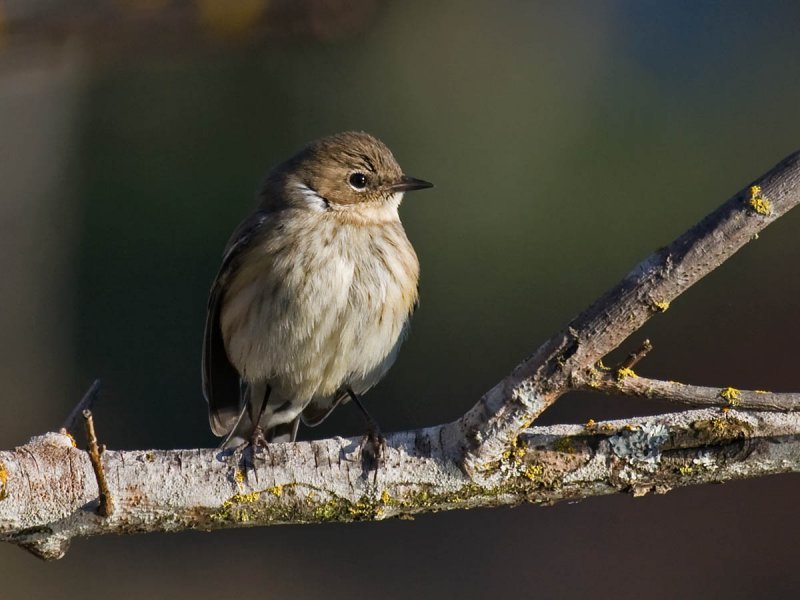
Yellow-rumped WarblerYellow-rumped Warbler, Beaverton, Oregon, 2 February 2011 by Greg Gillson.


I thought this bird caught nice afternoon light quite nicely.

We have discussed the Yellow-rumped Warbler previously.

Friday, March 4, 2011

Friday Foto: Foggy chickadee

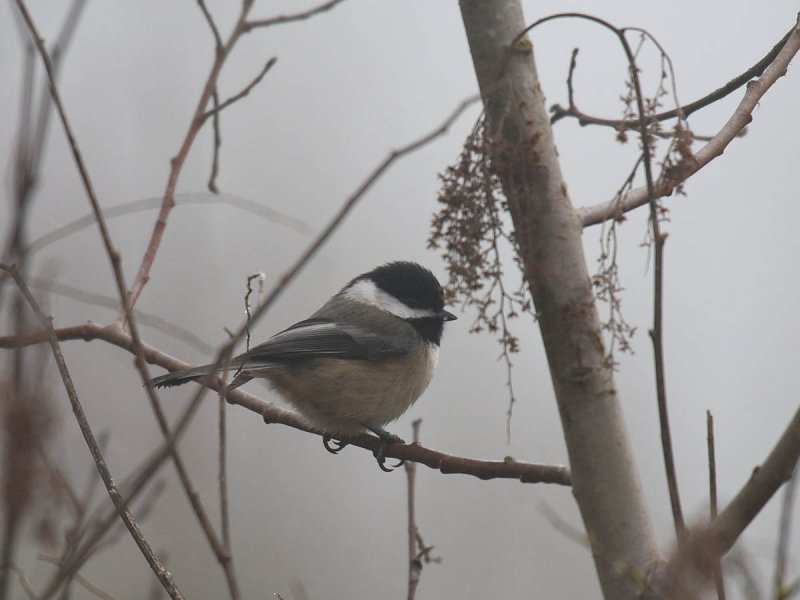
Black-capped ChickadeeBlack-capped Chickadee, Cooper Mountain Nature Park, Beaverton, Oregon, 26 January 2011 by Greg Gillson.


A couple of weeks ago I featured a Chestnut-backed Chickadee in the sun.

This week, we have a Black-capped Chickadee in the fog.

When I read Rich Dich's photography blog I get jealous. He's in Arizona, getting up with the sun.

Here in western Oregon's drab winters, we may not see the sun for days at a time, and rarely at dawn. More often than not it is dark and foggy in the morning. It may start breaking up a bit by noon... only to reveal a high overcast. Then it will likely fog back in by 3 p.m.

See a previous post about Black-capped Chickadees.

Wednesday, March 2, 2011

Attract birds to your backyard: Part 3: Styles of bird feeders


In Part 1 we discussed making your backyard attractive to birds with natural food and water. In Part 2 we discussed landscaping to create protective shelter and breeding habitat.

Next week we'll discuss the different kinds of bird foods and the birds they attract.

Now, though, we will discuss the different styles of bird feeders.

When you think of a bird feeder, perhaps the type above comes to mind. It is a tube-style seed feeder. They are preferred by finches, such as this Pine Siskin. Finches feed in the trees, so they like these kind of feeders that mimic (to a degree) the type of feeding these birds favor.

Importantly, these feeder discourage (but don't totally eliminate) larger birds, such as jays, Starlings, and House Sparrows, and squirrels. These unwanted feeder visitors are considered pests or just piggy--the jays will gulp down a bunch of food then carry it off to bury it. Then they soon return, emptying your feeder quickly.

Sparrows, including favorites such as towhees and juncos, however, like to feed on the ground or a raised flat surface. For these birds, and others, a tray feeder works best. These can be covered with a roof or uncovered. They can be as simple as this flat stump sprinkled with bird seed that has attracted this Song Sparrow.


My wife and I had success building a tray feeder using an open weave plastic--similar to a placemat--in a wooden frame. We attached this to our cedar fence with shelf brackets. The open weave allowed rain to drain, and keep the seed fresh longer. It detached and washed off easily.

Tray feeders will allow you to offer the birds something besides just seeds (wait until next week for more details of different foods you can offer).

Here is another example of a Black-headed Grosbeak using a very small open mesh metal tray feeder that attaches to a mounting pole:


An adaptation to a tray feeder is a hopper-style feeder. These are covered bins of seed, with a tray at the bottom. Birds pull seeds from the bottom and the tray is refilled automatically. These are more protected from the rain. Here is an example.


A specialized seed feeder is a thistle feeder. Shown below is one made of open wire mesh. These are especially for goldfinches and siskins, though, as you can see below, this female House Finch also joins the Lesser Goldfinch at this thistle feeder.

Another type of thistle feeder is called a thistle sock. The birds pull small seeds (usually niger seed, not thistle) that stick out from an open-weave fabric bag--just like weed seeds sticking out from my socks after walking through a weedy field in late summer. Again, the metal mesh dries out more quickly so the seed does not mildew as quickly in wet climes--and is easily cleaned.


That covers the seed feeders.

Pictured below is a suet feeder, in this case the suet (rendered beef fat) is in a suet cage. Suet is a food that provides protein. Once the temperature rises above 60 degrees F, the suet can spoil quickly, so this is primarily a winter food only.

You will note this suet cage is on a long chain. Doesn't this swing around wildly knocking birds off? Yes, and that is exactly why. European Starlings love suet. If allowed, a small flock will eat the suet block in a few minutes. However, Starlings have very weak feet. They must stand on top of the suet cage and bend over to eat it. This causes a starling merry-go-round! They still get some suet, but often are somewhat deterred.

Other birds, including large flickers, just fly up and hang on to the side of the suet cage to eat.


The final feeder style we will consider is the nectar feeder, perhaps best known as hummingbird feeder, though other birds may drink nectar, too.


Finally, you can buy all of these feeder types with suction cups that will attach these feeders directly to your windows. Smaller birds (chickadees, hummingbirds) easily become accustomed to your presence and will quickly move from a regular feeder to a nearby window feeder.

All feeders need cleaned periodically, or food will spoil, rodents will be attracted, birds may get diseases.

Soap and water works to clean cloudy hummingbird solution (bacteria). A weak bleach solution is needed for black mildew or mold, which can develop in a day in summer heat, or 4 or 5 days in cold weather. The trick is to only fill the feeder with the amount of nectar consumed before going bad. When you purchase a hummingbird feeder, choose one that can be disassmbled completely when cleaning, and buy a small bottle brush, too.

Part 1
Part 4

Thursday, February 24, 2011

Barely Spotted Towhees Get Super Spotted Visitors

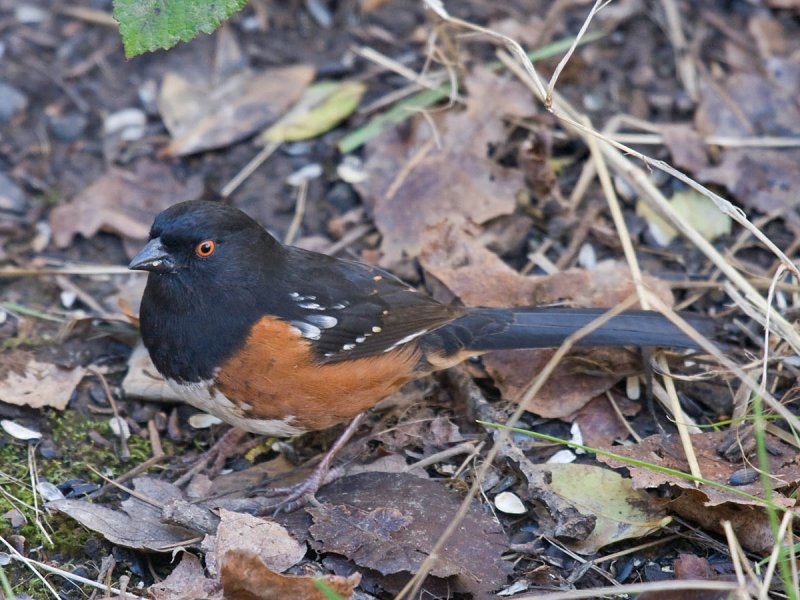
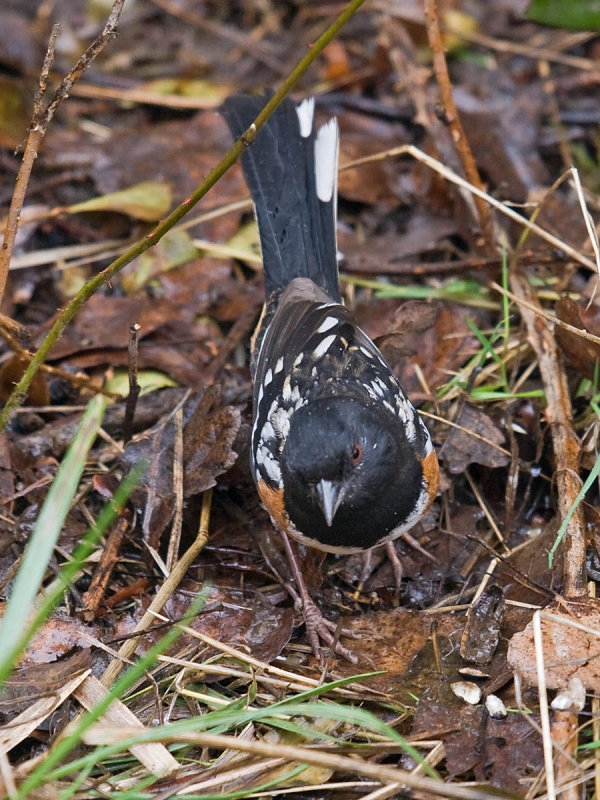
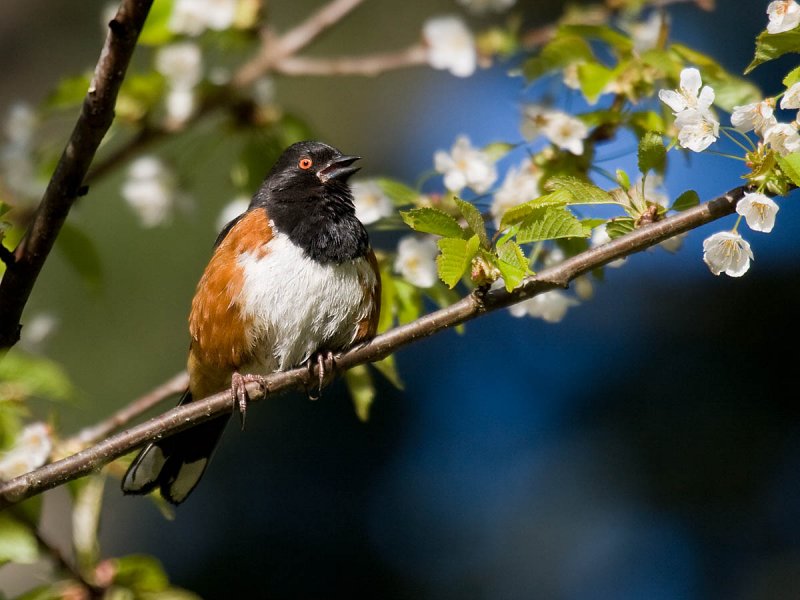
Spotted TowheeMale Spotted Towhee, Beaverton, Oregon, 19 February 2011 by Greg Gillson.


The Spotted Towhee above is typical of the "Oregon Towhee" (Pipilo maculatus oregonus), the subspecies of Spotted Towhee found west of the Cascades in Oregon, Washington, and coastal SW British Columbia. It is the least spotted of all Spotted Towhee populations with reduced white on the wings, scapulars, and tail. Compared to all other races it truly is barely spotted.


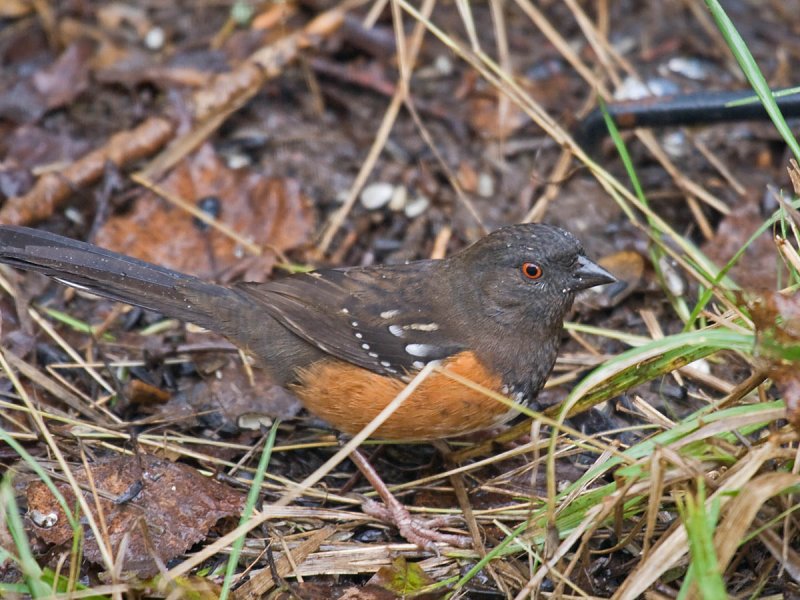
Spotted TowheeFemale Spotted Towhee, Beaverton, Oregon, 18 February 2011 by Greg Gillson.


Above is the grayish-brown female Oregon form of Spotted Towhee. She is even less spotted than the male. Both sexes of the Oregon Towhee have deeper brown (less orange) sides than other forms of Spotted Towhees.

Because the winters are mild where this form breeds, these towhees don't undergo a north-south migration, and most birds are thought to be residents, but there are some seasonal movements in and out of some locations.

These aren't the most artistic photos I have of Spotted Towhees--you can see a piece of the base of the bird feeder in two shots, and I'm looking down on the birds rather than the preferred level photo angle. But there they are, right outside my window. So, I can sit here and type a few lines and stand up, turn around, and snap another photo.... Oops, there, I did it again! I can't get any work done here--I love it!

But I wanted to show you the above birds first, so that I can show you the next photos. The birds below are apparently the "Nevada Towhee" (Pipilo maculatus curtatus), the form of Spotted Towhee found east of the Cascade crest from interior southern British Columbia and Idaho, south to northeast California and central Nevada.

The Nevada Towhee may winter sparsely in their breeding territories, but most seem to migrate to Arizona and southern California, and Sonora, Mexico.

I can find no documented occurences of Nevada Towhees in western Oregon. Thus I present the following photos.


Spotted TowheeSpotted Towhee, Beaverton, Oregon, 18 February 2011 by Greg Gillson.
 

The photo above is an apparent male Nevada Towhee, perhaps the first documented occurence in western Oregon. However, there are two of them. The following bird is even more spotted, super-spotted, if you will.


Spotted Towhee
Spotted Towhee, Beaverton, Oregon, 18 February 2011 by Greg Gillson.


Notice that these birds have more spots on the wing and scapulars. The outer tail feathers are edged in white and the tail spots are very large. The orange sides are a bit paler than the Oregon form.

You may notice that the primary wing feathers of all these birds are more brownish and worn than other blackish feathers of the wing, back, and tail. These molt limits indicate these are all one-year-old birds. Next fall they will molt their wing feathers and enter full adult plumage, never again to be aged by plumage.

On the female Oregon Towhee and the lower Nevada Towhee, you can see some white pin-feathers in feather sheaths on the face near the eyes, indicating active body molt.

At least for the Oregon Towhee, adults probably remain on their home territory year round. Young of the year venture out and establish their own territories. Thus, it is possible that come spring, these young birds will move on to better breeding territory than my backyard. Since there are no adults here now at all, maybe the habitat is not good enough for breeding. We'll have to wait and see.

The two Nevada Towhees above will no doubt migrate back over to the proper side of the Cascades here in a few weeks.

We have discussed Spotted Towhees before.

Addendum:

This female, and slightly aberrant (see rusty crown patch) Nevada Towhee put in a one-day appearance on 23 February 2011.


Spotted TowheeSpotted Towhee, Beaverton, Oregon, 23 February 2011 by Greg Gillson.


Wednesday, February 23, 2011

Attract birds to your backyard: Part 2: Shelter and breeding habitat

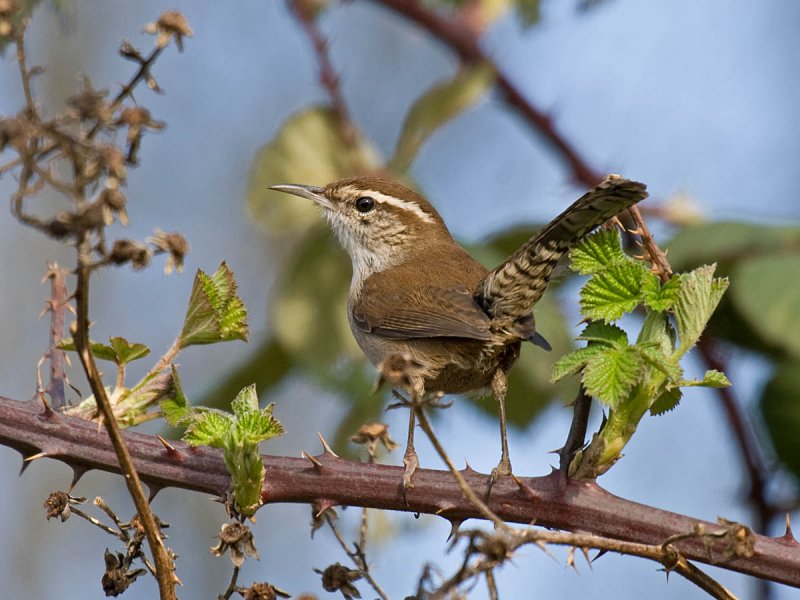
Bewick's WrenBewick's Wren, Hillsboro, Oregon, 4 March 2010 by Greg Gillson.


In Part 1 we discussed that all life needs food, water, and shelter. Specifically, we looked at a bird's need for water and food. In this post we discuss their need for shelter and breeding habitat.

As in real estate, attracting birds is all about 3 things: location, location, location.

Your backyard, even if only an urban deck, is part of your larger neighborhood. The surrounding neighborhood, then, has a direct bearing on the number and types of birds you can expect in your own bakyard.

Thus, if there is an unmanicured woodlot next door, you might expect wrens, such as the Bewick's Wren above, to visit your yard from time to time. They are primarily interested in insects they can find in the brush or low bushes.


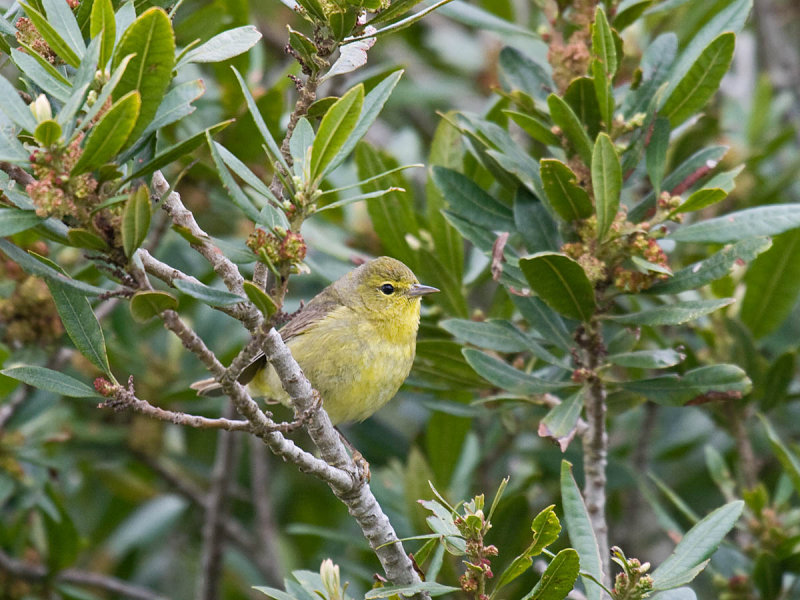
Orange-crowned WarblerA migrant Orange-crowned Warbler hides out in evergreen landscaping, Newport, Oregon, 30 April 2010 by Greg Gillson.
 

Evergreen shrubs provide shelter all through the year. It gives small birds a place to hide when a cat appears. During migration, your evergreen shrubs may host tired and hungry neotropical migrants, such as warblers, vireos, tanagers, buntings, and others.

If you have trees, you will attract even more birds.


Spotted TowheeA Spotted Towhee sings from a fruit tree, Scoggins Valley Park, Gaston, Oregon, 3 May 2009 by Greg Gillson.
 

In whatever neighborhood you live, you can attract the most birds by varying your landscaping. More birds are found in "edge" habitat, than in monoculture. Birds will appreciate an area that combines lawn, trees, shrubs, hedges, and gardens.

But what if you live in a simple residential housing area without large trees or mature landscaping? What can you do to make your yard more attractive to birds if you are renting your property and can't make major landscaping changes?

If your yard is mostly lawn, consider planting a central island of shrubs. How about creating planters or container gardens with small bushes, flowers, or vegetables?

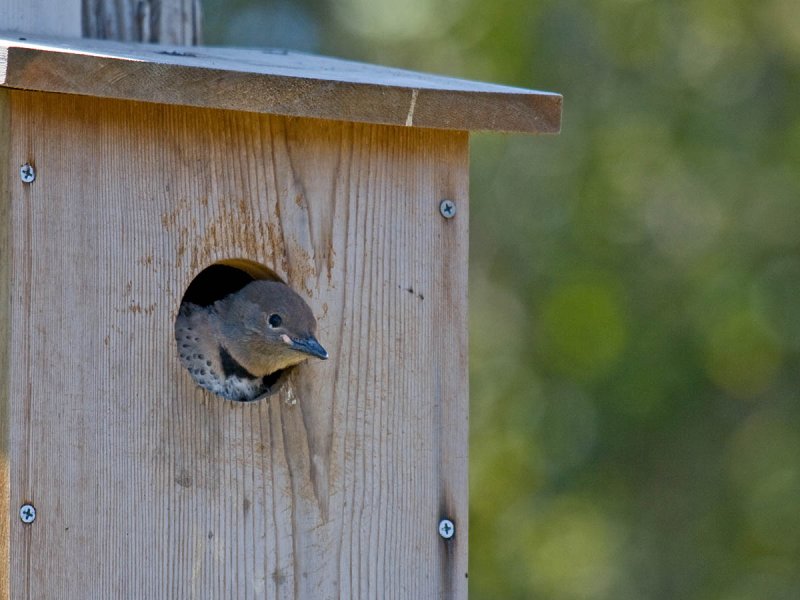
Not everyone can have an old snag in their backyard to attract cavity nesting birds. However, setting up a bird house can accomplish the same purpose.


Northern FlickerA juvenile Northern Flicker peers out of its nest box, Hillsboro, Oregon, 19 July 2010 by Greg Gillson.
 

Once you have done your best to make your yard attractive to birds with natural food, water, shelter, and breeding habitat, you are ready to set up a bird feeder.

Which foods attract which birds? What options are available as bird feeders, and which are best? We'll discuss these topics in the next two parts of this series.

Part 1
Part 3

Wednesday, February 16, 2011

Attract birds to your backyard: Part 1: Water and food

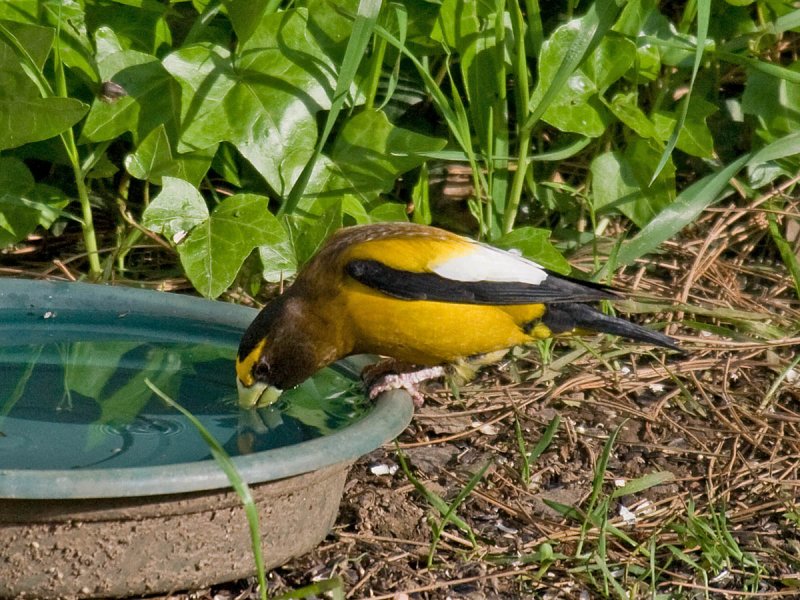
Evening GrosbeakAn Evening Grosbeak takes a drink, Forest Grove, Oregon, 15 May 2009 by Greg Gillson.
 

As do all living things, birds need food, water, protective shelter, and breeding habitat.

To attract birds to your backyard you must provide life's essentials. The more variety of these things you provide, the more attractive you make your yard.

Of course, you can stick a bird feeder out in your lawn and hope for the best. You certainly may get some birds. However, with a bit of planning, you can get more birds and really enjoy attracting them.

As the Evening Grosbeak in the above photo shows, birds need water. A simple dish on the ground works. This provides water for drinking. But that's not all. Water is also for bathing.

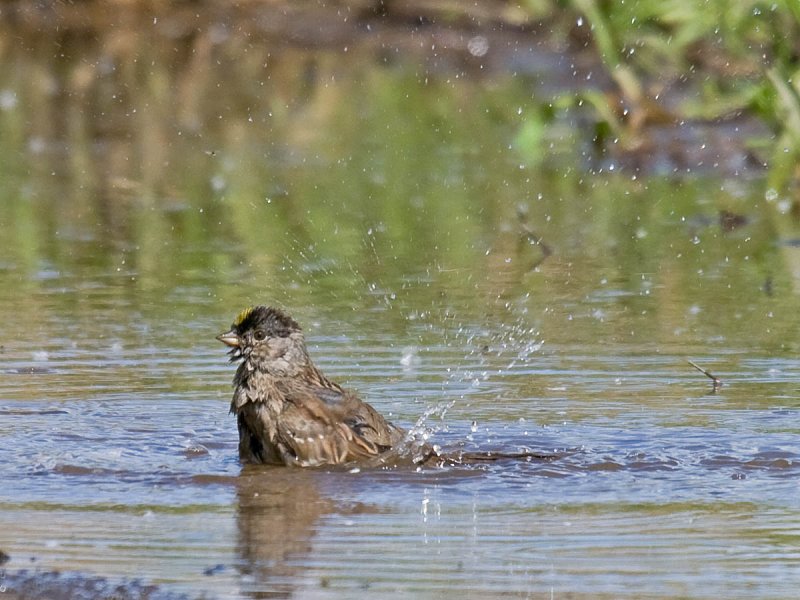
You can get as elaborate as you want, but the birds don't really care, as shown by the Golden-crowned Sparrow in the mud puddle below.


Golden-crowned SparrowA Golden-crowned Sparrow takes a bath, Hillsboro, Oregon, 29 April 2010 by Greg Gillson.
 

You may purchase a bird bath or make your own. Plastic bird baths are inexpensive--but slippery. You might add rocks for the birds to stand on, if the bottom is too slippery for them. A concrete bird bath provides rough texture so the birds don't slip. Whatever kind you decide upon, keep the water clean.

Remember, during extended freezing weather birds need fresh drinking water more than they need food. Some bird baths have heaters to keep them from freezing in the winter.

Dripping or flowing water is especially attractive for birds. Again, it doesn't have to be a complex fountain and recirculating pool. A 5-gallon bucket with a small hole in the bottom may drip into a shallow pie-tin for several hours. Use your imagination and artistic flair to design something esthetically pleasing.

---

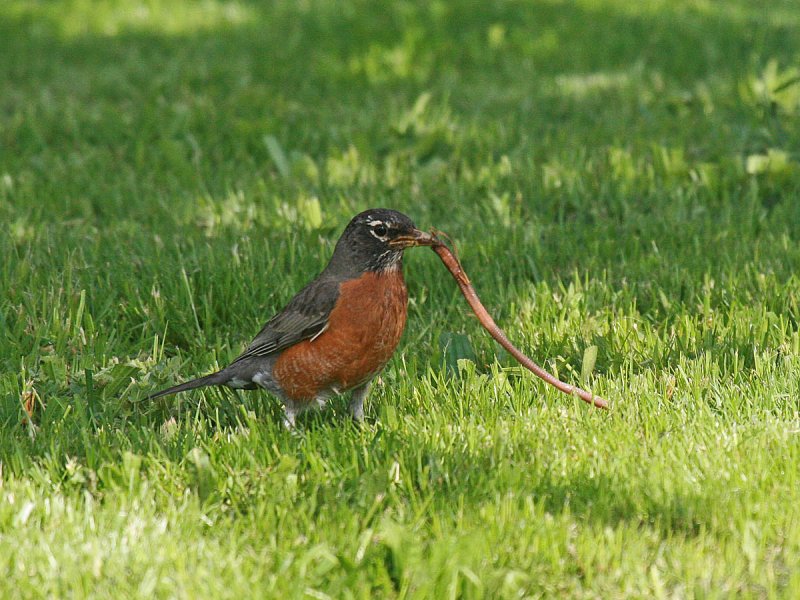
Even in lawn, birds can find some food...


American RobinAn American Robin finds a worm, Hillsboro, Oregon, 11 May 2008 by Greg Gillson.
 

The more varied the plants in your yard, the more types of birds and the higher numbers of each your yard will support.

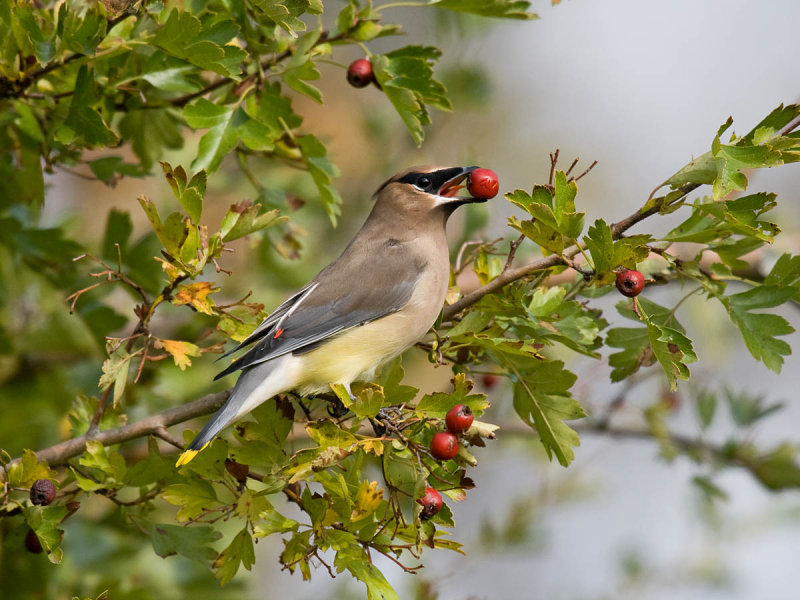
Trees and shrubs can provide food in the form of seeds, flowers, and berries. Such plants also attract insects, caterpillars, and other small animals the birds may eat.


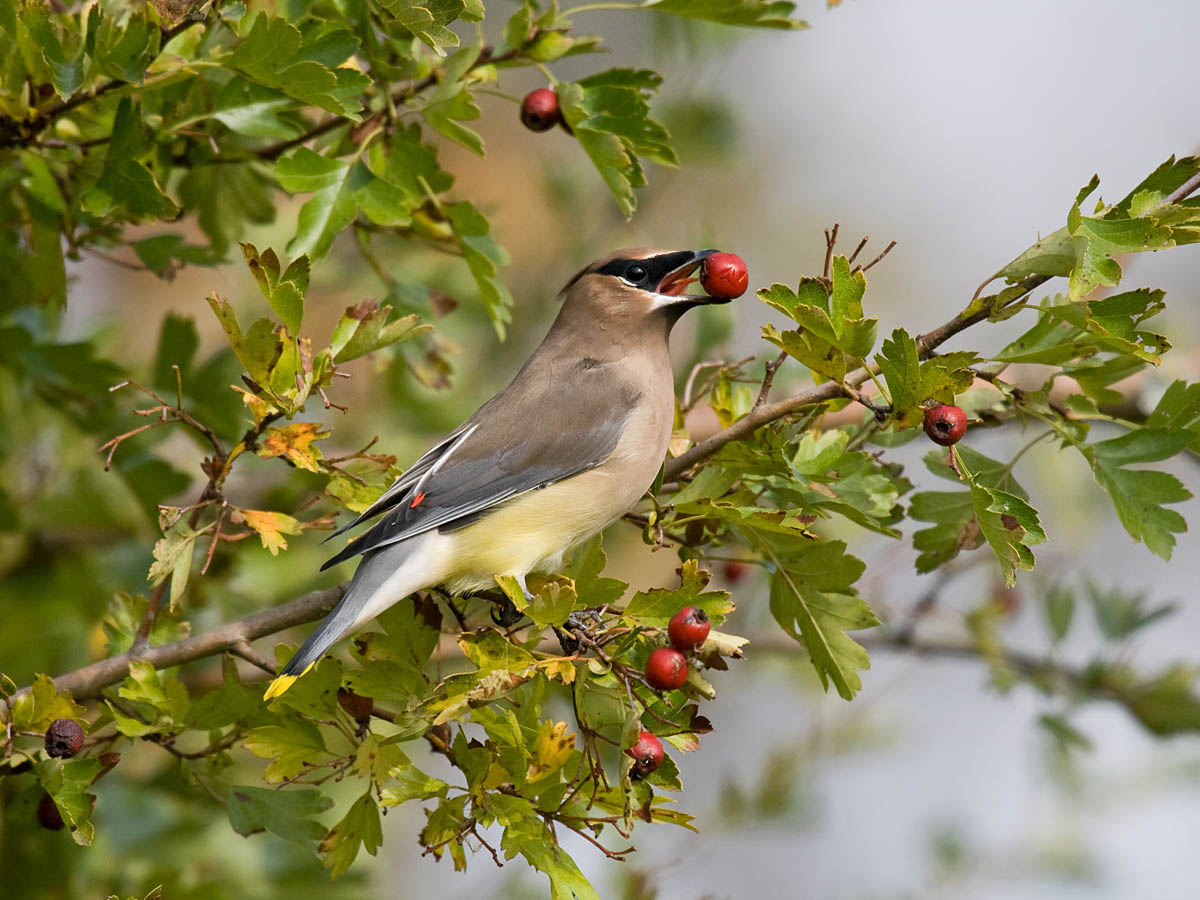
Cedar WaxwingA Cedar Waxwing eats hawthorn berries, Forest Grove, Oregon, 21 October 2010 by Greg Gillson.


In a future post, we'll discuss specific different kinds of food you can feed to birds, and different feeder styles. But next, we'll discuss how your yard can provide two other essential needs of birds: shelter and breeding habitat.

Part 2

Monday, December 13, 2010

A cold Lesser Goldfinch

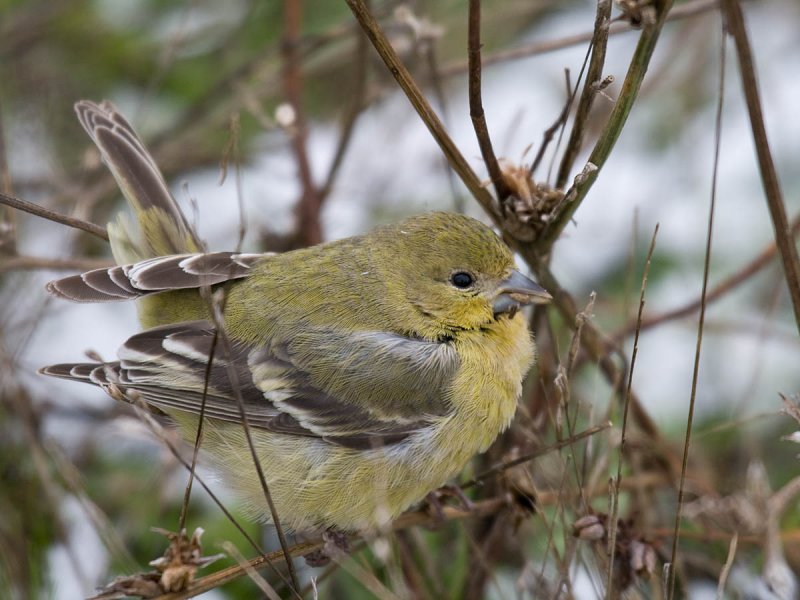
Lesser GoldfinchLesser Goldfinch, Fernhill Wetlands, Forest Grove, Oregon on 24 November 2010 by Greg Gillson.
 

The first snowfall of the season--only a quarter inch--caused the Lesser Goldfinches to be extremely unwary. This bird fed at my feet and refused to fly away! My camera lens wouldn't focus any closer!

Lesser Goldfinches usually migrate out of the cold inland portions of the Pacific Northwest. West of the Cascades in Oregon, however, the winters are usually relatively mild at lower elevations, and Lesser Goldfinches spend the winter.

But during some winters there will be periods of days or a week or more of sub-freezing weather. Some birds survive the cold extremely well. Surprisingly, Anna's Hummingbirds seem to make it through a week of freezing weather. Other birds, termed "half-hardy," at the northern edge of their normal winter range, may have difficulty with prolonged cold weather.

A week-long freeze may find Ruby-crowned Kinglets, Hermit Thrushes, and other birds down in the grass looking for food. They may die. It seems Lesser Goldfinches can be added to this list. Even this single two-day event seemed to cause Lesser Goldfinches some distress. The goldfinches I found this day seemed to be lethargic, and either sleeping in the rose bushes or feeding on the weed seeds at the road edge without regard for their safety. This is quite a change from their normal hyperactive behavior.

I have previously written about this bird: In the Backyard... Lesser Goldfinch.

Wednesday, November 10, 2010

One year old Cedar Waxwing

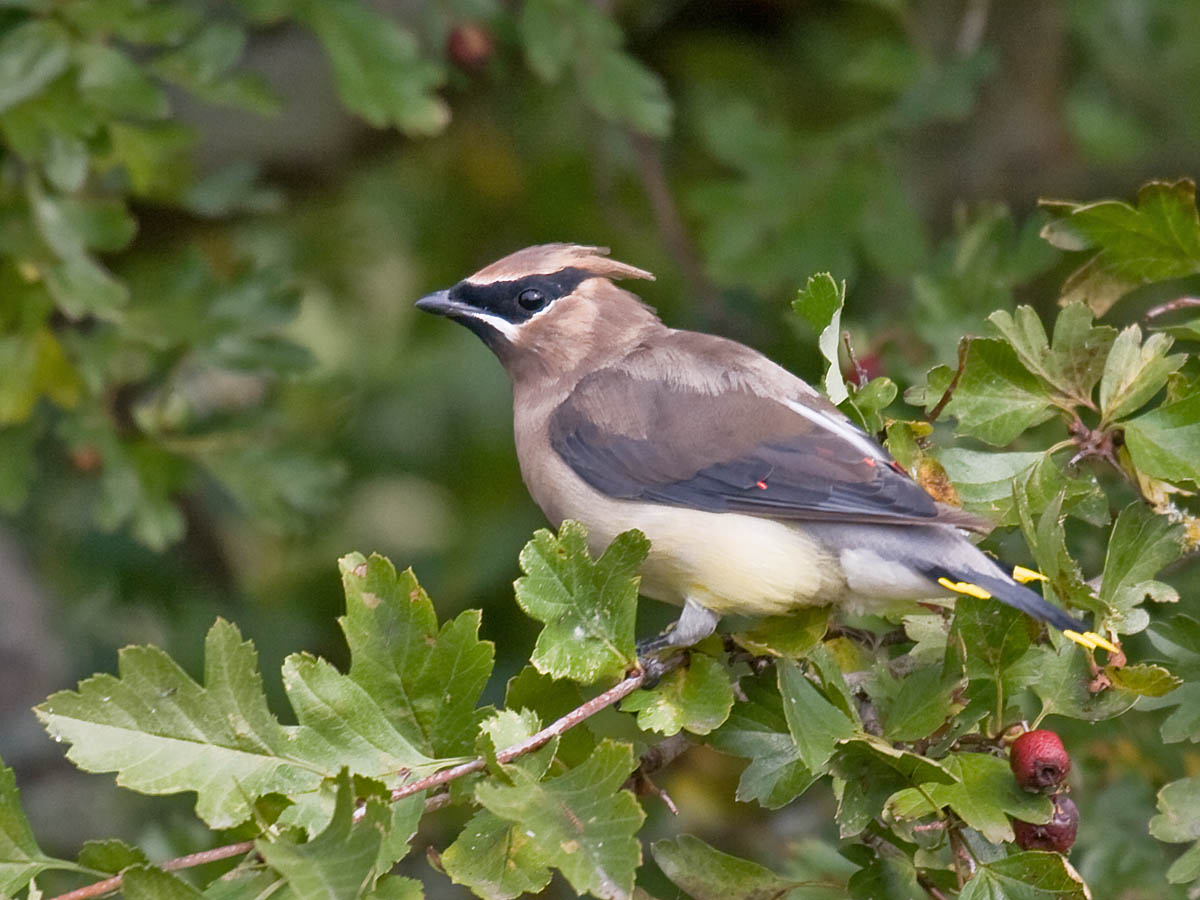
Cedar WaxwingCedar Waxwing, Forest Grove, Oregon on 21 October 2010 by Greg Gillson.
 

One final post on the many Cedar Waxwings I photographed in a hawthorn tree in October.

Post 1 showed 2 views of a waxwing feeding on hawthorn berries.

Post 2 discussed the molt and aging of this same adult bird.

Post 3 talked about an juvenile waxwing and discussed the waxwing's first description to science.

Today's post goes back to molt.

Perhaps after reading Post 2 you can see the patchy back plumage on this bird and discern a couple of pin feathers in sheaths on the cheek of this bird. Most obvious are the outer tail feathers that are still growing in. So this bird is undergoing a full prebasic molt into its first definitive basic plumage.

Why can we say this bird is attaining its first fully adult-like plumage?

If you look at the wings you will see some fresh dark inner primaries, and some very faded, worn, brown primaries. Those brown primaries are the remnants of juvenile plumage, the first (non-down) feathers this bird ever grew. Those tattered wing feathers are now over a year old. And that is the age of this bird--perhaps 16 months old. Once those feathers in the wing and tail are fully replaced and grown, probably before the end of November, it will no longer be possible to tell how old this bird is by looking at its plumage.

Here is a link that will bring up all my blog posts having to deal with molt.

Sunday, November 7, 2010

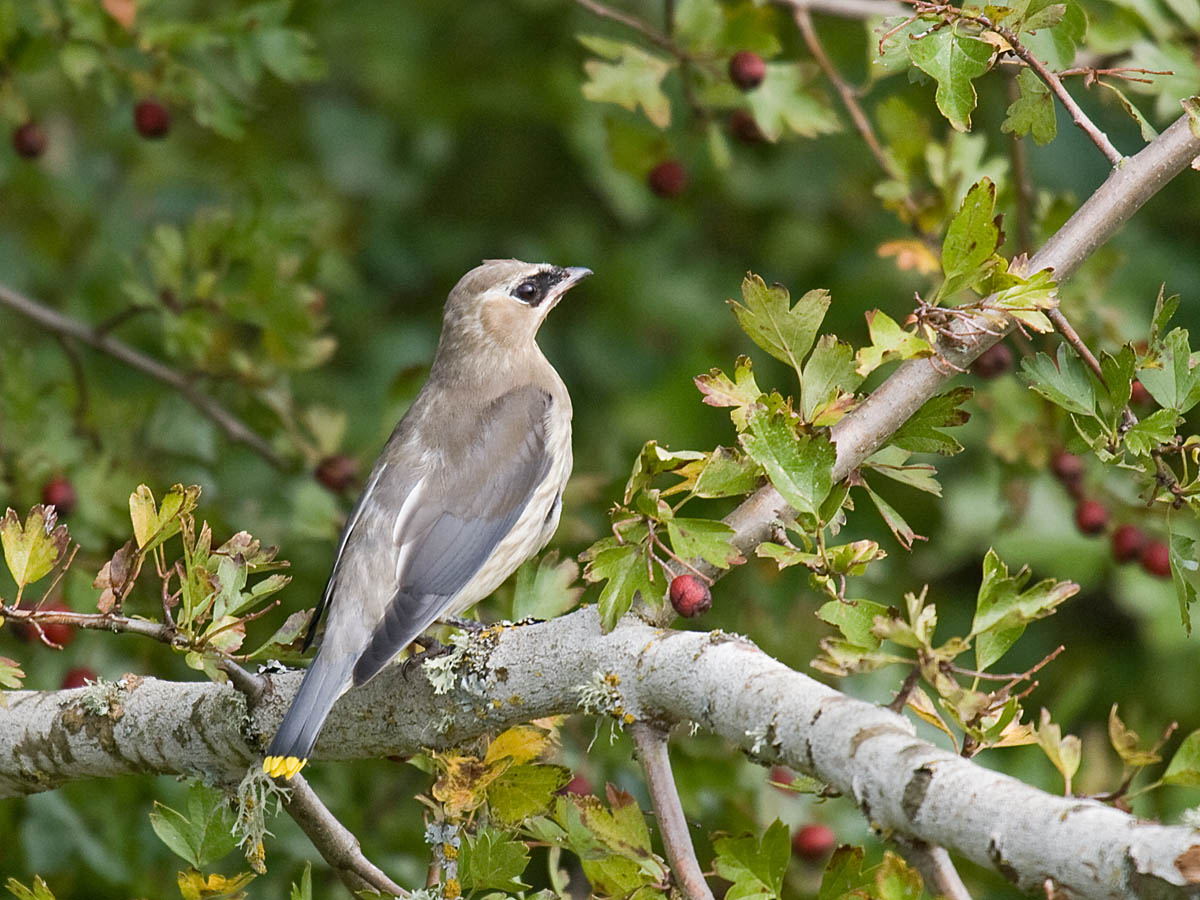
Juvenile Cedar Waxwing

Cedar WaxwingCedar Waxwing, Forest Grove, Oregon on 21 October 2010 by Greg Gillson.
 

We discussed the adult Cedar Waxwing and how to age it in two previous posts.

The streaky underparts of today's photo and lack of much crest are ample clues for most people to identify this bird as an immature.

The Cedar Waxwing was first described to science in 1808 by Louis Jean Pierre Vieillot. And this Frenchman had ample time to collect and describe birds in North America.

You see, Vieillot was on a business trip to Haiti when the French Revolution broke out in 1889. So, being on the wrong side of the new ruling class, he fled to the United States. There he began to study birds.

It was not until a dozen years later Vieillot was able to return to France and start working on his book, Histoire naturelle des oiseaux de l'Amérique septentrionale (Natural History of Birds of North America) that he published in 1808. In it was the first description of Cedar Waxwing from eastern North America.

One more waxwing photo is coming with the next post....

Thursday, November 4, 2010

More on the Cedar Waxwing

The Cedar Waxwing in the previous post, Cedar Waxwing feeding on hawthorn berries, was not only beautiful, it has a secret. Closely observing the photograph (and the bird in life) can tell us more about this bird.

In this species the sexes are described as "outwardly alike," meaning that the sexes have the same plumage and we can't tell the sex of the bird without some disassembly.*

But we can observe that the bird is in molt and thus tell a bit more about its age.


In the photo above, note some feather sheaths on the face (A). These are new growing feathers, not yet fully developed. Also notice that the new breast feathers are especially wispy with whiter tips (B) that contrast with the browner feathers of the shoulder. [You can click on the photo for a larger view.]

As these feathers wear and age, the plumage will become smoother and more evenly colored, as in a previous discussion of Cedar Waxwings.


Perhaps more obvious, we can see in the above photo that the outer tail feather on this bird (C) is short, and has not yet reached its full length. Wing and tail feathers in most birds are replaced sequentially so that the bird can continue to fly during the molt period.


Again, in the above photo, note that the 9th primary feather (D) is only half the length of the others and has more growing to do. [Waxwings have 10 primaries, but the outermost, the 10th, is always very tiny.] The new yellow belly and side feathers (E) are fresh and wispy. While the plumage of waxwings is naturally fluffy, these tips will wear down as the year goes on, creating a more smooth-looking plumage. The name-sake waxy tips of the secondaries (F) indicate this is an adult.

We thus can tell that this bird is an adult, 2 or more years old, undergoing a full pre-basic molt.

For more on molt and aging see this previous post.

* - Males have, on average, more extensively darker throats. Look at this web page that Mike Patterson alerted me to.

Sunday, October 31, 2010

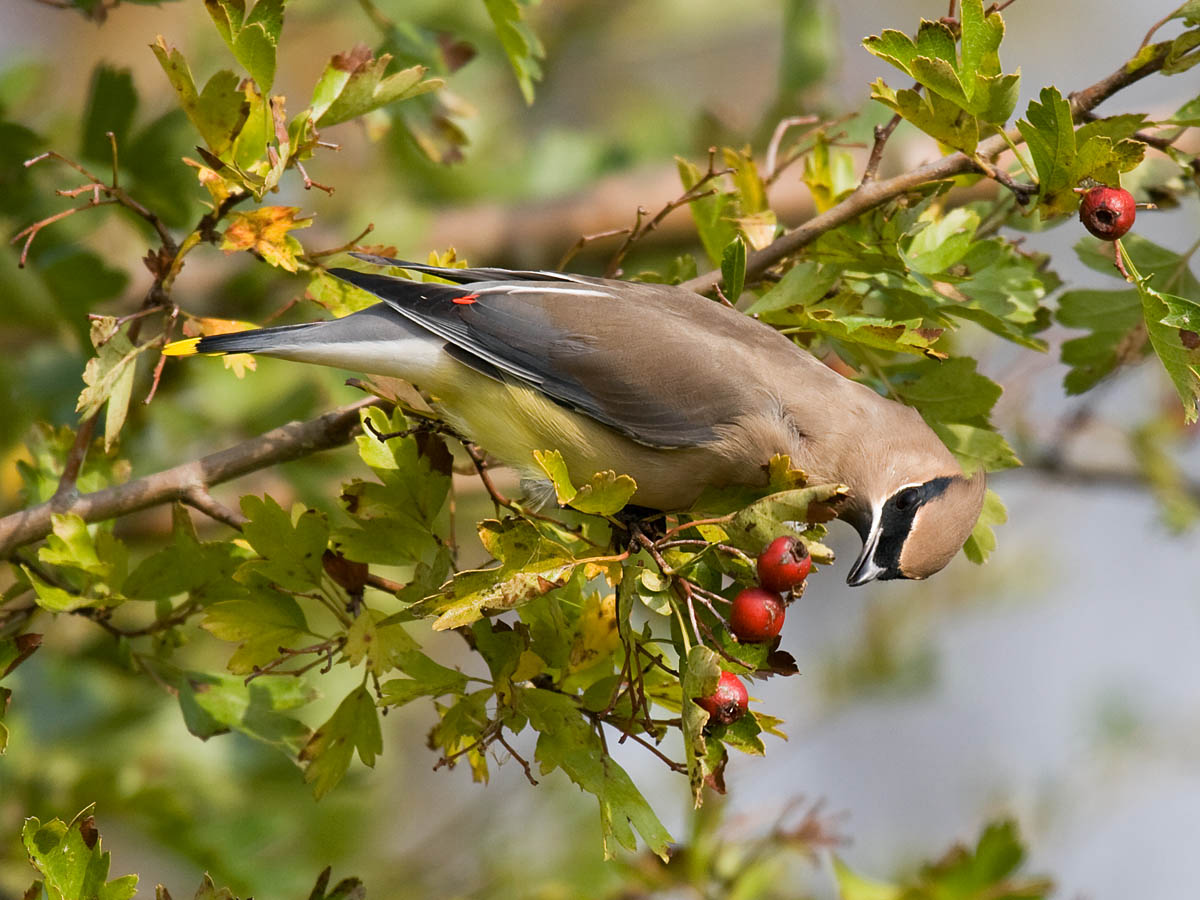
Cedar Waxwing feeding on hawthorn berries

Cedar WaxwingCedar Waxwing, Forest Grove, Oregon on 21 October 2010 by Greg Gillson.
 

Viewing Cedar Waxwings is always a joy. What is it about these subtly-colored birds that makes them so exciting? Maybe it is their distinctive crests or bandit-masks or hyperactivity. I don't know. But as their flocks buzz about hawking insects or descend on a fruiting tree in autumn, they always make me pause to watch.

Recently I came across a hawthorn tree loaded with berries... and Cedar Waxwings. They were gulping down these big berries. I don't know how many each bird was eating, but they were gorging themselves. The berries were rather large, but down they went. Whole. Gulp. On to the next.

Cedar Waxwing


Take a careful look. What else can we see and learn about this waxwing? Stay tuned for more about this waxwing on November 4....

Monday, September 6, 2010

Violet-green Swallow

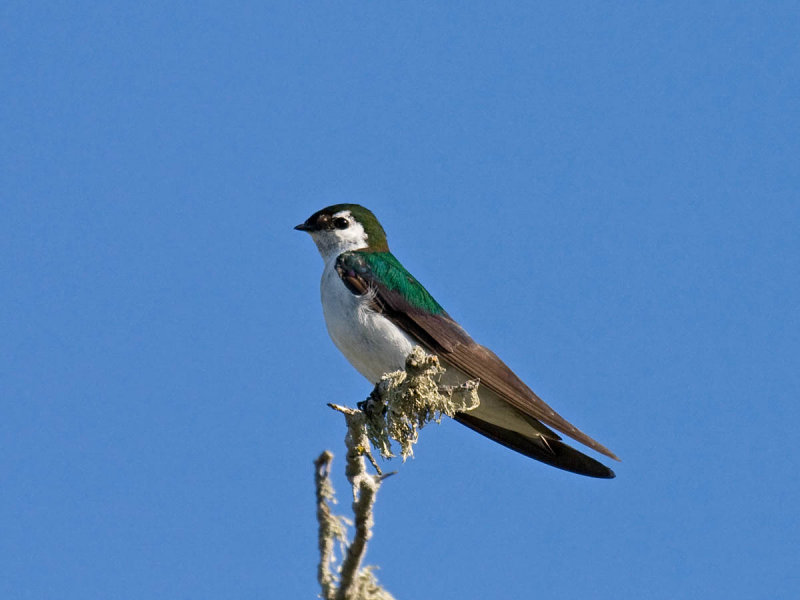
Violet-green SwallowViolet-green Swallow, Fernhill Wetlands, Forest Grove, Oregon on 29 July 2010 by Greg Gillson.


The Violet-green Swallow is the only swallow limited to western North America. In the Pacific NW they arrive in February and March and remain through September or early October. They winter from southern California and Arizona south to Middle America.

Similar to Tree Swallows, Violet-green Swallows differ by having a white face, lime-green back, and white rump divided in half by a violet strip of feathers.

These birds are very common throughout most of the Pacific NW. They occur from sea level to the tops of the mountains. They are equally at home flying over forests or towns chasing insects high in the air and uttering pleasant twittering notes.

They nest in crevices in cliffs, tree cavities, nest boxes, and holes in buildings.

In the fall, Violet-green Swallows migrate south in large flocks. Some times these flocks can number in the thousands. You may then notice them shoulder-to-shoulder on telephone wires, often near water.

Monday, August 30, 2010

Black-headed Grosbeak

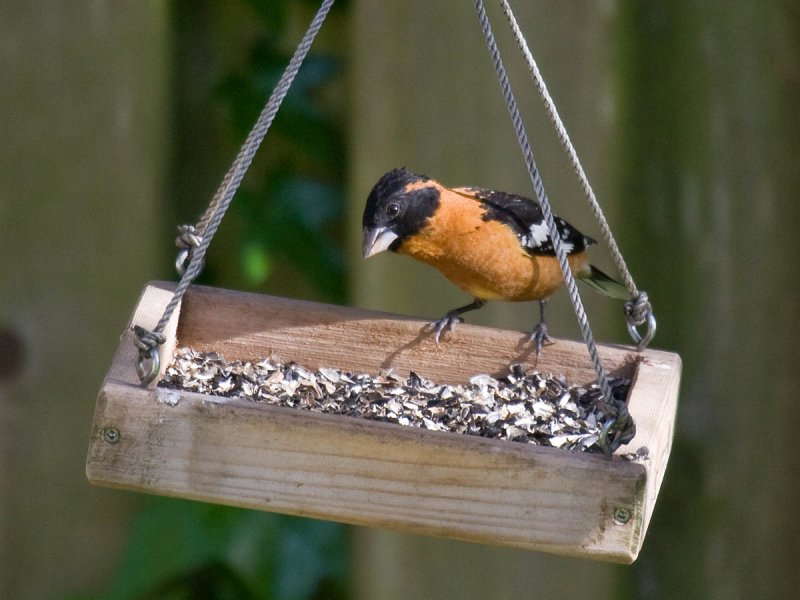
Black-headed GrosbeakBlack-headed Grosbeak, Forest Grove, Oregon on 15 May 2009 by Greg Gillson.


Black-headed Grosbeaks are common migrants and summer residents throughout the Pacific NW. They arrive in May and are quite common in towns at bird feeders and in riparian areas and deciduous and mixed woods through September.
The male, pictured above, is rusty-orange on the breast and rump, yellow on the body, black on the back. It has a black head and black wings and tail with large white patches and spots. Males sing a clear, rapid, robin-like warble. Both sexes give a sharp pik call.

Females and young during the first year are duller overall (brownish and pale orange) with striped head ("chipmunk bird").

These songbirds take 2 years to reach full adult plumage. The immature male plumages have a more striped head and back than adults.