Showing posts with label Spotted Towhee. Show all posts

Sunday, November 27, 2011

Learning about birds... at your feeder

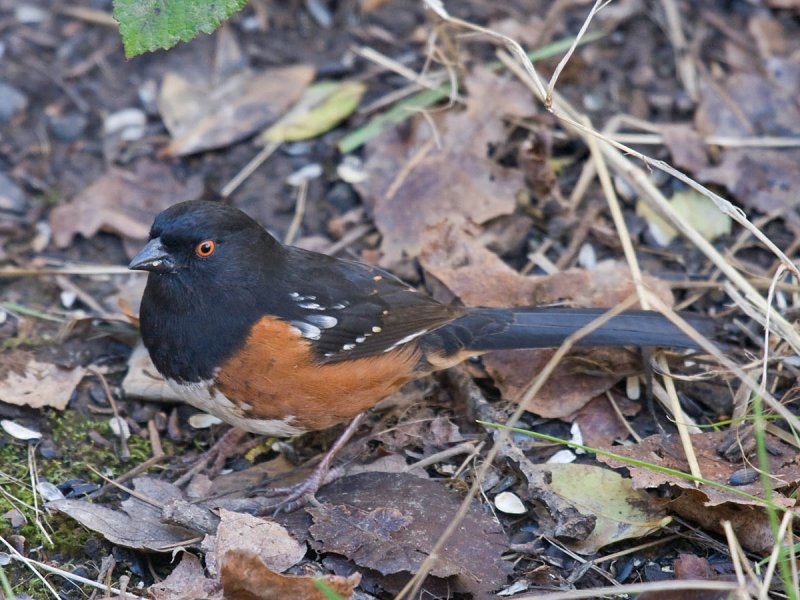
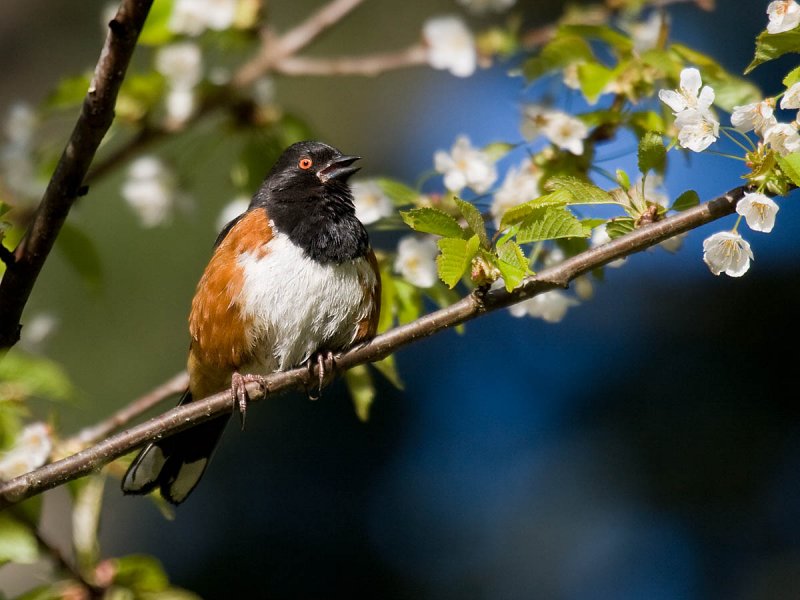
Spotted TowheeMale Spotted Towhee, Beaverton, Oregon, 27 November 2011 by Greg Gillson.


For improving one's birding skills, Kenn Kaufman (Kaufman Field Guide to Advanced Birding) recommends a bird feeder as a learning tool. Even a common species observed closely over time can teach about age and gender differences, molt and plumages, hybridization, and individual or population variation. Learning how to observe these items on common birds will let us more quickly and accurately identify rare birds--a source of joy and excitement for many birders.

Earlier this year I learned something very interesting by observing the birds at my feeder. Although perhaps not surprising, I observed a subspecies of Spotted Towhee not previously documented in western Oregon. I wrote about it here: (Barely spotted towhee gets super spotted visitor).

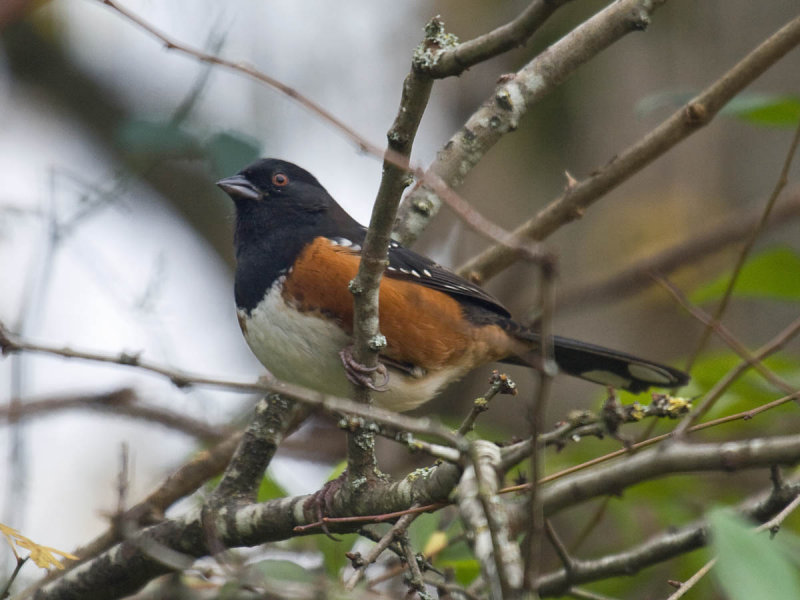
Now that I am attune to this particular ID challenge, I was ready today when I again spotted an unusual towhee visitor to my feeder. The top photo shows a resident male Spotted Towhee, typical of those found in western Washington and Oregon, the so called Oregon Towhee (Pipilo maculatus oreganus).

The ID of the above bird is straightforward. Compared to all other populations it has fewer spots on its scapulars and wings. The rufous sides are darker than other populations. Finally, the spots on the undertail are very small, perhaps restricted to only the outermost tail feathers of each side of the tail.

Compare the bird above with the bird below, seen about 15 minutes apart in the same tree--photographed through my very dirty window!
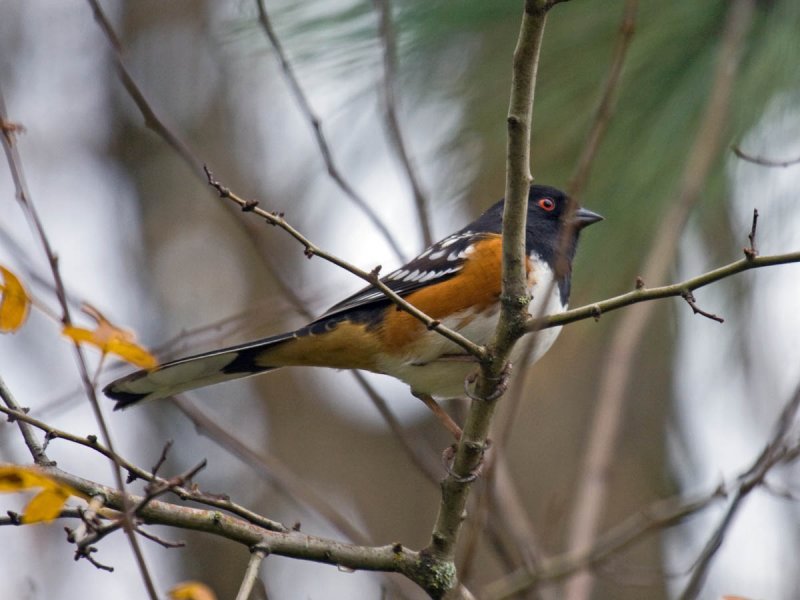
 
Spotted TowheeMale Spotted Towhee, Beaverton, Oregon, 27 November 2011 by Greg Gillson.


This bird is paler orange on the side and undertail coverts. It has more and larger spots on the scapulars and wings. Obviously, the white tail spots take up more than half the tail and are spread out on at least three of the outer tail feathers.

This bird matches one of the "Interior" forms of Spotted Towhee. The new National Geographic Field Guide to the Birds of North America, Sixth Edition has range maps showing the various subspecies of Spotted Towhees.

Without a specimen to measure fine variations, it is only speculation as to which exact subspecies may be represented. And due to individual variation, even a specimen may not be unequivocally decisive in this matter. However, it is sufficient to separate the Pacific form (to which the Oregon Towhee belongs) from the Interior form to report this to eBird. In fact, birders in Washington are noting the winter influx of the Interior form of Spotted Towhees into western Washington where, as in western Oregon, they were previously undocumented.

These new winter distribution records are found, not from scientists studying specimens or conducting field research, but by amateur bird watchers at their backyard feeders!

What's in your feeder?

Thursday, February 24, 2011

Barely Spotted Towhees Get Super Spotted Visitors

Spotted TowheeMale Spotted Towhee, Beaverton, Oregon, 19 February 2011 by Greg Gillson.


The Spotted Towhee above is typical of the "Oregon Towhee" (Pipilo maculatus oregonus), the subspecies of Spotted Towhee found west of the Cascades in Oregon, Washington, and coastal SW British Columbia. It is the least spotted of all Spotted Towhee populations with reduced white on the wings, scapulars, and tail. Compared to all other races it truly is barely spotted.


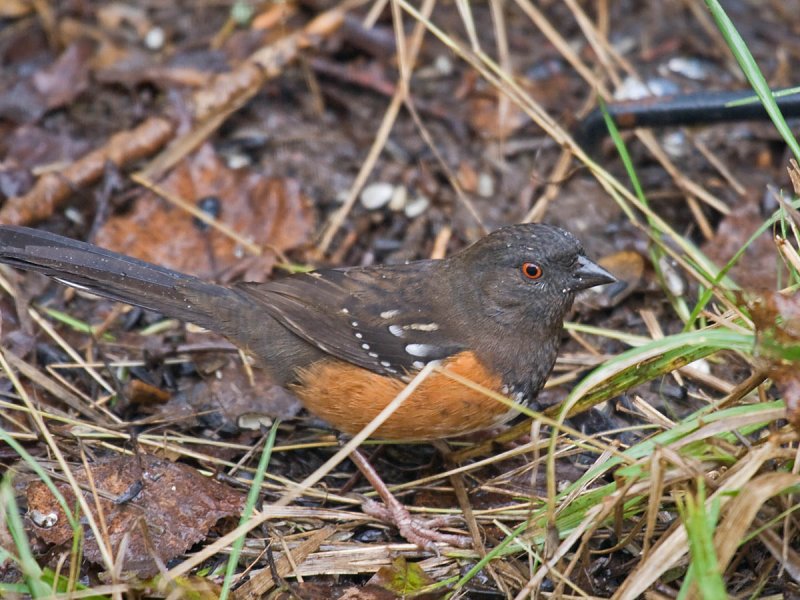
Spotted TowheeFemale Spotted Towhee, Beaverton, Oregon, 18 February 2011 by Greg Gillson.


Above is the grayish-brown female Oregon form of Spotted Towhee. She is even less spotted than the male. Both sexes of the Oregon Towhee have deeper brown (less orange) sides than other forms of Spotted Towhees.

Because the winters are mild where this form breeds, these towhees don't undergo a north-south migration, and most birds are thought to be residents, but there are some seasonal movements in and out of some locations.

These aren't the most artistic photos I have of Spotted Towhees--you can see a piece of the base of the bird feeder in two shots, and I'm looking down on the birds rather than the preferred level photo angle. But there they are, right outside my window. So, I can sit here and type a few lines and stand up, turn around, and snap another photo.... Oops, there, I did it again! I can't get any work done here--I love it!

But I wanted to show you the above birds first, so that I can show you the next photos. The birds below are apparently the "Nevada Towhee" (Pipilo maculatus curtatus), the form of Spotted Towhee found east of the Cascade crest from interior southern British Columbia and Idaho, south to northeast California and central Nevada.

The Nevada Towhee may winter sparsely in their breeding territories, but most seem to migrate to Arizona and southern California, and Sonora, Mexico.

I can find no documented occurences of Nevada Towhees in western Oregon. Thus I present the following photos.


Spotted TowheeSpotted Towhee, Beaverton, Oregon, 18 February 2011 by Greg Gillson.


The photo above is an apparent male Nevada Towhee, perhaps the first documented occurence in western Oregon. However, there are two of them. The following bird is even more spotted, super-spotted, if you will.


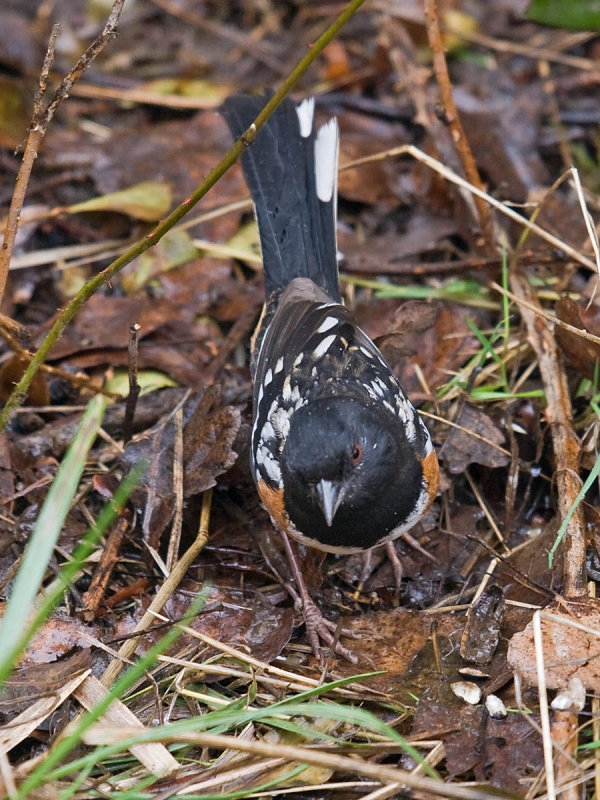
Spotted Towhee
Spotted Towhee, Beaverton, Oregon, 18 February 2011 by Greg Gillson.


Notice that these birds have more spots on the wing and scapulars. The outer tail feathers are edged in white and the tail spots are very large. The orange sides are a bit paler than the Oregon form.

You may notice that the primary wing feathers of all these birds are more brownish and worn than other blackish feathers of the wing, back, and tail. These molt limits indicate these are all one-year-old birds. Next fall they will molt their wing feathers and enter full adult plumage, never again to be aged by plumage.

On the female Oregon Towhee and the lower Nevada Towhee, you can see some white pin-feathers in feather sheaths on the face near the eyes, indicating active body molt.

At least for the Oregon Towhee, adults probably remain on their home territory year round. Young of the year venture out and establish their own territories. Thus, it is possible that come spring, these young birds will move on to better breeding territory than my backyard. Since there are no adults here now at all, maybe the habitat is not good enough for breeding. We'll have to wait and see.

The two Nevada Towhees above will no doubt migrate back over to the proper side of the Cascades here in a few weeks.

We have discussed Spotted Towhees before.

Addendum:

This female, and slightly aberrant (see rusty crown patch) Nevada Towhee put in a one-day appearance on 23 February 2011.


Spotted TowheeSpotted Towhee, Beaverton, Oregon, 23 February 2011 by Greg Gillson.


Friday, July 9, 2010

Spotted Towhee in the rain

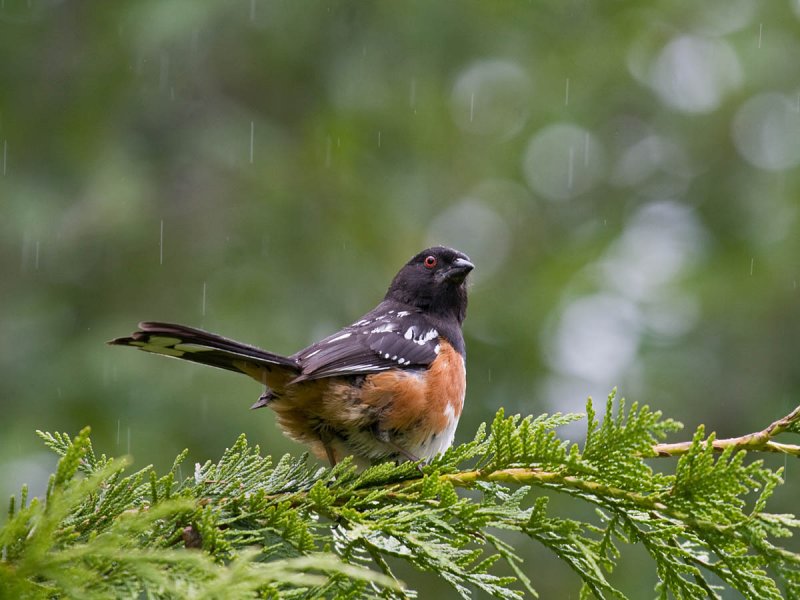
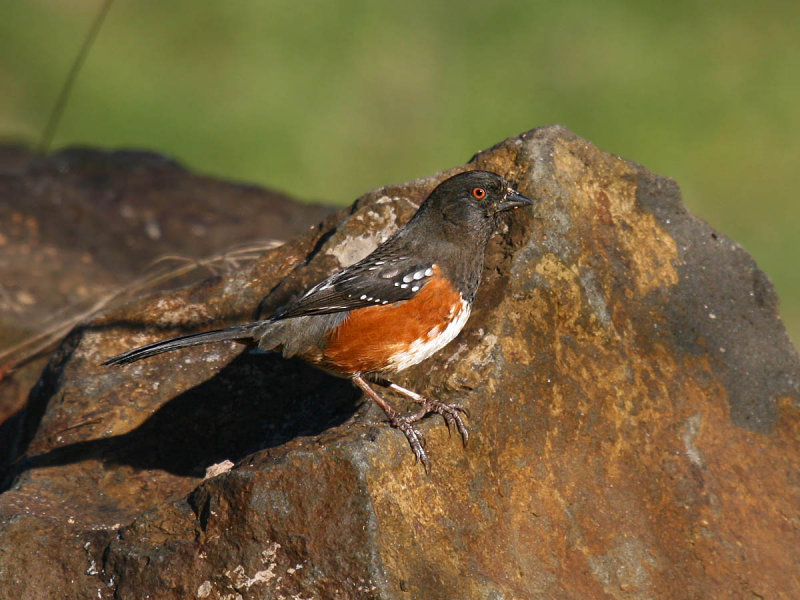
Spotted TowheeSpotted Towhee in the rain at Cooper Mountain Nature Park, Beaverton, Oregon on 15 June 2010 by Greg Gillson.


Since we're in the second day of above-90 degree temperatures, my mind began to drift back to the cool rainy days of spring when we thought summer would never come. In other words, just two weeks ago.

I was birding up at the new Cooper Mountain Nature Park on a hill south of Beaverton, Oregon. During our hike it started sprinkling a bit. The towhees didn't seem to mind, singing away. [Click for previous blog posts on Spotted Towhees.]

In this photo you can see the raindrops, as streaks, frozen in time. Exactly 1/160th of a second, to be precise, according to the camera settings. OK, my mind churns, the towhee is about 8 inches long and the raindrop streak looks to be approximately one inch long. Distance divided by Time equals Rate, according to algebra learned some time between the 5th and 8th grade. Thus, 1 inch divided by 1/160th of a second equals 160 inches per second, or... 9.1 miles per hour!

A quick Google! search for "how fast does rain fall?" leads me to several sites where I learn that a raindrop falls 5 to 18 miles per hour. Any faster and the raindrop breaks apart and slows down. File that trivia away for the next time conversation drags at your party!

[This post has been rewritten on 12 July 2010. Thanks to Mike Patterson for helping me correct my math errors on the earlier post.]

Tuesday, May 5, 2009

Recent photo... Spotted Towhee

Spotted TowheeSpotted Towhee, Hagg Lake, Washington Co., Oregon on 3 May 2009 by Greg Gillson.


Saturday was my planned photography day. However, when I awoke at night to the sound of heavy rain, I changed my mind. Since concentrating more and more on photography over the past couple of years I have become a fair-weather birder, it seems. But I awoke early Sunday morning and noted the dry streets so decided just to get out there for the morning. Of course, it was soon apparent that it was foggy and gloomy, which isn't good for making striking bird photos either. My goal was to head up into the hills and get above the fog. And so I did, ending up at Hagg Lake in the foothills of the Coast Range west of Portland, Oregon.

In March I posted In the backyard... Spotted Towhee, discussing this species in more detail. The bird photographed in the previous post was a more brownish female. The bird pictured above is a shiny black male, singing away in this flowering tree. I took several photos of this bird, including some shots of it eating the blossoms of this fruiting tree. Actually, I think they eat the flower's fruiting ovaries and spit out the petals, which slowly rain down from the tree.

On my web site for The Bird Guide I have a birding site guide for Hagg Lake (updated in April 2007) that may be of interest to those birding in the Portland area.

In an attempt to make more artistic photos I have been following a few rules of composition. In the photo above I cropped it so that the bird was off-center, with more space above the head and more space in the direction in which he is looking. My camera is the Canon EOS Digital Rebel XTi and the lens is the Canon EF 100-400mm f4.5-5.6L IS USM. The settings were 1/400 sec, f/5.6, ISO 200, aperture priority, matrix metering, 400mm focal length, fill flash at -2 stops. I shot in RAW mode and used Photoshop Elements 6.0, masking off the bird to adjust the exposure of the bird and sharpen it separately from the background.

Thursday, March 26, 2009

In the backyard... Spotted Towhee

Spotted TowheeSpotted Towhee, Jackson Bottom Wetlands, Hillsboro, Oregon on 8 December 2007 by Greg Gillson.


Blackish above with rufous sides and a white belly, this large sparrow with a red eye and white spots on the back, wing, and tail corners is a widespread and common bird in the Pacific Northwest.

It has been about 10 years since the American Ornithologists' Union split the former Rufous-sided Towhee into two species, the Eastern Towhee and the Spotted Towhee of the West. Spotted Towhees breed in brushy areas from extreme southern Canada from British Columbia to Alberta and south through California east to west Texas, and in the mountains of Mexico to Guatemala. In winter the Rocky Mountain and western Great Plains populations move south.

In the Pacific Northwest, birds west of the Cascades and Sierra Nevadas are resident or only weakly migratory. Birds are found throughout the year in brushy woods, clear cuts, riparian habitats, and backyard hedges. They are not found in the deep woods or open fields, but take up residence in any open brushy areas edging these larger habitats.

On the other hand, east of the Cascades, Spotted Towhees are restricted to brushy areas in mountains and along riparian corridors, such as stream and lake sides. They are also found in backyards in most towns throughout the Pacific Northwest. In winter, most Spotted Towhees east of the Cascades migrate south. A few remain in backyards in towns.

The song of Spotted Towhees vary by population, but most Pacific NW birds start with a sharp note and then a long trill, for which they are named: tow-eeeeeee. Birds in the Great Plains have 1 to 8 introductory notes before the trill. The common call note is a nasal rising, zhreeee. Besides differences in migratory patterns and songs, birds west of the Cascades have smaller and fewer spots than more easterly and southern populations. The photo above is of this less-spotted form west of the Cascades. This bird's upperparts are more brownish, an indication that it is a female, though the differences between the sexes are slight.

In the backyard, towhees hop on the ground under bushes kicking up leaf litter looking for insects, grubs, and seeds. They will eat at tray feeders, but rarely venture out far from cover.