Showing posts with label Rock Pigeon. Show all posts

Monday, July 4, 2011

In the backyard... Rock Pigeon

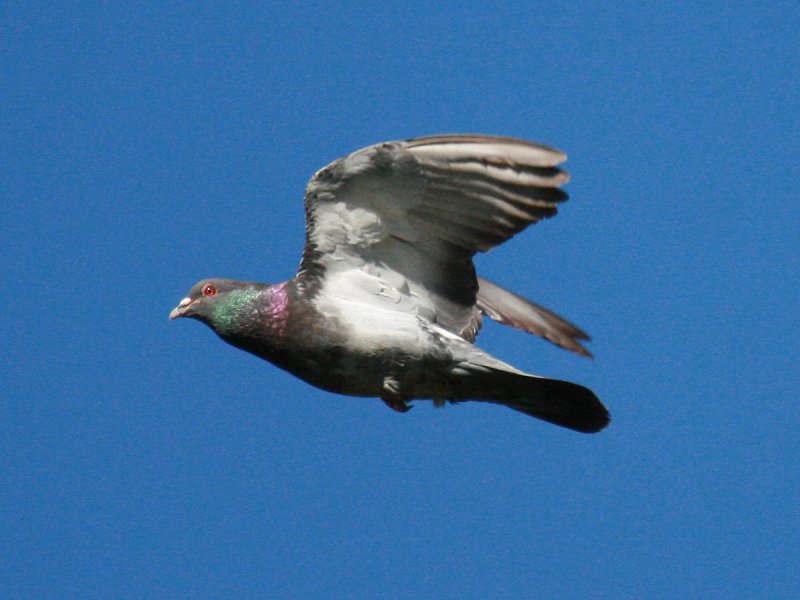
Rock PigeonRock Pigeon, Portland, Oregon, 19 February 2011 by Greg Gillson.


You may find the Rock Pigeon in older field guides listed as Rock Dove. Their name was recently changed.

Regardless, this is the common domestic pigeon. They are widely raised as free-flying "pets." However, they are also widely distributed as wild birds, breeding on highway overpasses, large bridges, and tall city buildings. You can find them in city parks in nearly every city in the world. They also breed on cliffs in remote settings.

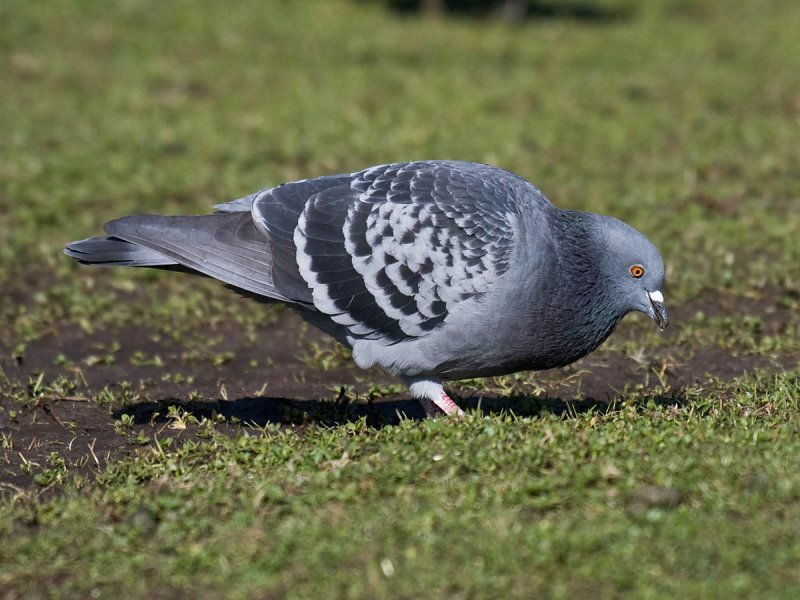
The typical, "natural," plumage is blue-gray with wide dark wing bars and white rump--as in the photo above. They have been bred to be various colors and patterns, and even with feathered legs or odd neck ruffles or crests.

Though many people view these birds as dirty city birds, I can't help feeling a bit of attachment as they fly by--thanks to my favorite childhood movie, Mary Poppins!

Now where did I put my tuppence?

Monday, September 27, 2010

Pigeon? Dove? What's in a name?

Rock PigeonRock Pigeon, Terrebonne, Oregon on 14 June 2008 by Greg Gillson.


Is there a difference between a dove and a pigeon? The short answer is no.

However, Peterson, Mountfort, and Hollom wrote in their 1974 A Field Guide to the Birds of Britain and Europe:
The terms "pigeon" and "dove" are loosely used and interchangeable, but in a general way "pigeon" refers to the larger species with ample, squared or rounded tails, "dove" to the smaller more slender species with longer, graduated tails.

In 1992 the British Ornithologists' Union changed the name of the Rock Dove and Stock Dove to Rock Pigeon and Stock Pigeon, respectively. This unified all the birds in the genus Columba with the name "pigeon." But, then, they also removed New World pigeons formerly in the genus Columba and put them into a new genus called Patagioenas. The American Ornithologists' Union followed suit in 2003.

How does that affect us in the Pacific NW? Well, if you have the "Big Sibley" guide printed in 2000, you will find a listing for "Rock Dove" as Columba livia. You will also find "Band-tailed Pigeon" as Columba fasciata. More recent field guides, such as the National Geographic (5th Edition) will list the new name "Rock Pigeon" still as Columba livia, and "Band-tailed Pigeon" now as Patagioenas fasciata.

Why change the common and scientific names and the order in which they appear on the checklists and field guides? These changes occur as scientists discover new relationships among birds.

That's the party line.

I sometimes joke that this is just a game and the scientists are just making it all up. In a way it's true. People like to pigeon-hole (pardon the pun) things to try to create order out of our complex universe. Nature is rarely so simple.

You may appreciate this blog post from 10,000 Birds:
Requiem for a Rock Dove