Question:
(June 6) "Hello Greg,
My son and I spotted a unique bird in our backyard. Can you identify this from the attached picture?
Thanks,"
Mike, location not given
Answer: I do, indeed, recognize the silhouette, Mike. That's a Northern Flicker.
Question: (May 30) "Greg, Thanks for your web site. It's very educational and very well laid out.
I work in Salem, Oregon and generally see the same birds that I see in my Portland neighborhood, but last week, I was walking back to my office around 12:30 p.m. and heard a bird song that I'd not heard before. I immediately assumed it was a warbler and I still believe so but I cannot put the song to the bird. I have listened to every warbler song on-line that I might expect in our area and cannot match it. Can you help?
The bird was singing in a mature purple-leaved plum so not a huge tree perhaps singing8-10' up in the tree. I never saw the bird while it was singing. I cautiously circled the tree (going out into the street and across the street to try to see it, but no luck seeing the bird!). This is an area of high-density buildings both government and apartments with heavily-parked lots and lots of pedestrians. There are many mature trees and shrubs around these buildings, however. The purple-leaved plums are the street trees on this street.
The song was fairly fast-paced, sounding more like a Warbling Vireo than any warbler song that I can I.D.
It eventually flushed and flew away from me and I could see that it was warbler sized with a flash of yellow on the rump and perhaps olive. It definitely wasn't a Lesser Goldfinch or an American Goldfinch. It wasn't their song.
Any ideas? The bird was solitary and flew into a large red maple row against a large apartment. I had started to draw a crowd with my cautious movements and my staring into the tree! I thought I better get back to work so didn't see the bird again. I've never seen a Warbling Vireo as I'm mainly a back-yard birder. Could it have been a Warbling Vireo with the yellowish rump? Such a sweet but vigorous song in such an urban area.
Thanks for your help, Greg."
Steve in SW Portland, Oregon
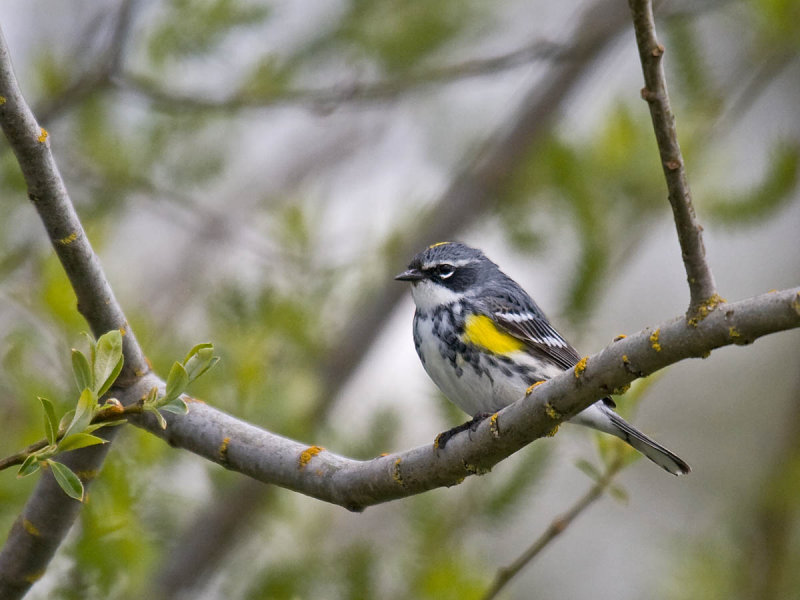
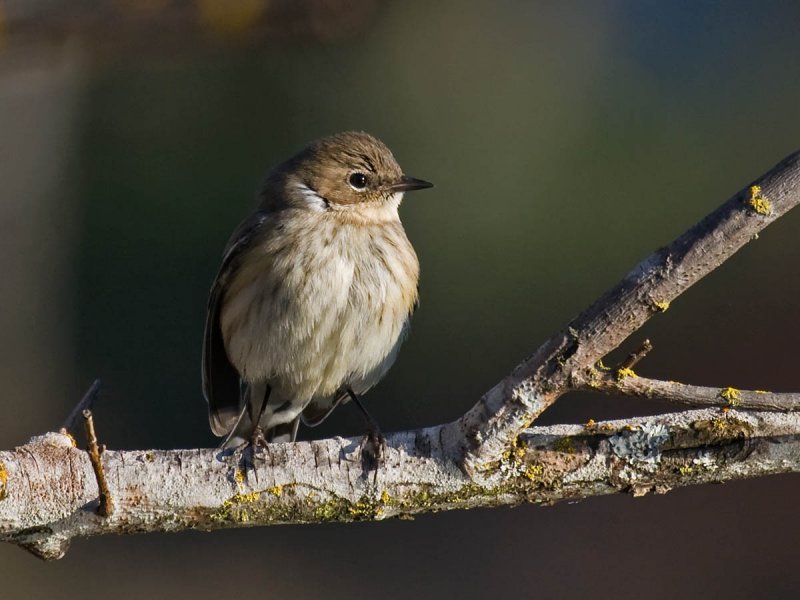
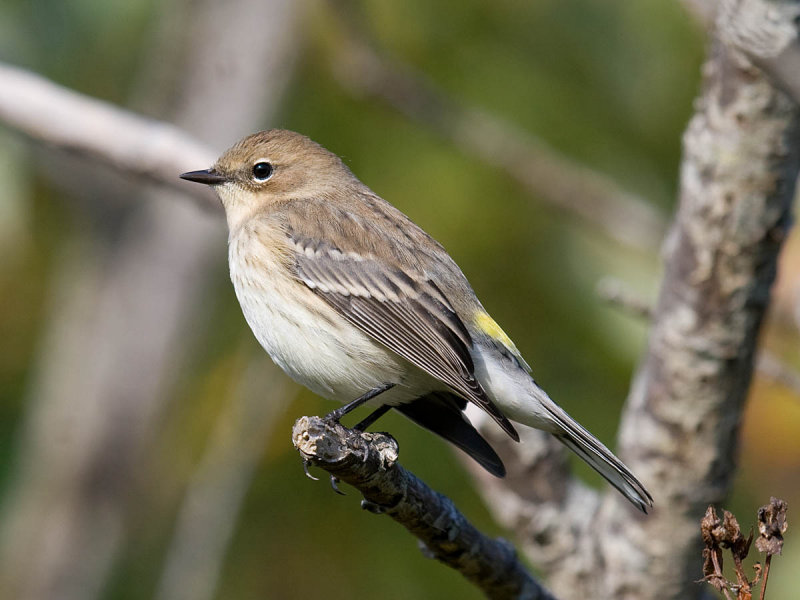
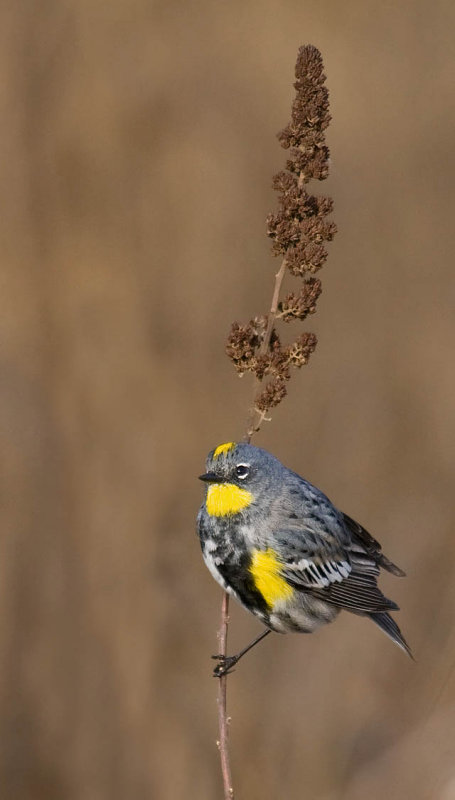
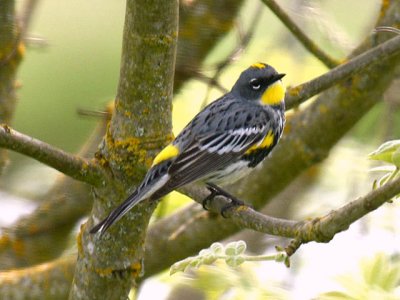 Answer: Steve, while Warbling Vireo is certainly possible at the time and place your saw this bird, the description of the yellow rump just doesn't fit. Thus, I would suggest that it is the most abundant migrant in western Oregon during the spring. Guess what? It has a yellow rump in its name! There are two races of Yellow-rumped Warblers and both migrate through the Pacific NW, Myrtle breeds farther north and starts migrating as early as March, and Audubon's starts in May, but both occur through spring. The voices, both calls and songs, are different. Many recordings are of the more widespread (common in the East) Myrtle Warbler. So make sure you are listening to the correct bird recording. Listen to the Audubon's Yellow-rumped Warbler songs on Cornell's "All About Birds" online field guide site.
Question: (June 3) "Hello Greg - I'm going nuts trying to discover the author of a fantastical call that I hear all day, every day right now. Here's my best description of it:
A single high-pitched, upwardly rising note, that spirals upward in three "loops", ending in a shimmery, echoing glissando effect. I am referring to this unseen bird as the Ventriloquist due to the amazing shimmery finish at the end, like water ripples spreading. It seems that between these beautiful calls, the bird hops around and makes a tiny, quiet, single "po" call. Then the upward-spiralling call again and again. It's so beautiful. I recall hearing it all last Summer and it just started again a few weeks ago.
Today I saw a classic LBB (little brown bird!) in the vicinity of the call... Looked just like a Hermit Thrush or so, with large eye and needle-sharp insectivore bill. Buff color with some speckles at the throat and barely lighter buff belly.
Any hope of IDing this masterpiece? I am always trying to get a glimpse of the singer but the bird is very, very shy. I live near a forested wetland with tons of cover. Lots of Robins around and lots of other birds too. (blog link below) If you can help me, it would be just wonderful. If not, I totally understand!! Thanks for reading this. Sincerely,"
Bonnie in Quilcene, Washington
http://back2theland.blogspot.com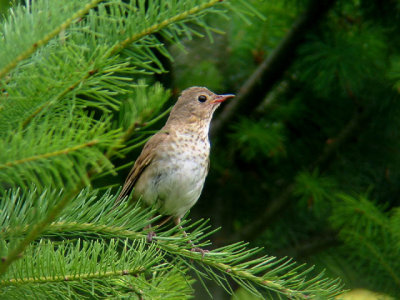 Answer: What a beautiful and accurate description of the song of Swainson's Thrush! Most people have a very difficult time describing a bird song or call, but you nailed it, Bonnie! The spotted thrush with buff underparts is Swainson's and not Hermit Thrush. Hermit Thrushes have more gray underparts and breed in the high mountains (spruce and true fir) and those that breed in Alaska will winter in your lowland woods. Hermit have rusty rump and uppertail. Swainson's Thrushes are rare north of Mexico before mid-April and head back down there in September when their distinctive "whit" and "heep" calls are heard overhead during their night migration. Swainson's Thrushes may be one of the most abundant birds in riparian foothill clear cut regions of red alders before the Douglas fir grow up too much. The other abundant birds in Swainson's Thrush habitat are Wilson's Warblers and Warbling Vireos. Listen to Swainson's Thrush song in Cornell's "All About Birds" field guide.
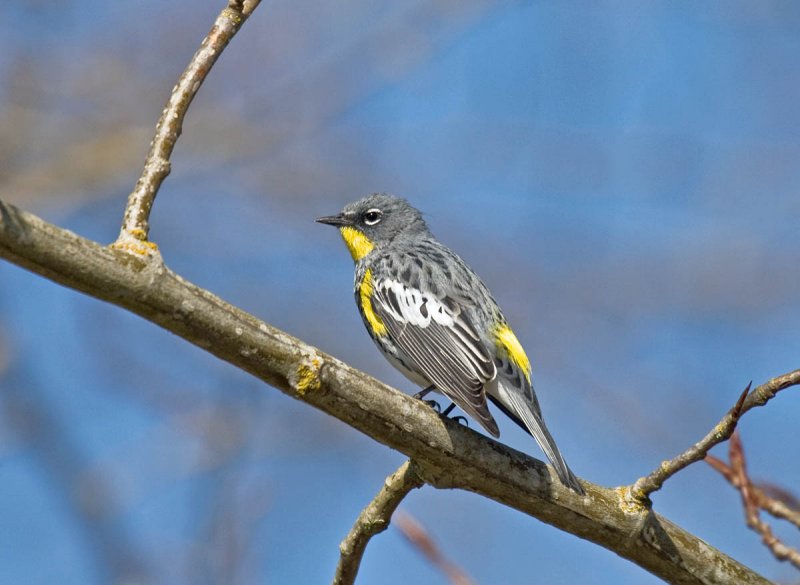 Yellow-rumped Warbler, Forest Grove, Oregon on 23 March 2012 by Greg Gillson