Showing posts with label behavior. Show all posts

Tuesday, March 12, 2013

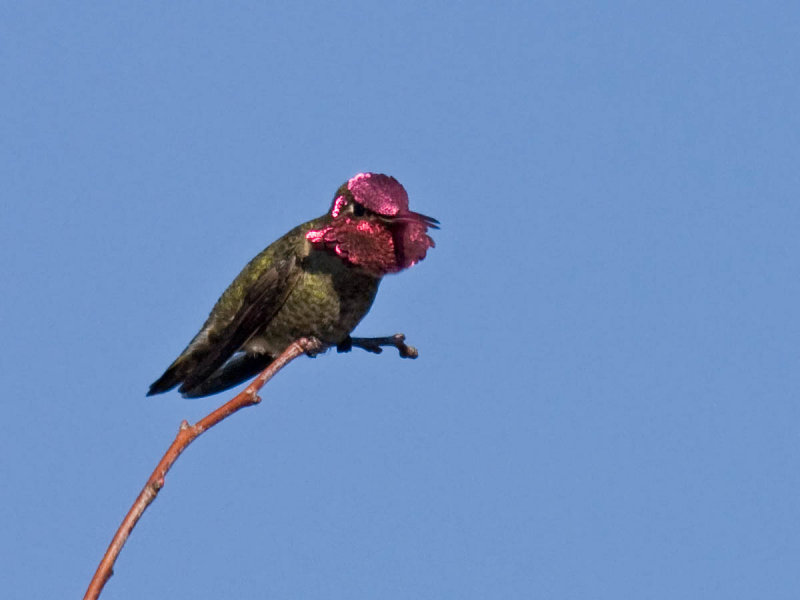
Anna's Hummingbird territorial display

Anna's Hummingbird display
Anna's Hummingbird singing, Cooper Mountain Nature Park, Beaverton, Oregon. February 15, 2013 by Greg Gillson

Anna's Hummingbirds rival Great Horned Owls for earliest nesting bird in the Pacific Northwest. Unlike other hummingbirds, this resident year-round species is the only one regular in the United States in winter (a resident race of Allen's Hummingbird lives on the Santa Barbara islands group off southern California) Many Anna's Hummingbirds lay eggs in February in the Pacific NW. The males don't help with nesting duties or raising of the young. They are just "trophy husbands," providing a pretty face and some DNA for the next generation.

By mid winter the males are claiming territory for their "singing." These are the only North American hummingbirds that sing. The song is an insect-like buzzy noise: "beez-zee-zee-zeeb-zee," etc. from a high perch. It's kind of like some of the starling's buzzy, squeaky song notes, but reduced in size to a large insect.

I was so happy to find a male singing recently in some winter sun. The angle was just right for the black throat feathers to refract sunlight back in a metallic rosy hue and provide some great photos in a natural (non hummingbird feeder) setting.

Another male hummingbird flew into the blackberry tangle. It didn't quite have the full breeding gorget. So, perhaps it was a younger bird. It stayed quietly inside the protection of the tangle. The singing male became more agitated and flew and behaved in a stylized way.

The territorial bird rose quickly straight up 70 feet or more--nearly out of view, like it was on an elevator, levitating, keeping it's body level to the ground. Then it dove at high speed toward the ground and angled toward the interloper in a J-shaped flight. It made a popping squeak or chirp at the lowest point of its flight quite near the invading hummingbird. Then it continued up about 20 feet and hovered in place for about 3 seconds, completing the J-shaped flight path. Then it rose again and repeated the same display flight several times. I was able to get the photo below as it hovered briefly at the end of its J-flight.

Hovering Anna's Hummingbird
Hovering hummingbird in display flight.

The popping chirp noise in the display flight is probably made by the tail feathers. If I hadn't seen the bird and associated sound, I would not have known what it was. The sound was similar to the bark of a chipmunk or squirrel or even some kind of insect sound (if it was summer instead of winter).

At any rate, a sunny winter day, a great series of photos, and interesting behavior I had never observed before. Birding at it's best!
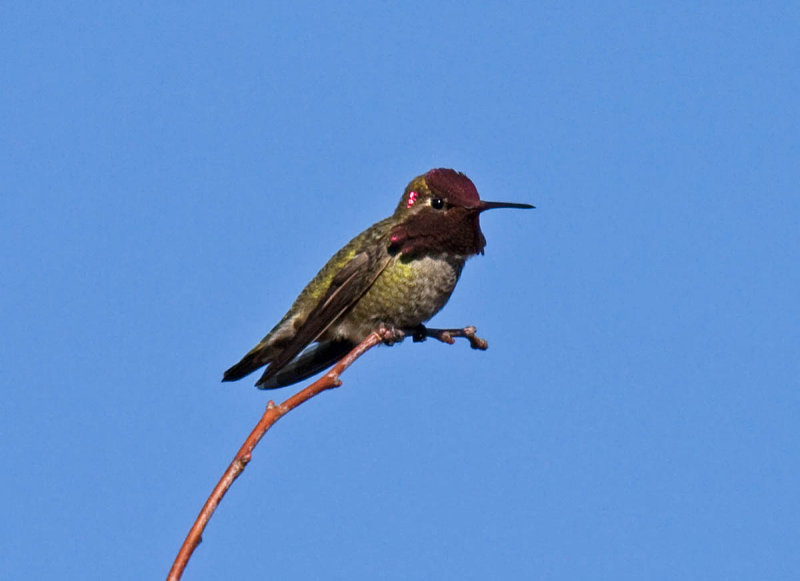
Singing Anna's Hummingbird
Victorious hummingbird has vanquished the interloper.

Friday, August 3, 2012

Peek-a-boo

Canada Goose chick
Canada Goose. May 29, 2012. Forest Grove, Oregon.

Even if Canada Geese have become pests in some areas, they can still be cute. There were actually two chicks hiding under mother's wing. Only this one was brave enough to peek out at the world.


Monday, December 27, 2010

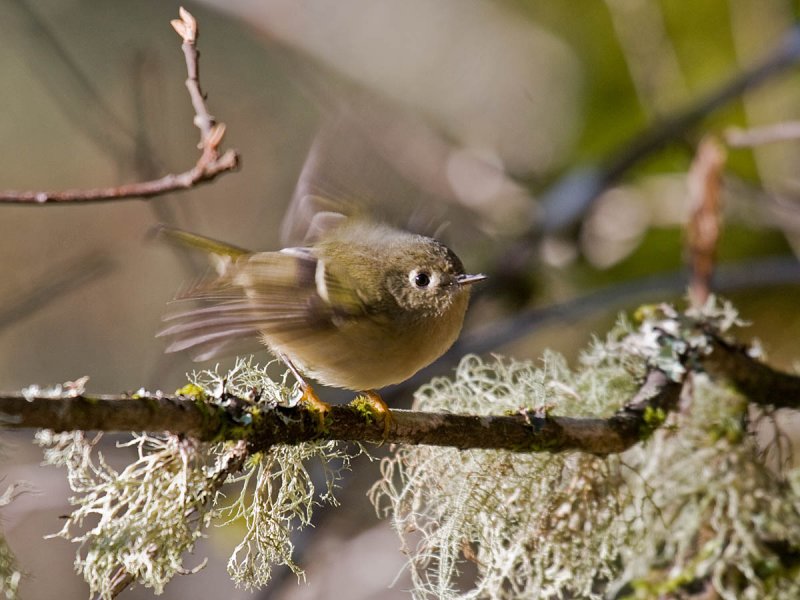
Wing-flicking: Ruby-crowned Kinglet

Ruby-crowned KingletThe constant wing-flickinging of Ruby-crowned Kinglet is a characteristic behavior. Photographed at Hagg Lake, Washington Co., Oregon on 17 December, 2010 by Greg Gillson.


"Tiny active birds of tree branches,... with a characteristic habit of nervously flicking the wings."
-- The Birds of Canada, 1979 by Earl Godfrey.


In our previous identification post about the separation of Ruby-crowned Kinglet and Hutton's Vireo we concentrated on the color and shape of feathers, bill, legs, and feet.

Birds also have many interesting behaviors that help separate them. These are rarely mentioned in the field guides--unless conspicuously obvious. Thus field guides typically mention the bobbing and teetering of Spotted Sandpipers, the hovering of Rough-legged Hawks, and the plunge-diving of Belted Kingfishers.

The nervous wing-flicking of Ruby-crowned Kinglet also is mentioned in most field guides.

This innate (instinctive) behavior is like a constant tic. Every couple of seconds the kinglet flicks its wings, as in the photo above. When agitated, it may flick its wings twice in a second. Combined with its constant movement--rarely does a kinglet sit on a branch more then 4-5 seconds--this tiny bird gives the impression of being in a constant state of nervous hyperactivity.

This isn't to say that the look-a-like Hutton's Vireos never flicks their wings, because they do--many small birds do--just not anywhere near the same degree as the kinglets.

Tuesday, November 23, 2010

Feeding habits of the Northern Shoveler

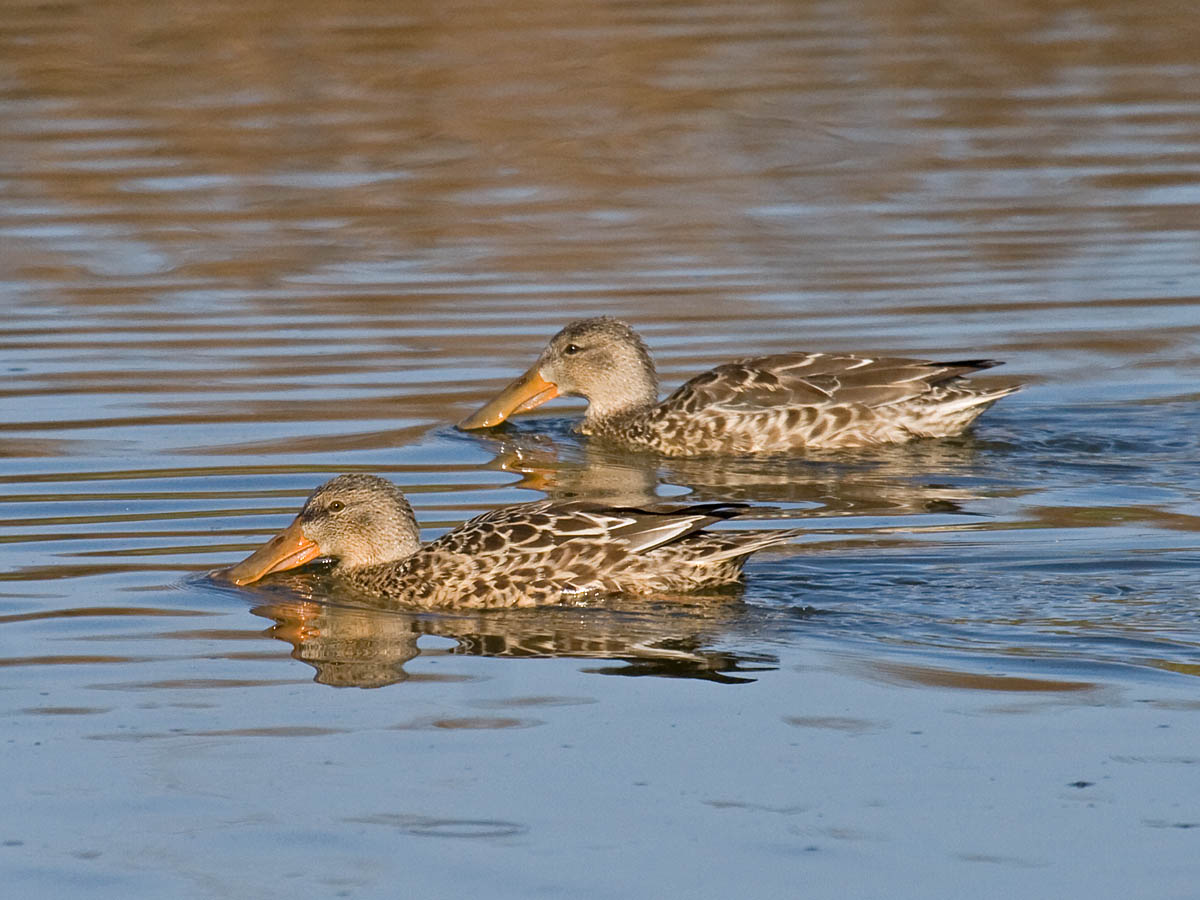
Northern ShovelerFemale Northern Shovelers, Fernhill Wetlands, Forest Grove, Oregon on 19 October 2010 by Greg Gillson.


Many birders are a bit hesitant when it comes to identifying female ducks. The hen's plumage is camouflaged browns. Clues from the brightly-colored wing are often concealed, folded up and covered by the scapulars and breast feathers. It doesn't help, either, that they frequently keep their bills hidden, tucked away in the scapulars as they rest.

But what's this? All those ducks swimming around seem to be feeding with their head half way under the water! Looking around, it doesn't take long to spot plenty of drakes feeding in the same manner--Northern Shovelers all.

Called "spoonbills" by hunters, for their long spatulate bills, Northern Shovelers are the 4th most abundant duck on the Pacific Flyway, following Northern Pintail, Mallard, and American Wigeon.

Shovelers are included in the "puddle ducks" or "dabblers" that primarily feed by upending--head under the water and tail and legs in the air. But not so the Northern Shovelers. They feed more on the surface, pushing their bills through the water, straining out food with the sieve-like lamellae--a comb-like structure on the edges of the bill. All ducks have lamellae, but on the Northern Shoveler it is especially well-developed.

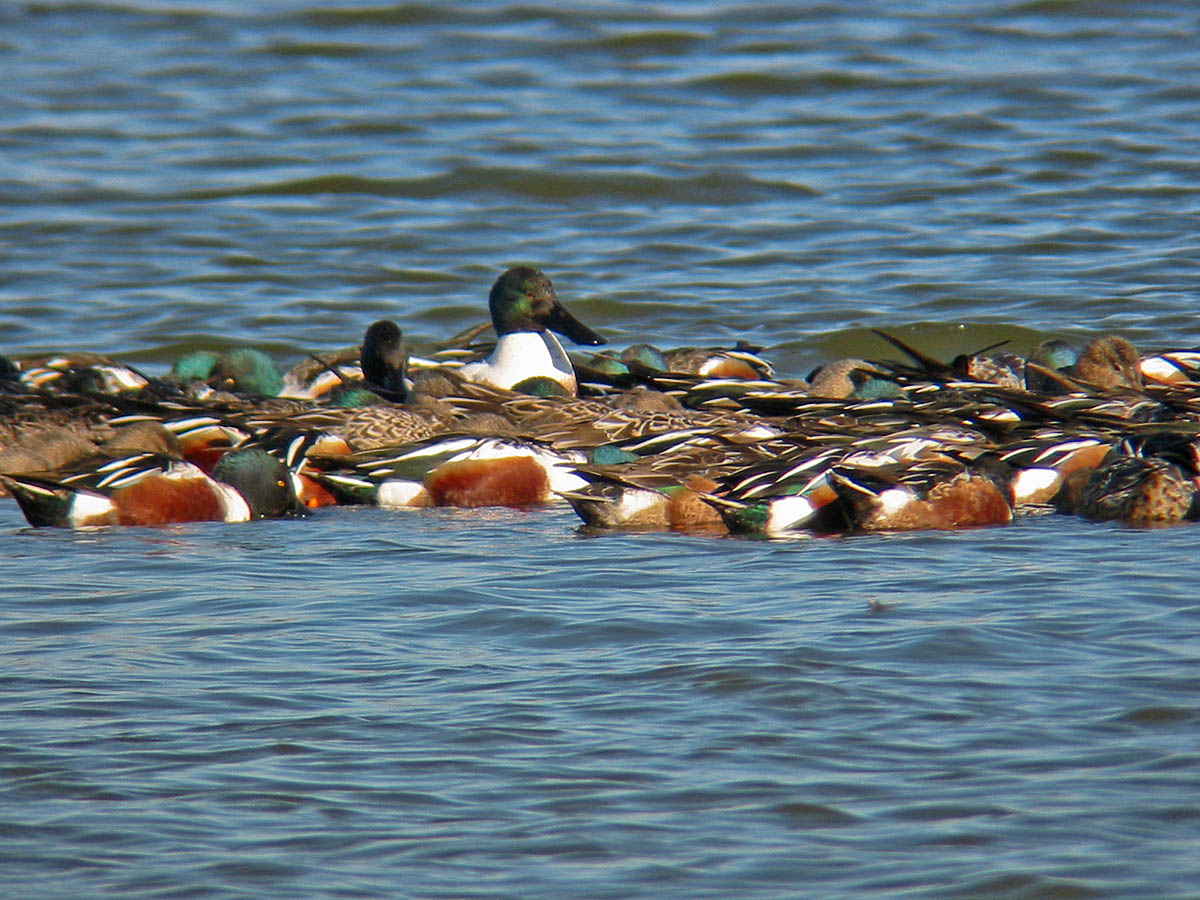
These ducks commonly feed in small groups that circle about, stirring up mud with their feet. They take more animal matter than most puddle ducks, about 65% animals to 35% plants. Snails and water boatmen seem to be favorites, according to John K. Terres in his 1980 reference work, The Audubon Society Encyclopedia of North American Birds.

However, whereas Terres indicated that the feeding groups are "three or four" in size, I have often noted groups of a hundred or more in a tightly packed raft, circling and circling as they feed. As they feed, the males (only?) constantly grunt a mechanical chug-kuk chug-kuk chug-kuk....


Northern ShovelerA whole raft of nearly headless ducks! Feeding Northern Shovelers, Fernhill Wetlands, Forest Grove, Oregon on 19 February 2006 by Greg Gillson.

Wednesday, August 25, 2010

Do the Shuffle!

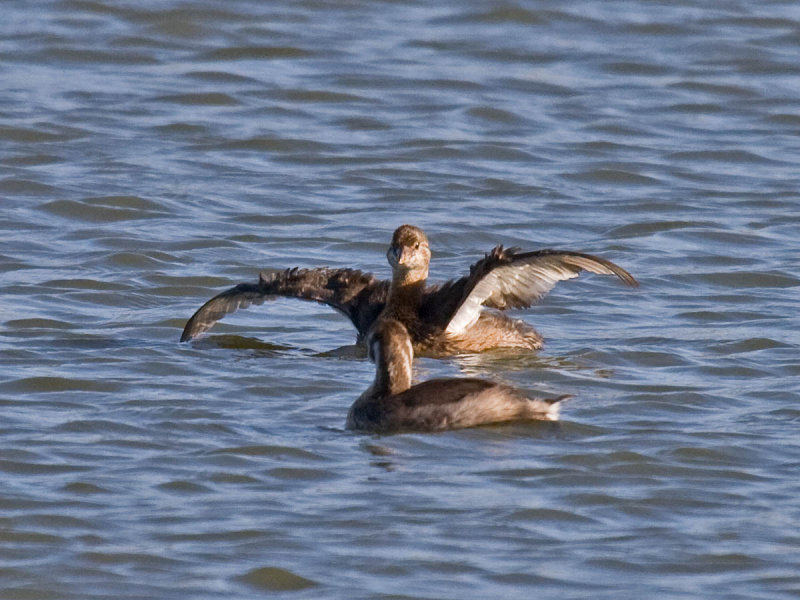
Pied-billed GrebeJuvenile Pied-billed Grebes, Fernhill Wetlands, Forest Grove, Oregon on 19 August 2010 by Greg Gillson.


Last month I photographed the sinking dives of a Pied-billed Grebe at Fernhill Wetlands, in Forest Grove, Oregon. This week I photographed two birds there, one of which is probably the same individual.

These two birds have been hanging around the ponds there. From a distance I noted that they were regularly holding out their wings. So I walked closer to investigate, obtaining the photo above.

I observed that the grebe (the bird farthest back) holds its wings out about 3 seconds, fluffs its back feathers and shakes its back and tail, as in the next photo below, taken 6 seconds after the top photo. [Click photo for larger view.]


This behavior is called "feather settling." It is one of a number of maintenance behaviors that presumably gives the bird comfort. Other comfort movements are yawning, stretching, and resting. Many behaviors in birds are innate--they are instinctively performed following a constant pattern. Feather settling is often performed by raising the feathers, shaking the body, flapping the wings, and finally depressing the feathers down into proper position.

This reshuffling of the feathers was performed several times alternately by both birds. In the photo below the other bird takes its turn (6 more seconds after the second photo above). [Click photo for larger view.]


I realized that I had seen this before, without really thinking about it. Rich Ditch recently photographed a Pied-billed Grebe with its wings out. Now I know what it was doing!

This also explains the bizarre "fuzzy gull" I photographed last week at the coast. The adult California Gull fluffed itself all up as you can see in the photo below. [Click photo for larger view.]


Then it shook itself and flapped its wings. [Click photo for larger view.]


This gull was very worn. The feathers of the tail has lost most of the vanes and the tips are just bare feather shafts. This bird needs to start its fall molt and replace its old feathers very soon!

Perhaps this gull is getting new feathers and they itch? That would explain a reason for feather settling, too. As a matter of fact, the juvenile Pied-billed Grebes are also going through body molt. Itchiness might explain the repeated feather settling they are doing.

Thursday, August 12, 2010

Nature Journal: Sunbathing Cliff Swallows

Cliff Swallows sunbathing on a roof, Jackson Bottom Wetlands Preserve, Hillsboro, Oregon on 7 July 2010 by Greg Gillson.


We had a rather cool and wet spring. Thus, when it finally warmed up just after Independence Day [Editor's note to visitors: it always rains on all holidays in western Oregon.], I went out on the trails at Jackson Bottom one hot morning and found these Cliff Swallows sprawled out and panting on the roof of this wildlife viewing stand.

Why?

I got out my trusty reference guide, The Audubon Encyclopedia of North American Birds (1980) by John Terres.

It turns out all sorts of birds sunbathe, fluffing up their feathers and panting. Some take it to the extreme by flopping their wings forward wildly, gasping for air, while lying prostrate.

That seemed to be the case for the birds observed here, many of which were in a dusky juvenal plumage.

Why do they do it?

Terres' sources indicate that sunbathing benefits birds in several possible ways. Heat is absorbed (they were just cold and wanted to warm up); Vitamin D is produced; skin and feather parasites may move off the back and to a place where the birds can remove them. Some birds apparently sunbathe during the time of molt--perhaps it stops the skin from itching?