Showing posts with label White-breasted Nuthatch. Show all posts

Thursday, July 15, 2010

Nature Journal: Nest box double-take

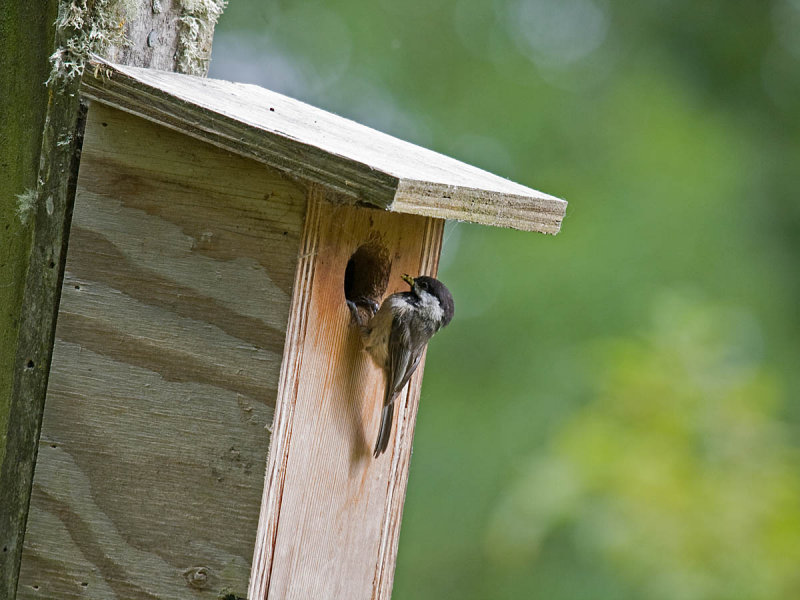
Black-capped ChickadeeBlack-capped Chickadee, Jackson Bottom Wetlands, Hillsboro, Oregon on 13 July 2010 by Greg Gillson.


There is nothing unusual in the above photo. On the free Wednesday morning bird walk I lead, we encountered this Black-capped Chickadee feeding nestlings at a nest box at Hillsboro, Oregon's Jackson Bottom Wetlands Preserve. The nestlings were grown enough to meet the parents at the nest entrance to receive food.

What is unusual, is that White-breasted Nuthatches were feeding nestlings at this same nest box 68 days earlier (see photo below)!
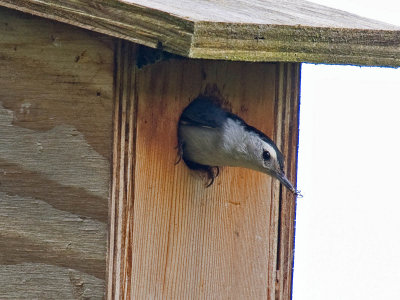
White-breasted NuthatchWhite-breasted Nuthatch, Jackson Bottom Wetlands, Hillsboro, Oregon on 6 May 2010 by Greg Gillson. Click on photo for larger views.


Here is what John K. Terres has to say about Black-capped Chickadee nesting in his book The Audubon Society Encyclopedia of North American Birds. He says that incubation is by both parents, 11-13 days and that the young leave the nest when 14-18 days old. The incubation and fledgling period is nearly the same for White-breasted Nuthatch (12 and 14 days, respectively).

It appears that the nest box might have been unoccupied approximately 42 days between the nesting of the nuthatch and chickadee.

Monday, July 20, 2009

In the backyard... White-breasted Nuthatch

White-breasted NuthatchWhite-breasted Nuthatch, Calliope Crossing, Sisters, Deschutes Co., Oregon on 12 June 2008 by Greg Gillson.


At five and three-quarter inches in length from bill to tail, the White-breasted Nuthatch is the largest of four North American nuthatches. We have already discussed the Pacific Nortwest's other two nuthatches, the Red-breasted Nuthatch and the Pygmy Nuthatch.

This bird is found across southern Canada and south through the US and into the mountains of Mexico. The 11 subspecies across North America can be divided into three groups. The stout billed and paler birds of the East, the long and thin billed and dark birds in the center of the continent, and the "tweeners" of the Pacific slope. Each of these three groups have different vocalizations.

In the Pacific Northwest the population west of the Cascades is found primarily in older oak groves. These birds are becoming quite rare in western Washington. The call note of these birds is described as a long drawn-out aaarn. East of the Cascades, birds of the longer-billed subspecies are found in mature ponderosa pine forests (as shown above). The call note of these birds is described as a rapid: yiji-yiji-yiji-yiji.

White-breasted Nuthatches are often observed crawling over the larger limbs or head-first down the trunk of trees, searching for bark-dwelling insects to eat. They will eat sunflower seeds and suet at your feeder.