There are many times when you are birding you may wish to record more than just species in eBird.
For instance, the mouth of the Columbia River is the center of the breeding range for hybrid Western and Glaucous-winged gulls. In winter these hybrids are quite common in western Oregon and Washington--perhaps more so than either parent species. You'll want to add Western x Glaucous-winged Gull to your checklist.
Throughout the Pacific Northwest the common Dark-eyed Junco is the Oregon form. However, one might encounter Slate-colored, Pink-sided, or even Gray-headed forms. These used to be considered separate species, but are now all considered varieties of just one species. But if you see an individual of the Slate-colored subspecies, such a unique sighting deserves to be recognized in your checklist as Dark-eyed (Slate-colored) Junco, not just as a comment under Dark-eyed Junco. [One caution. Don't record subspecies based only on range if you really can't identify them. For instance, in North America the default Osprey is the American form. There are other forms in Eurasia, the Caribbean, and Australasian regions that you can choose from eBird. But don't write down "Osprey (American)" for a bird in Idaho unless you have specifically identified that form and eliminated the others.]
What, though, is a "spuh"? Well, say you see some kind of swallow, but aren't sure exactly what species. Then the species is undetermined and you would record: swallow (species unknown), more often just abbreviated as: swallow (sp.), pronounced "swallow spuh."
You can add hybrids, subspecies, and spuhs to your checklist at any time. If they are common in your area, they may appear on the default area checklist already. If not you can add them. But how do you know if what you want to add exists in eBird? When you "add species" when submitting a checklist, a menu drops down. But what if the bird you want doesn't seem to exist in the list? One way to check is to broaden your search.
For instance, I just clicked the Add Species and entered Goose. All geese in the world come up. From there you can choose from several domestic types, hybrids, subspecies groups, and species pairs that often do not appear on the default checklist.
Remember, when you add a species to a checklist (hybrid or subspecies) it will go the the local eBird Reviewer for verification. So be sure to include a brief comment on how you identified it in the comments (size and shape, plumage, behavior, song, and habitat).
More help on this subject is available from eBird.
Showing posts with label hybrid. Show all posts
Showing posts with label hybrid. Show all posts
Monday, July 8, 2013
Sunday, January 1, 2012
Separating first winter Thayer's Gull from "Olympic" Gull
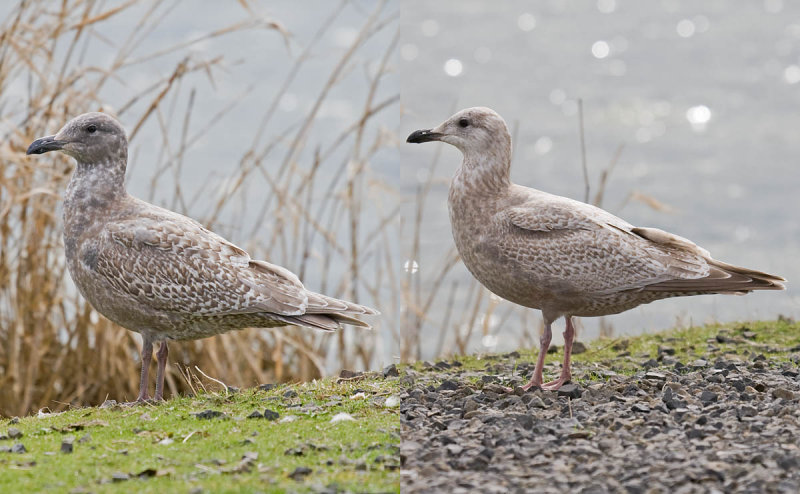 First year Olympic Gull and Thayer's Gull. Which is which? Forest Grove, Oregon, 23 March 2011 by Greg Gillson.
Right here in the Pacific Northwest we have one of the most confusing arrays of winter gulls in the world.
As if the 13 regular gull species weren't enough, we have numerous rarities and hybrids. In fact, in many locations on the Oregon and Washington coast, the hybrids between Western and Glaucous-winged Gull may be more common than the pure parent species. But we also have hybrids between Herring and Glaucous-winged, Herring and Glaucous, and Glaucous and Glaucous-winged!
The larger gulls take 4 years to reach adult plumage and change appearance twice each year as they do so. No wonder many birders never get comfortable identifying immature gulls--truly one of the more difficult topics of bird identification!
Olympic Gull
Western Gulls breed along the Washington coastline southward. Glaucous-winged Gulls breed from the central Oregon coast northward. Thus, their breeding ranges overlap for about 200 miles, centered at the mouth of the Columbia River. In this area of overlap there is considerable hybridization. Due to backcrosses, there is complete clinal variation from one end of the spectrum to the other. South of the Columbia River birds looking more like Western Gulls become more common. To the north, gulls that appear more like Glaucous-winged Gulls become more prevalent. This swarm of Western, Glaucous-winged, and hybrid Western x Glaucous-winged gulls is called the "Olympic Gull."
In winter, these coastal breeding hybrid gulls are found also inland in the Puget Sound and the Willamette Valley, and south along the coast regularly to at least San Francisco. Pure Western Gulls are rare inland; most adult "Western Gulls" reported inland show some evidence of past hybridization if you look closely at winter head streaking and intensity of black in the wingtips.
Hybrids, especially those tending toward Glaucous-winged Gulls in appearance, are easily confused with Thayer's Gulls. This post discusses these birds in the first year only. However structural features are consistent across various age groups.
First, correctly age the gull by looking at the back
First year gulls are rather brown-barred throughout. In the second year the upper back feathers become smooth gray similar to the adult coloration. Thus, on first year gulls the back is barred brownish. Most first year gulls have blackish bills and pink legs, so the color of these important adult ID field marks are of little to no use during the first year or two.
Look at the size and shape of the bill
Because there is so much plumage variation with hybrids, look next at the bill. Western Gulls and Glaucous-winged Gulls (and, thus, hybrids between the two species) have very large, thick bills. There is considerable size variation between the sexes (males are larger) but, even so, the bills are thicker than all regular Pacific NW gulls, and average longer than all gulls except the largest Glaucous Gulls. The bills are widest on the gonys. This is the point on the lower mandible where the right and left halves fuse together and angle up sharply to the bill tip, as shown on the adult Glaucous-winged Gull head photo, below.
The bills of Thayer's Gulls are shorter and thinner than the Olympic Gull. The female Thayer's Gull has an especially small bill, often described as "petite." The angle of the gonys is not as sharp as the Olympic Gull--the lower mandible of Thayer's Gull appears straighter.

Look at the primary/tertial/rest-of-wing contrast
Now turn your attention to the other end of the gull. It is important to be able to identify correctly the back, the scapulars, wing coverts, secondaries, tertials, primaries, and tail.
In the photo below, the tertials, primaries, and tail are identified. Most first year gulls have back, scapulars, wing coverts and secondaries very similar in color and pattern, as below. It is the contrast (or lack thereof) between the primaries, tertials, and the rest of the folded wing, that provides the final clues to reaching an accurate identification.

Most of the larger white-headed gulls in first winter plumage (Mew, Ring-billed, California, Herring, Western) have blackish primaries and tertials, contrasting with the rest of the wing which is barred brownish and pale.
Pure Glaucous-winged Gulls have matching colors to the primaries, tertials, and barring of the rest of the wing on a first year bird. Often the color is a very pale gray-brown.
First year Thayer's Gulls are the only pure gulls that show medium-brown primaries, contrasting with a paler wing panel.
Hybrids--the Olympic Gulls--show a similar pattern to pure Glaucous-wingeds. There will be little contrast between the various wing feathers, but they are often much darker brown than pure Glaucous-winged Gulls, especially on the primaries.
If the primaries on a first year gull are brown, you are probably looking at a Glaucous-winged hybrid (most-likely an Olympic Gull) or a Thayer's Gull.
The key is in the contrast of the primaries, tertials, and rest of wing. These match in coloration on Glaucous-winged hybrids. Thayer's Gulls show a unique difference--three shades. The tertials are darker than the secondaries and wing coverts, and the primaries are darker than the tertials.
Are you ready to identify these gulls? What do you see on the next photo? Big and thick bill or smaller and slight? Do the primaries, tertials, and rest-of-wing all contrast strongly with each other and get paler with each feather group?
 Hybrid Western x Glaucous-winged Gull ("Olympic Gull"), Forest Grove, Oregon, 7 February 2009 by Greg Gillson.
How about the next photo? Same questions. Big and thick bill or smaller and slight? Do the primaries, tertials, and rest-of-wing all contrast strongly with each other and get paler with each feather group?
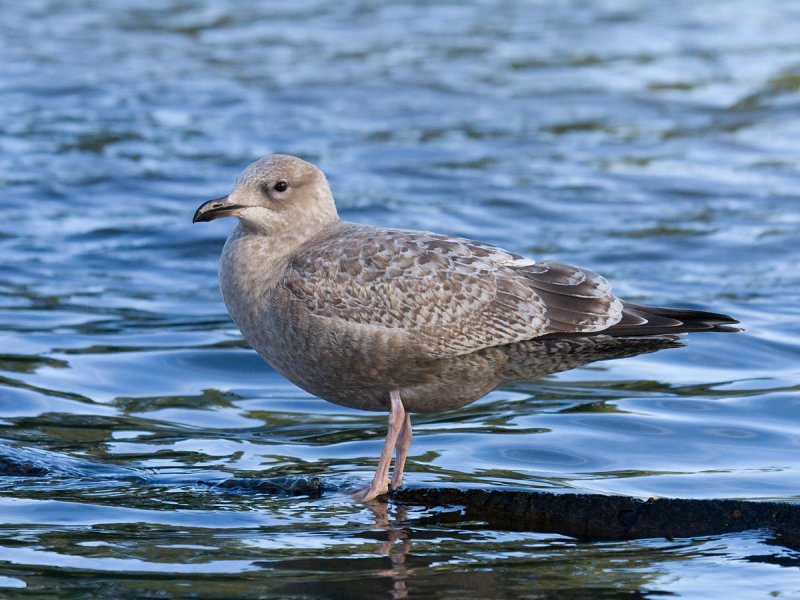 Thayer's Gull, Portland, Oregon, 19 February 2011 by Greg Gillson.
Now you are ready to go back to the top photo and puzzle it out.


Monday, March 29, 2010
Glaucous-winged Gull
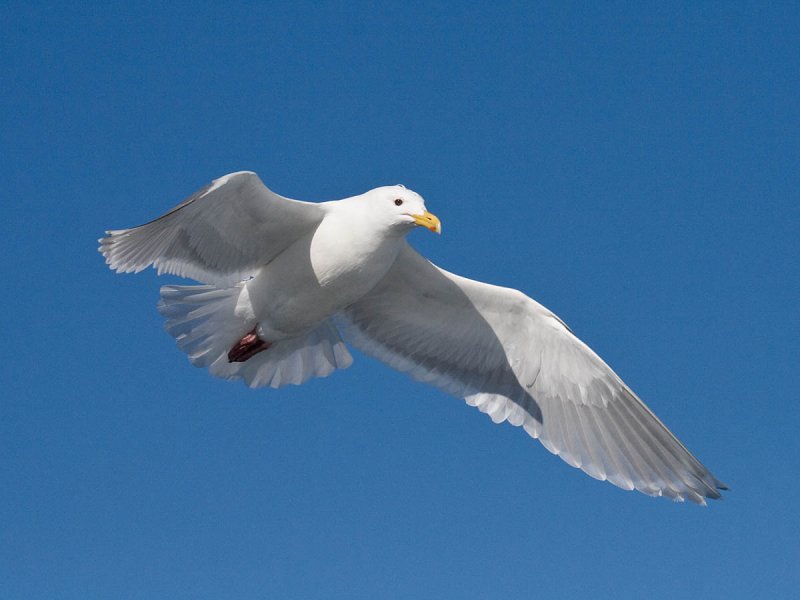 Glaucous-winged Gull, at sea off Newport, Oregon on 6 March 2010 by Greg Gillson.
In the 1953 book, Birds of Washington State, Jewett, Taylor, Shaw, and Aldrich described the southern edge of the breeding range of Glaucous-winged Gull as Destruction Island, Washington, nearly due west of Mt. Olympus on the Olympic Peninsula. Likewise, that island about 4 miles offshore was the northern edge of the breeding range of the much darker Western Gull.
Today the situation is much different--for the Glaucous-winged Gull, anyway. This pale gray gull, with upper wingtips concolorous (in all plumages) with the rest of the upper wing and back, now breeds south to the central Oregon coast.
The range expansion created a new population dynamic. In the 200 miles where the two ranges now overlap, Glaucous-winged and Western Gulls hybridize extensively. The fertile crosses and back-crosses span the entire spectrum from looking quite pale like Glaucous-winged Gull to very dark like Western Gulls. The hybrid swarm is often referred to by birders in the Pacific NW as "Olympic Gulls." In fact, many birders along the central Washington coast do not try to differentiate them, even when surveying seabirds.
In winter, Glaucous-winged and hybrid gulls are common along the coastline south to San Francisco or farther, in the Puget Sound area, and inland in the larger towns west of the Cascades, and increasingly as vagrants across North America. In contrast, "pure-looking" Western Gulls are rare away from the immediate coast.
As with most larger gulls, they are omnivorous, eating anything they can swallow. They are common in garbage dumps and parking lots of fast-food establishments.
Subscribe to:
Posts (Atom)