Wednesday, April 27, 2011

How did Townsend get away with it?

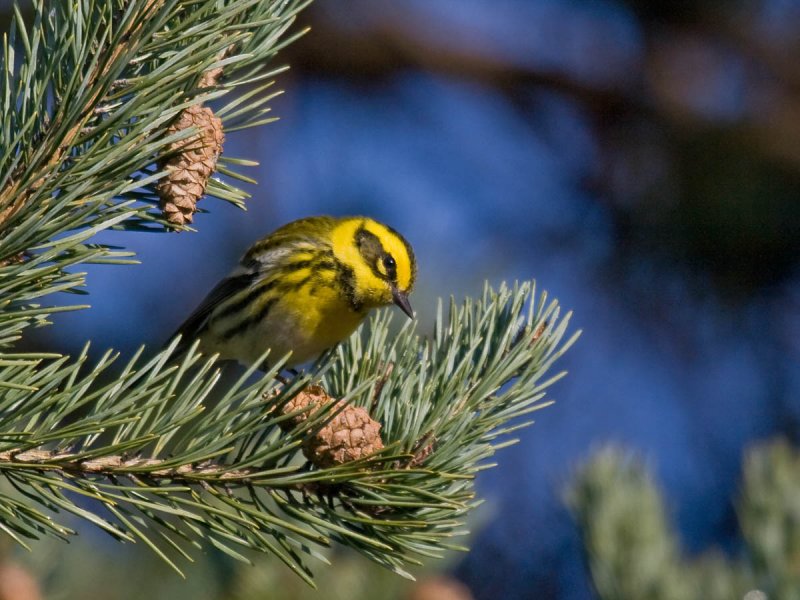
Townsend's WarblerTownsend's Warbler, Beaverton, Oregon, 22 January 2011 by Greg Gillson.


Townsend's Warbler Dendroica townsendi (Townsend, 1837)

The above reference is the scientific listing of Townsend's Warbler. Let's analyse this further.

Townsend's Warbler is the common English name as established by the American Ornithologists' Union (AOU).

The binomial is a Latinized set of words, the genus name first and species name second (always non-capitalized). The person who describes a new species to science (by being the first to publish the description in a scientific journal) gets to choose this name. This bird is named townsendi, for John Kirk Townsend.

The final part (in parentheses) is the person who described the bird to science and the year of publication. Seems simple enough. It was John Kirk Townsend in 1837 in the Journal of the Academy of Natural Sciences of Philadelphia.

Now wait just a minute!

There aren't too many rules about naming a species. But I do know that you can't name a species after yourself!

How did Townsend get away with it?

John Kirk Townsend was born 200 years ago, in 1809. As a young man he distinguished himself in medicine and natural history, especially bird collecting (shooting and stuffing). He was asked by botanist Thomas Nuttall to join him on Nathaniel Wyeth's second expedition to the Oregon Territory from 1835-1837. The expedition was a failed business venture on Wyeth's part, but was scientifically rewarding.

Townsend wrote about his adventures in the 1839 book: "Narrative of a Journey Across the Rocky Mountains."

It turns out, though, that the article in the Journal of the Academy of Natural Sciences of Philadelphia was actually written by Thomas Nuttall in Townsend's name.

Thus, Nuttall named Townsend's Warbler in a journal using Townsend's name as author. Confusing? Yes. Sneaky? Perhaps. But certainly interesting!

This new species of warbler wasn't the only new bird described to science that Townsend collected. He also collected Mountain Plover, Vaux's Swift, Chestnut-collared Longspur, Sage Thrasher, and Black-throated Gray Warbler.

Several birds and mammals are named after Townsend, including Townsend's Solitaire, Townsend's Chipmunk, etc. [The Townsend's Shearwater was named after Charles Haskins Townsend (1859-1944) an ornithologist and ichthyologist.]

Being a doctor, you'd think Townsend would have been more careful. But he died of arsenic poisoning in 1851 when only 41 years old. Arsenic was the main preservative in bird specimens. So birding was the direct cause of his death!

More images and history of Townsend's Warbler:

Audubon's Birds of America

Columbia River Images

Monday, April 25, 2011

Townsend's Warbler

Townsend's WarblerTownsend's Warbler, Beaverton, Oregon, 22 January 2011 by Greg Gillson.


A rare sunny day this winter enticed me outside, camera in hand. At a nearby park I came across this feathered ray of sunshine.

Townsend's Warblers nest in mountains from SE Alaska, western and southern British Columbia, Vancouver Island, Olympic Peninsula, Cascades south to central Oregon, northeastern Oregon, northern Idaho, western Montana.

In winter, a coastal population is found from Vancouver, British Columbia (rarely), western Washington and western Oregon south along the coast to southern California, and into Baja California (a few). A large population winters in the Central Valley of California.

Surprisingly, there is an inland wintering population found from northern Mexico to Panama.

Though there are no named subspecies, the coastal wintering birds average shorter wings and larger bill and tarsus, and may breed mainly on the Queen Charlotte Islands to SE Alaska. A good reference on these birds is the Peterson Field Guides series book from 1997: Warblers by Jon Dunn and Kimball Garrett.


Is the bird in the photo above a female, as one might deduce from the field guides? Perhaps not.

There is an interesting note in the Sibley Guide about warblers. In the "Big Sibley," page 437, under the heading of "Warbler Plumages" he states that there is quite a bit of variation and overlap in plumage between males, females, immature, breeding, and non-breeding birds. He cautions: "field observers should not attempt to label individual birds without experience and reference to detailed literature on determining the age and sex of birds."

Never one to worry about blundering in over my head, I suggest that this bird is likely a first year male. I base this on the blackish (rather than greenish) facial mask, along with what appears to be worn outer primaries (brownish) on another photo I have of this bird. I could be wrong.

There is more to be said about the Townsend's Warbler, but I'll save that for the next post...

Friday, April 22, 2011

Friday Foto: Bushtit

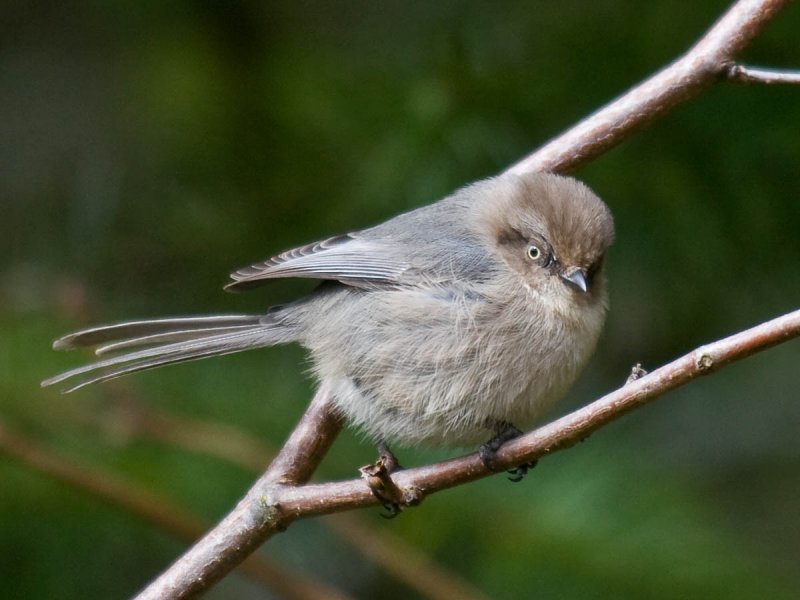
BushtitBushtit, Hagg Lake, Oregon, 11 March 2011 by Greg Gillson.


This is the brown-headed California race, common west of the Cascades in the Pacific NW.

The pale eye indicates a female.

See a previous post on Bushtits.

Wednesday, April 20, 2011

Recent sightings with eBird

Birders want to know: 'What birds have been seen in public locations near my home recently?'

eBird answers this with a Google Gadget.

Directions for creating your own Gadget on your web page (or desktop) are at Birding is Fun!.

My attempt is below.

This tool lists the most recent 7 days of bird reports for public eBird Hotspots in Washington County, Oregon. eBird data is updated periodically, thus the very most recent sightings may be delayed.

Not totally bug free, if Google Maps doesn't show Washington County correctly (Showing instead "Coffeeville Country Club, Kansas"), you may need to add the closing parenthesis [')'] to the navigation bar of Google Maps and hit enter.


Have fun with this!

Monday, April 18, 2011

At the pond... American Wigeon

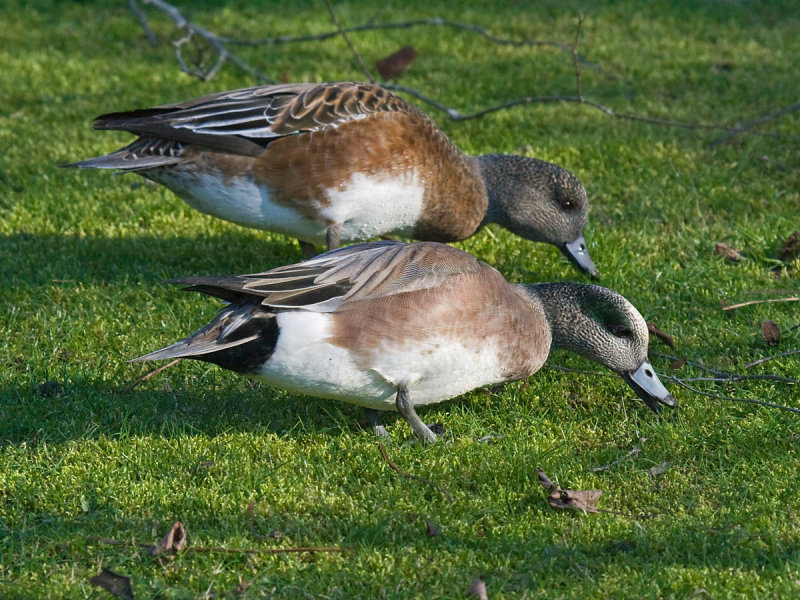
American WigeonAmerican Wigeon, drake front, hen rear, Beaverton, Oregon, 2 February 2011 by Greg Gillson.


This duck is second only to Mallard in population of migrant and winter ducks in the Pacific Northwest.

It also breeds in smaller numbers here, primarily east of the Cascades. Otherwise, it is a widespread breeder from Alaska, across Canada, and into the prairie states.

Unlike most other dabbling ducks, wigeon are grazers, feeding on tender grass shoots. Thus, you can find them grazing in city parks with ponds and lawns, as in the photo above.


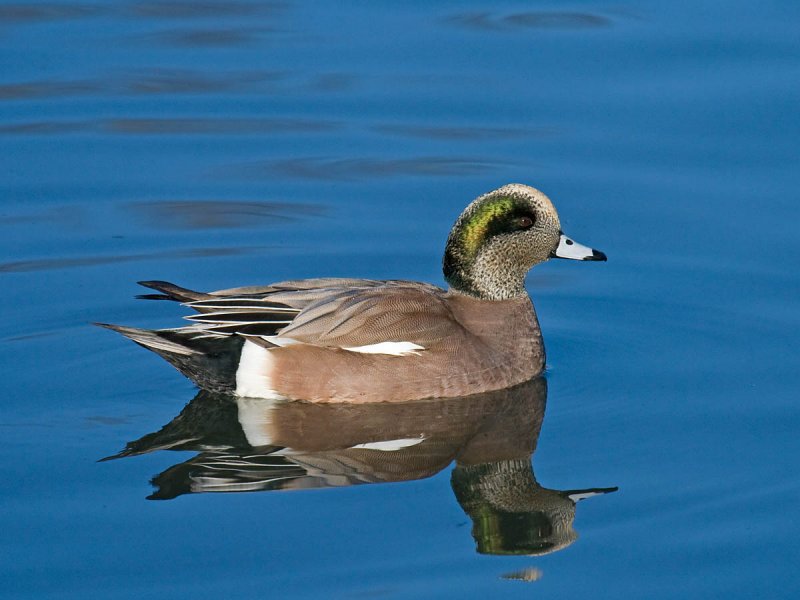
American WigeonDrake American Wigeon, Beaverton, Oregon, 2 February 2011 by Greg Gillson.


There is an iridescent greenish patch of feathers around and back from the eye. The amount of dark freckling on the face of drake American Wigeons varies greatly. Some birds have mostly white or cream-colored heads. Others have fairly dark faces with a cream crown.

The voice of drake American Wigeons is a distinctive 3-part wheezy-whistled call: zwe-ZWEEE-zew. Hens utter a quiet "quack."