This post continues the discussion of the Seven methods of identifying birds.
[Answer to Quiz 2: American Avocet]
Feather-by-feather analysis
In several families of birds, identification is aided or clinched by noting either individual feathers or feather groups. Such is the case for gulls and shorebirds. Sometimes in-field study of the specific feather group patterns can determine age, which then eliminates other certain species at the same or different age.
When you are discussing scapulars or tertials or molt, you are using this method of bird identification.
Quiz) The internal pattern on the tertials of juveniles of this long-billed shorebird easily separates these two species.
Next: Sounds
Sunday, May 15, 2011
Friday, May 13, 2011
Seven methods of identifying birds:
#2: Structure
This post continues the discussion of the Seven methods of identifying birds.
[Answer to Quiz 1: Western Tanager]
Structure:
The end plates of the Peterson field guides are silhouettes: "Roadside Silhouettes" and "Shore Silhouettes." These show size and shape among most of the different orders of common birds.
The section "How to Watch Birds" in Peterson's field guides gives an excellent primer on structure of bill, tail, and wing. Don't skip the introductory material in field guides!
Earlier this spring I wrote a post, Dabbling duck silhouette quiz, which uses shape alone to identify female ducks.
Quiz) This medium to large slender bird has extremely long legs, very long neck, and long, thin, upturned bill.
Next: Feather-by-feather analysis
[Answer to Quiz 1: Western Tanager]
Structure:
The end plates of the Peterson field guides are silhouettes: "Roadside Silhouettes" and "Shore Silhouettes." These show size and shape among most of the different orders of common birds.
The section "How to Watch Birds" in Peterson's field guides gives an excellent primer on structure of bill, tail, and wing. Don't skip the introductory material in field guides!
Earlier this spring I wrote a post, Dabbling duck silhouette quiz, which uses shape alone to identify female ducks.
Quiz) This medium to large slender bird has extremely long legs, very long neck, and long, thin, upturned bill.
Next: Feather-by-feather analysis


Wednesday, May 11, 2011
Seven methods of identifying birds:
#1: Color and pattern
This post continues the discussion of the Seven methods of identifying birds.
Color and pattern:
This is the basis of the "Peterson System" of bird identification. The Peterson System illustrates birds all in the same pose, with patternistic drawings. Arrows then point to the unique area of color or pattern on a bird that separate it from similar species. Wing bars, eye rings, eyebrow stripes, tail spots, and all such feather groupings are used in a stylized way to aid identification. Ingenious.
Newer birders start here. Sadly, many never advance because they don't learn the remaining methods of identifying birds. And it doesn't help that some "field guides" are arranged by color, effectively preventing bird watchers from advancing further.
Quiz) A yellow bird with black wings and tail and red face.
Next: Structure
Color and pattern:
This is the basis of the "Peterson System" of bird identification. The Peterson System illustrates birds all in the same pose, with patternistic drawings. Arrows then point to the unique area of color or pattern on a bird that separate it from similar species. Wing bars, eye rings, eyebrow stripes, tail spots, and all such feather groupings are used in a stylized way to aid identification. Ingenious.
Newer birders start here. Sadly, many never advance because they don't learn the remaining methods of identifying birds. And it doesn't help that some "field guides" are arranged by color, effectively preventing bird watchers from advancing further.
Quiz) A yellow bird with black wings and tail and red face.
Next: Structure
Monday, May 9, 2011
Seven methods of identifying birds:
Introduction
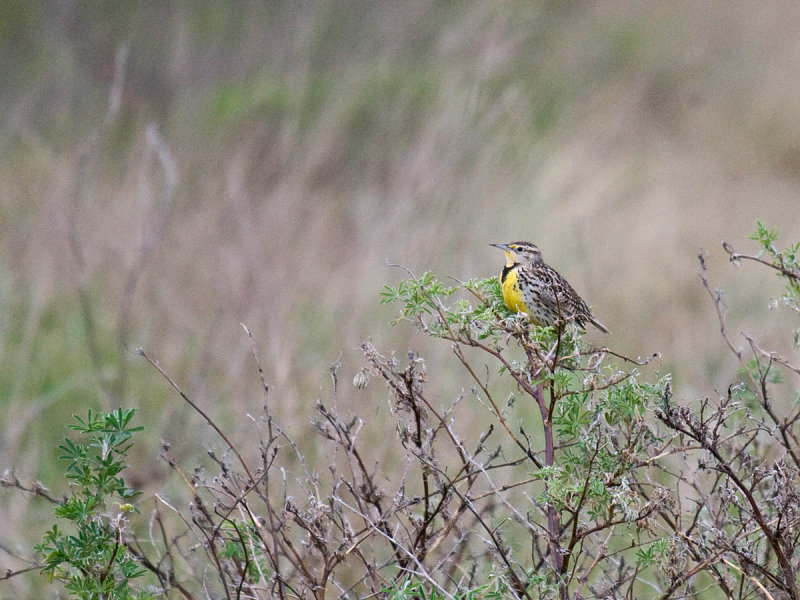 Western Meadowlark at Newport, Oregon on 7 March, 2010 by Greg Gillson.
Are you amazed at the skill of some birders in identifying quickly-viewed and distant birds? Whether they know it or not, they are likely using a combination of up to 7 different methods in identifying birds.
Would you like to improve your bird identification skills? Then you will want to use all 7 of these clues that birds give to you.
In fact, you may already be using these methods to a small degree.
In each of the discussions that follow there will be a quiz example of each method. See how many of the quiz birds you can identify. Then practice and hone your skills by concentrating on using each of these different methods on every bird you see.
Next: Color and pattern
Sunday, May 8, 2011
What makes Mount Tabor such a good place for migration?
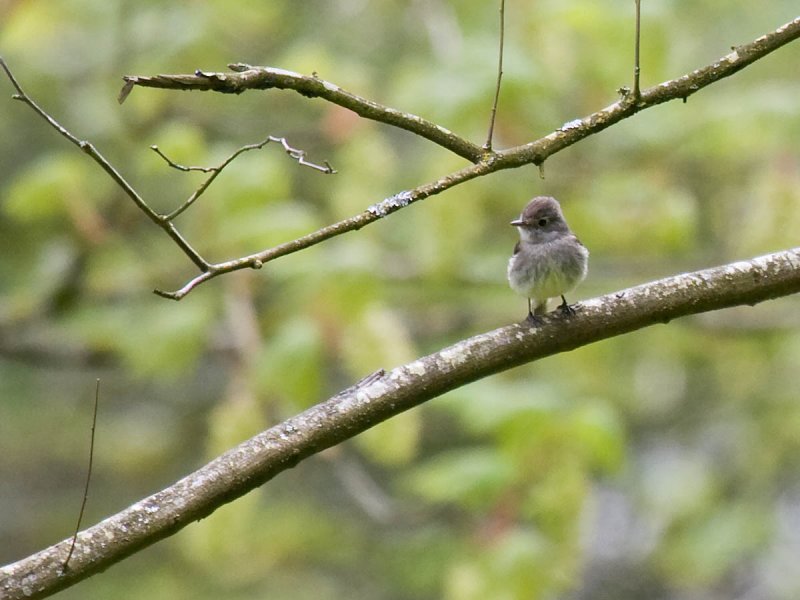 Dusky Flycatcher, a rare spring migrant west of the Cascades, Mount Tabor, Portland, Oregon, 7 May 2011 by Greg Gillson.
Yesterday I talked about Mount Tabor park in Portland, Oregon. I asked: "What makes Mount Tabor so good for Neotropical migrants? When is the best time to visit?"
The information here applies specifically to spring migration in the lower valleys west of the Cascades in the Pacific Northwest. But it also applies more generally to the entire the West Coast.
The insectivorous Neotropical migrants that breed in or migrate through the Pacific NW--warblers, vireos, tanagers, orioles, buntings, grosbeaks, flycatchers, and others--winter in western Mexico or central America. As days become longer and spring arrives, with trees leafing out and insects hatching, bird migration begins.
The first migrants arrive in mid-April (swallows by April 1), but many do not arrive until early May--each species is different (and predictable). Migration is usually over by the first week of June. In most species, adult males arrive first, adult females a few days later, and first-year birds (hatched last year) often a bit later.
Birds migrate first through the warmer lowlands, then move north or upslope as it becomes warmer. So, for instance, migrants may appear on the coast first, western valleys next, east of the Cascades later, and the mountains lastly. In years with heavy snow pack, mountain breeders may remain unseasonably late in nearby lowland areas (into June).
In general, a species of bird will arrive in Eugene, Oregon a week before Portland. Then a week later they arrive in Seattle. It seems there are always a few scouts--individual birds well in advance of the main movement. Finding these first of year (FOY) migrants is a fun challenge for many birders.
These birds migrate primarily at night. They don't want to fly into strong headwinds, thus wait for winds from the south. In the Pacific NW, that means unsettled weather in spring. Clear skies in spring are accompanied most often by cold winds from the north, impeding migration.
If a cold front is over you at dawn, all migration will stop at this front--you'll have an incredible "fall out" of migrants. So, wise birders watch the weather and weather maps in spring.
Migration proceeds in "waves" as the weather promotes or impedes migration.
But why is the city park of Mount Tabor so good for migrants?
Mount Tabor's top is just over 600 feet elevation. This old volcanic cone, now covered in trees, rises sharply 400 feet higher than the surrounding city of Portland. When dawn ascends, migrating birds over the industrial, commercial, residential landscape of Portland see the green slopes of Mount Tabor and land there. It is an island effect.
As the sun hits the eastern part of the mount first, insects wake up and warm up there first. As the warm air rises, insects move upslope. So migrant bird activity is often most observed first on the east and southern exposures near the top of such hills where the tired and hungry birds have a needed food source. In order to see birds best, it helps to have openings, such as a clearing or parking lot near the top of such hills.
So, what time of day are we talking about? Soon after dawn. In early May, arrive by 7 am on cloudy days, earlier if sunny. By 9:00 am, activity may be over. Birds have eaten, so they sleep the rest of the day away, preparing for the next night's migration to continue on their journey.
Subscribe to:
Posts (Atom)