Wednesday, May 25, 2011

Seven methods of identifying birds:
Conclusion

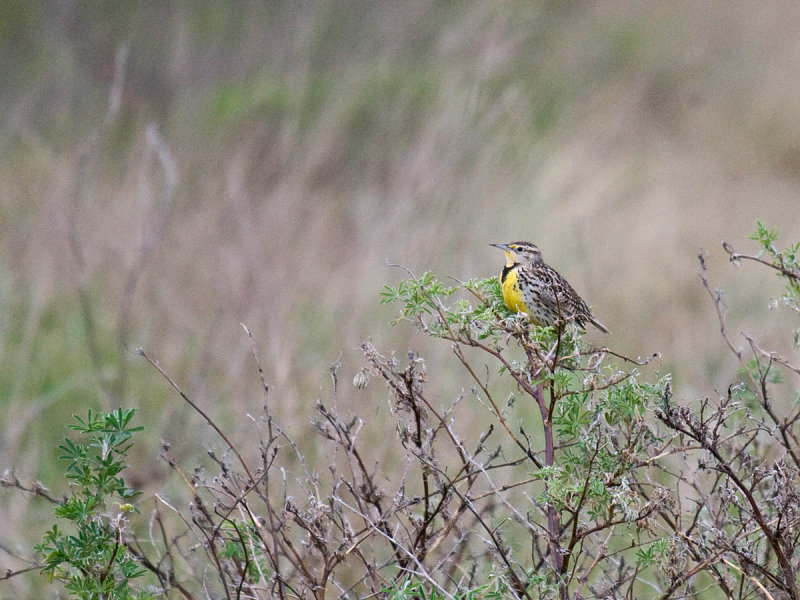
Western Meadowlark Western Meadowlark at Newport, Oregon on 7 March, 2010 by Greg Gillson.


We have now concluded the Seven methods of identifying birds.
[Answer to Quiz 7: Turkey Vulture]

To improve your bird identification skills you will want to practice using all 7 of these clues that birds give to you.

How did you do on the quizzes? They were designed to be fairly easy and to show that you already use these 7 methods to some degree.

Remember that your view may not allow you to identify the bird to species with each method. In some cases you may get to just the family, such as nuthatch or gull.

Obviously, if the bird doesn't sing or fly while you observe it, you can't use that method this time.

Let's review, using the bird in the above photo.

The Western Meadowlark in the photo above can be identified using all 7 methods.
1: Color and pattern-- The yellow breast with black breast band instantly identifies this bird as a meadowlark.
2: Structure-- The flat head with sharp pointed bill nearly as long as the head, plump body, and short tail identify this bird as a meadowlark.
3: Feather-by-feather-- The yellow on the submustachial stripe identifies this bird as Western Meadowlark, rather than Eastern Meadowlark. Also, if you could see the outer 3rd tail feather, it would have much less extensive white on it than an Eastern Meadowlark.
4: Sounds-- The flute-like song of Western Meadowlark is quite different from the rising and falling whistle of Eastern Meadowlark.
5: Expectation-- No Eastern Meadowlark has ever been found in the Pacific Northwest. Any meadowlark here must be Western Meadowlark--though you are certainly welcome to look.
6: Behavior-- Lone or paired pudgy, short-tailed birds sitting rather horizontally on a fenceline or telephone wire in open country will separate most meadowlarks from similarly sized and shaped birds, including starlings.
7: Flight-- Meadowlarks fly distinctively in rather level flight with periodic bursts of flapping and brief glides on rounded wings.

Monday, May 23, 2011

Seven methods of identifying birds:
#7: Flight style

This post continues the discussion of the Seven methods of identifying birds.
[Answer to Quiz 6: American Dipper]

Flight style

Flight is such an important behavior that I consider it separately. How fast are the wing beats? Are the wing beats continuous or with a pause between bursts? How far above and below the body do the wing strokes go? Is the flight progression straight, undulating, or irregular? Are the wings rounded or pointed? Are the wings held straight out or forward at the wrist and swept back?

Does the bird fly in a flock or singularly? Is the flock 'v' shaped, rounded, or a straggling line?

For more information see the article on separating Cedar Waxwings and Starlings in flight.

Quiz) This bird soars unsteadily for long periods of time, with its wings in a dihedral.

Next: Conclusion

Saturday, May 21, 2011

Seven methods of identifying birds:
#6: Behavior

This post continues the discussion of the Seven methods of identifying birds.
[Answer to Quiz 5: Western Meadowlark]

Behavior

Observing how birds behave can quickly narrow down a bird to the correct family. Then, even if you don't see all the plumage field marks, you can still identify it based on minimal plumage patterns, but well-seen behavior. For instance, though Hutton's Vireos and Ruby-crowned Kinglets are very similar in plumage, their behavior is enough to separate them.

Does the bird walk or hop? Does it flick its wings or wag its tail? Does it pick at the surface or probe deep into the mud? Does it hitch itself up the tree using its tail as a prop or walk freely?

Quiz) A bird bobbing on a rock in the middle of a mountain stream in the West, walks into the water and disappears below the surface.

Next: Flight style

Thursday, May 19, 2011

Seven methods of identifying birds:
#5: Expectation: Status, Distribution, Habitat

This post continues the discussion of the Seven methods of identifying birds.
[Answer to Quiz 4: American Bittern]

Expectation: Status, Distribution, Habitat

When you see a bird it is not usually necessary to compare it with every bird in the world in order to come to a reasonably accurate identification.

Each continent and bioregion has primarily unique bird species.

During the year, the amazing miracle of migration will mean that at some times of year, certain birds are just not present locally at all, even if common at another time of year.

You wouldn't look for a rail in a tree, or a woodpecker diving into a lake.

Quiz) A flock of meadowlarks in Montana.

Next: Behavior

Tuesday, May 17, 2011

Seven methods of identifying birds:
#4: Sounds

This post continues the discussion of the Seven methods of identifying birds.
[Answer to Quiz 3: Short-billed and Long-billed Dowitchers]

Sounds

Some birds sing to attract a mate or declare their territory. Some birds have alarm calls, feeding calls, and flight calls--all different. In woodpeckers, drumming takes the place of song, and the drumming pattern of many woodpeckers are unique. Certain birds make distinctive sounds with their wings or tail feathers.

Some people do have poor hearing. But most people just need practice listening. You already know some bird sounds, even if it is only Old MacDonald who has a duck that goes "quack, quack." Build from there. Find a sound you don't recognize and track it down. Add it to your auditory birding repertoire.

Quiz) A deep, resonating, bubbly "oong-ka-loonk" coming from a grassy marsh in spring.

Next: Expectation: Status, Distribution, Habitat