I've been thinking quite a bit, lately, about how birders identify birds. Well, actually, by "lately" I mean the past few years--but more so in recent months.
Two blogs discussed this topic in June. A post by Blake Mathys on the ABA blog (How do we identify birds?) and by Ann Nightingale and Dave Irons on the BirdFellow blog (The Recognition vs. Identification Gap) provide an introduction to this topic.
My thoughts ponder the following types of questions.
Why can one person accurately identify a distant and poorly-glimpsed bird, while the person next to him, with the same view and apparently equal field experience and desire to identify birds, has no idea what the bird might have been?
Everyone does it; it's not just beginners who misidentify birds. Why do some experienced birders, who know all the correct field marks, sometimes badly misidentify a common and well-seen bird?
Why does a bird photo sent to the local bird discussion list generate so many diverse (and strongly held) opinions about what it is--even though it is unambiguously identifiable?
I think the answer to these questions comes down to two different reasons.
One reason is that some birders recognize birds based on clues in addition to the standard "field marks" listed in the book. Besides the plumage description (color pattern, wingbars, etc.) in the field guide, each bird comes with a certain shape, a set of behaviors, a certain habitat and specific niche within that habitat. Flying birds have a characteristic flight pattern. And most birds are not silent. And we're seeing them on a certain date, a specific season or time period during the year. (Birds in photos lack these supporting additional clues, thus why they sometimes fool even the best birders.)
Of course, each birder brings with them their own unique set of experiences with the birds they've seen in the past. Certainly, the more time in the field each birder has, the more opportunity they have to form patterns of bird recognition. Thus, to get better at bird ID, spend more time watching birds. (Duh.)
But to a large degree, shape, habitat, niche, behaviors, flight style, songs and calls, and status and distribution can be precisely described--they aren't totally subjective. They can be taught and can be learned--even without direct field experience with the bird under consideration. [See the series of posts: Seven methods of identifying birds.]
Oh, and the second reason some birders have trouble getting to the "advanced" level (meaning quickly and accurately identifying nearly every bird they see)? A future post ("Advanced birding means learning the basics") discusses this.
Saturday, October 1, 2011
Monday, September 26, 2011
ABA blog: Ten Ways to be a Better Birder
A recent post by Ted Floyd on the ABA blog was quite interesting. Titled "Ten Ways to be a Better Birder," the article makes for some thought-provoking reading.
Some of the things you have no control over. For instance, you can't go back and start birding at a younger age.
But I think that point number 5, on understanding status and distribution, is worthy of a future discussion. So also are points number 2-4, learn vocalizations, understand behavior, and put down your binoculars ("go naked").
Some of the things you have no control over. For instance, you can't go back and start birding at a younger age.
But I think that point number 5, on understanding status and distribution, is worthy of a future discussion. So also are points number 2-4, learn vocalizations, understand behavior, and put down your binoculars ("go naked").


Friday, September 23, 2011
eBird updated!
I had a nice surprise this morning when I logged into eBird to upload a few birds seen at my feeder.
The eBird team has updated the "View and Explore Data" page with some long-requested features.
Now, you get the same maps whether you view maps directly for one species, or make bar charts for a region or area. Good, zoom out to see the world range and zoom in to see the individual sightings. Better, click on the individual sighting locations to see when and who has seen the species at that location in the past. Best, click on an individual record and see that person's entire checklist for the day!
These changes really make 'viewing and exploring data' useful and addicting!
Well done, eBird!

The eBird team has updated the "View and Explore Data" page with some long-requested features.
Now, you get the same maps whether you view maps directly for one species, or make bar charts for a region or area. Good, zoom out to see the world range and zoom in to see the individual sightings. Better, click on the individual sighting locations to see when and who has seen the species at that location in the past. Best, click on an individual record and see that person's entire checklist for the day!
These changes really make 'viewing and exploring data' useful and addicting!
Well done, eBird!
Wednesday, September 21, 2011
Wrentit
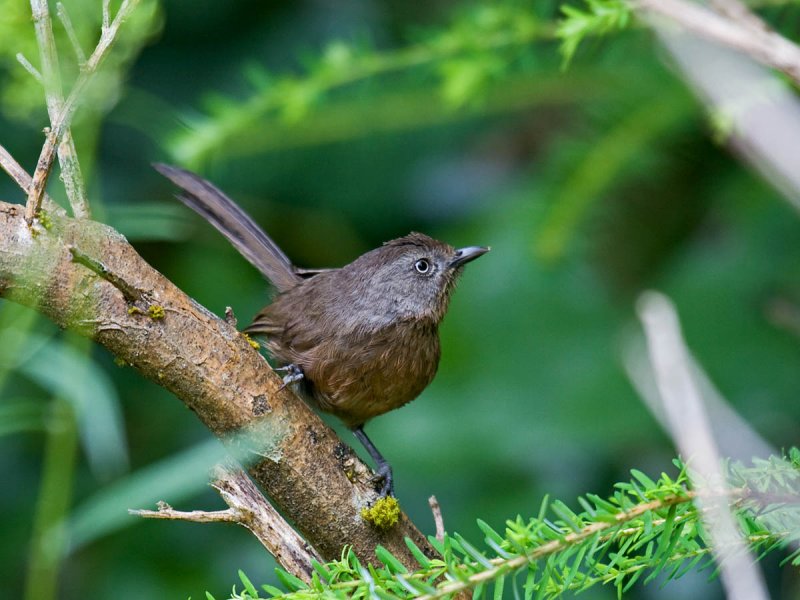 Wrentit, near Lincoln City, Oregon, 30 July 2011 by Greg Gillson.
The Wrentit is a small little mouse of a bird found in coastal scrub and chaparral from extreme northern Baja California Norte to the mouth of the Columbia River in Oregon. It stays hidden and fly-hops from branch to branch, rarely crossing an opening. If it wasn't for its bouncing whistled song and quiet rattling call, no one might ever know it existed!
In the Pacific NW it is only found in Oregon, along the entire coast, inland in clearcuts nearly to the summit of the Coast Range. It is found in SW Oregon inland in the California-type vegetation habitats of the Rogue Valley and Klamath Mountains to Klamath Falls.
In the past century it has slowly expanded its range. It has crawled its way northward in western Oregon to the Umpqua and edges of the southern Willamette Valley. In the past decade or two it has colonized new locations along the edges of both the eastern and western edges of the mid-Willamette Valley. Imagine everyone's surprise when they showed up in the last year at the mouth of the Sandy River into the Columbia east of Portland!
Will it ever cross the Columbia into Washington State? Well, it has been common in Astoria for at least 200 years and hasn't crossed the River, nor even expanded upriver toward Portland. The recent birds in Portland evidently came from the south, not the west.
The bird is not closely related to any other bird in the New World. At present, it is listed with the Old World Babblers--the only New World representative in that group.
Sunday, September 11, 2011
Bird Watcher, Birder, Ornithologist--Who cares?
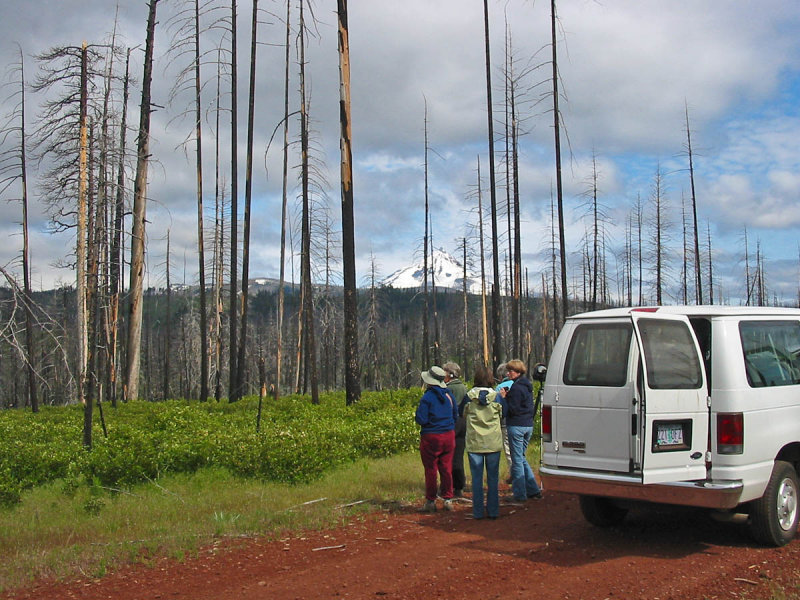 People watching birds--whatever you call it--at Abbott Creek Burn, Jefferson County, Oregon, 7 June 2009 by Greg Gillson.
It's a perennial discussion. What do bird watchers call themselves? Although you would think that it is silly and doesn't matter, the name we associate with ourselves is very personal and self-defining. Such discussions can be quite emotional.
Recently, there has been discussion of changing the name of the Oregon Field Ornithologists in order to possibly increase membership. It seems that many bird watchers think that this birding organization is only for professional biologists. Not even close to true. Likewise, the organization that is the very definition of the word "birder," the American Birding Association, still wrestles with the word, as it did from its very inception. Having "birding" in its name does not keep the ABA from losing membership in the Internet age.
Very broadly, anyone who watches birds is a bird watcher. The old man that feeds bread to the ducks at the local city park, the neighbor with the empty hummingbird feeder hanging outside the window, visitors to the wildlife refuge to view the Bald Eagles, and the enthusiast who plans her third trip to Borneo this year just to view that one species missing from her huge list of birds she has seen in the world--all these are bird watchers.
Though not without argument, the term that describes a person who searches out and tries to identify all the birds they see, is usually called a birder. Birding often (but not always) includes listing--keeping careful track of birds they see, ticking them off on their list(s). There are life lists, country lists, state lists, county lists, backyard lists, and year lists of all these types and more. A friend once compared it (without bias) to stamp collecting. Birders are concerned with identification and distribution of birds in order to find (collect sightings of) them.
Field ornithology is the study of living birds in their natural habitat. Population status, behavior, and nesting are some of the topics of field ornithology. Recording data (including counting the number of individual birds seen) is a major component of field ornithology.
So, if you like to watch birds and desire to know their names you can be considered a birder. If you have ever participated on a Christmas Bird Count or breeding bird atlas, helped create a park checklist, or submitted sightings to eBird, you are, in fact, participating in a field ornithology activity.
Oregon, Washington, and British Columbia all have their Field Ornithology organizations. These are primarily birding organizations. They host their respective Bird Records Committees, which keep track of, and sanction, the official state bird list and vet rare bird sightings. They often produce a periodical that includes an updated state bird checklist, a comprehensive list of recent bird sightings, details about rare birds discovered, site guides to relatively unknown birding locations, and identification articles.
If you want actual field ornithology, then the East Cascades Audubon Society in Bend, Oregon does many more field ornithology projects than many state field ornithology organizations. Of course, Audubon Societies, in general, are environmental advocacy organizations that have membership primarily made up of the generic "bird watchers" and birders, and very few actual biologists or professional ornithologists.
So, no matter what you call your bird watching activities, you're probably also participating in birding and field ornithology.
Subscribe to:
Posts (Atom)