Showing posts with label American Dipper. Show all posts

Friday, February 17, 2012

Winter Wings Festival: Day 1

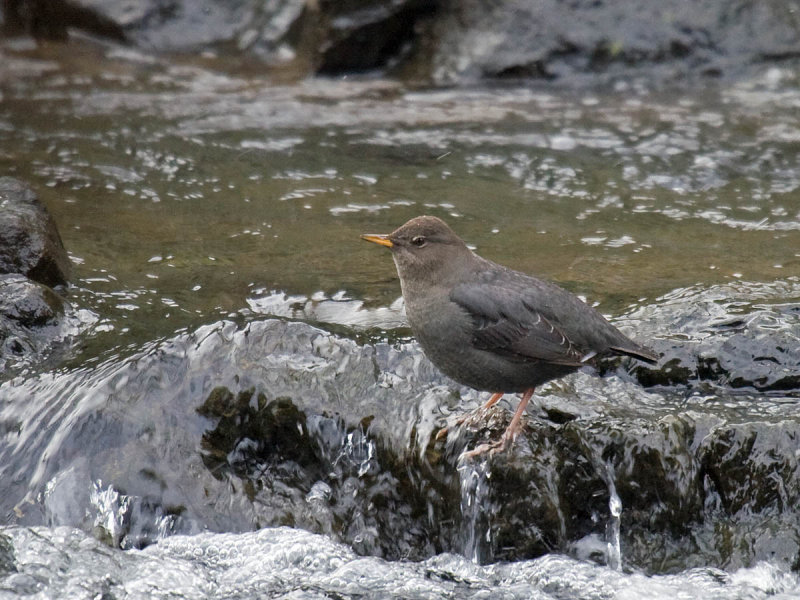
Collier State Park, Klamath County, Oregon, 17 February 2011 by Greg Gillson.


I don't attend very many bird festivals. The Oregon Shorebird Festival in fall is the one I usually attend, as The Bird Guide coordinates pelagic trips for that.

But I was asked to come to the Winter Wings Festival and present a slide show on pelagic birds off the Oregon coast, which I will do Sunday morning.

So I ventured out of my comfort zone, and headed up over the Cascades in winter to Klamath Falls. At 5000 feet elevation on the Willamette Pass, I was worried. But instead of 8 feet of snow there was only 8 inches! Roads were bare and the temperature was 45F--the same as in Portland! This is important as I don't winterize my cars with show tires and such. Nor do I "summerize" my car either (we only had 2 days over 90F this past summer, so no need to fix the leak in the car's air conditioner). But I digress.

I stopped at Collier State Park north of Klamath Falls about 30 miles. Not too many birds. But I did come across an obliging and out-in-the-sun American Dipper!

Tonight's BBQ Banquet was wonderful at the festival. And I listened to a presentation on citizen science by a member of the Klamath Bird Observatory.

Tomorrow I hope to do some more birding and photography. In the evening I will go to another banquet and Kenn Kaufman's keynote: "Kingbird Highway and Extreme Birding in Another Era."


American Dipper, Collier State Park, Klamath County, Oregon, 17 February 2011 by Greg Gillson.


Monday, November 29, 2010

American Dipper... North America's only aquatic songbird

American DipperAmerican Dipper at Hagg Lake, Washington Co., Oregon on 24 November 2010 by Greg Gillson.


Some birds are very difficult to photograph. At least, I've had some trouble. One of those is the American Dipper. These gray aquatic songbirds live along rushing streams with steep banks edged by dense forest. So they are often in shade, with bright reflections off the water. The shade requires a slower shutter speed. Any shafts of sunlight are over-exposed. Slow shutter speed also means the bird must be still. And dippers got their name for their constant dipping, bouncing 40-60 times per minute on their legs even when standing in place.

On November 22 we got our first snow of the season. It wasn't much, as typical for western Oregon, just a bit as rain showers all week were pushed south by a cold front and the dry air behind it. By November 24 the roads had dried, the icy roads had mostly cleared. I went up to Hagg Lake at the edge of Oregon's Coast Range about 30 miles west of Portland.

At the upper end of the lake I stopped briefly to see if the resident pair of American Dippers were present at the Scoggins Creek Picnic Area, where this creek enters the reservoir. The birds were there, swimming and diving in the water, so I got my camera out. The leaves of the maples and alders were gone, and the quarter-inch of snow brightened up the creek under the western red-cedar and Douglas-fir. So I sat on a rock at the edge of the creek about 20 feet from the ledge where two birds were diving for caddisfly larvae--their favorite food.

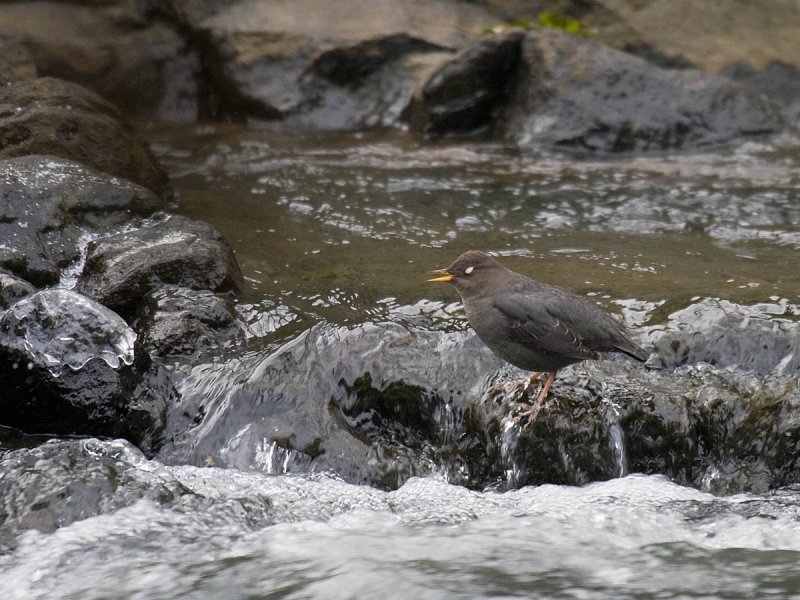
Then something wonderful happened. The bird pictured here began his long, warbling, high-pitched song. It wasn't as loud as it will be in a couple of months, but clearly heard above the roar of the creek. It is not unusual to hear dippers singing throughout the year. But the bright cascading trills and sweet notes brightened the cold overcast winter day, when most other birds were silent.

Another thing that can ruin a good photo of a bird is the inner eyelid, the nictitating membrane. In some birds it is transparent, but is opaque in the American Dipper, as seen in the photo below, creating a vacant-eyed "Little Orphan Annie" appearance.


American DipperThe nictitating membrane, or inner eyelid, covers the eye of this singing American Dipper at Hagg Lake, Washington Co., Oregon on 24 November 2010 by Greg Gillson.


The nictitating membrane is under the eyelids. It sweeps across the eye from its base on the bill side of the eye. It allows light to enter. On birds with clear nictitating membranes they can see through it. It is thought many birds fly with their nictitating membrane closed--to keep the air from drying out the cornea. The well-developed nictitating membrane protects the eye of the American Dipper from the spray of water (The Audubon Encyclopedia of North American Birds, 1980 by John K. Terres).

A year ago I discussed How to find a Dipper nest. There is more information on these fascinating birds there.

Monday, September 14, 2009

How to find a Dipper nest

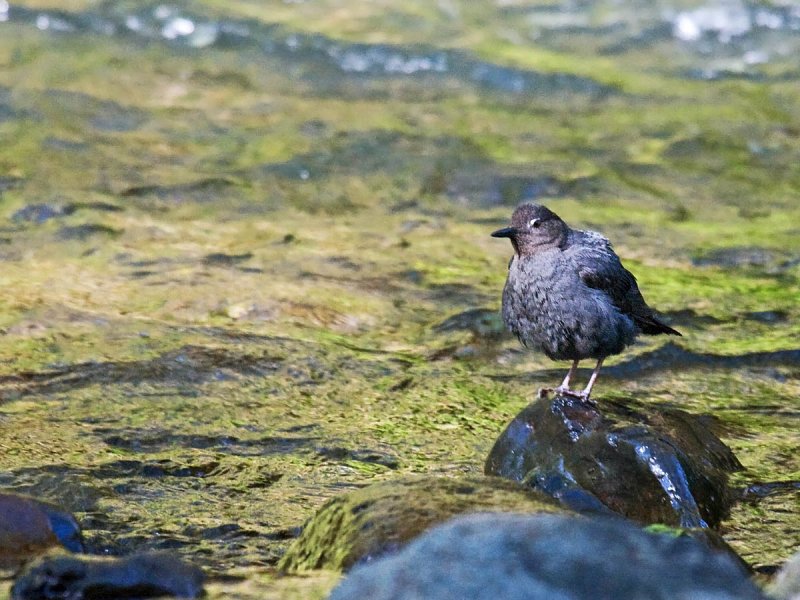
American DipperAn American Dipper stands on a rock amid-stream, near Timber, Washington Co., Oregon on 17 May 2009 by Greg Gillson.


An aquatic songbird! The American Dipper is truly a unique wonder of the American West. Whether floating on the surface like a little gray duck, "flying" under the water like an auklet, or walking along the bottom as easily as if it was a sandpiper on the shore, this odd bird is truly different from all other birds.

It chooses as its home the wildest rapids of a mountain stream. It builds its soccer-sized nest of moss and mud in crevices or logs over waterfalls. It also uses man-made substrates, such as the beams of bridges over rushing water.
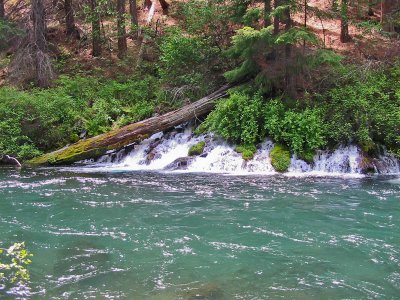
American DipperGushing Springs, Metolius River, Jefferson Co., Oregon on 7 June 2009 by Greg Gillson. An American Dipper has a nest under the fallen log. (Click photo for larger view.)


The photo above shows Gushing Springs on the Metolius River, about 1/2 mile below Cache Creek Campground, near Camp Sherman, Oregon during this spring's Woodpecker Wonderland Bird Festival on the east slope of the Cascades.

The photo below is a close-up view of the nest on the log. You can see a Dipper poking its head out of the nest!

American DipperAmerican Dipper poking its head out of its nest under a fallen log over a roaring stream on the Metolius River, Jefferson Co., Oregon on 7 June 2009 by Greg Gillson. (Click photo for larger view.)


As you might imagine, these streams really roar during the winter when swollen with rain water and snow melt. Thus, last year's nest site may be washed away when the birds are ready to nest again in March and April. It is therefore quite understandable that these birds may choose to nest on beam under a bridge, giving a pair of birds a reliable nest site year after year.

A typical Dipper stream and nesting bridge is shown in the photo below in the northern Oregon Coast Range.
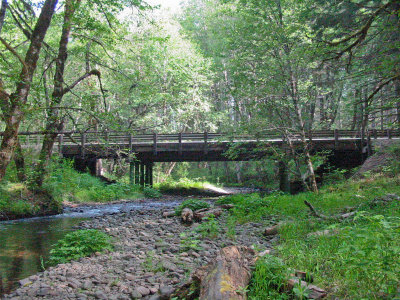
American DipperAmerican Dipper nests in the beams under this bridge near Timber, Washington Co., Oregon on 18 May 2007 by Greg Gillson. (Click photo for larger view.)


American Dippers build their nest on the I-bar bridge support as seen in the photo below. These type of wooden bridge structures seem to be quite popular with the dippers.
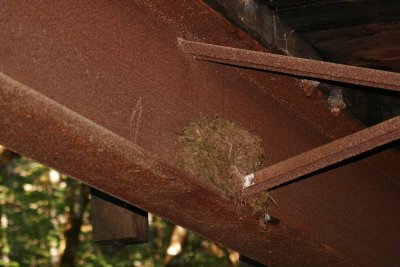
American DipperAmerican Dipper nest under a bridge near Timber, Washington Co., Oregon on 18 May 2007 by Greg Gillson. (Click photo for larger view.)


American Dippers can start nesting as early as February at lower elevations. They may raise a second brood that generally fledges in June.

The photos above show typical Dipper breeding streams as well as nests on natural and man-made structures. With this information you should be able to locate the nests of American Dippers. That is important, as the nest is the center of a Dipper's territory. From the nest, the Dipper's territory extends about 400-500 yards both upstream and downstream. That means that even on the best of streams it is likely there are less than two pairs of American Dippers per stream mile.

Figuring out where the nest might be located can put you near the center of the pair's year-round territory, making it more likely you will spot these unique birds when you visit.