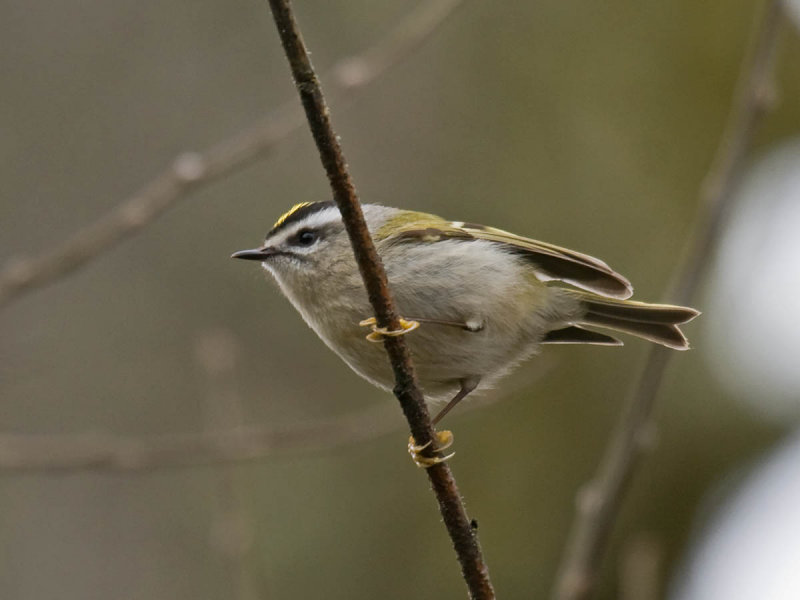
 Golden-crowned Kinglet, Cooper Mountain Nature Park, Beaverton, Oregon, 19 March 2011 by Greg Gillson.
 Tiny little balls of fluff, moving nervously through the forest branches.
Sibilant, soft, high-pitched notes from birds unseen in the tree-tops.
Golden-crowned Kinglets.
Was that a haiku? It wasn't meant to be. Just some brief notes I put down to include in my post, to be finished later. But those sentence fragments capture the impression of these common, yet unfamiliar (to many) birds.
I feel privileged that my "over 50" ears can still hear the high frequency songs and calls of Golden-crowned Kinglets. The National Geographic field guide describes the song as an "almost inaudibly high... series of
tsee notes accelerating into a trill."
And they are truly tiny. At only 4 inches long, they are the same length, bill tip to tail tip, as Anna's Hummingbird, though the kinglet has a larger body and shorter bill and is about 50% heavier, overall. Still, it is 1-1/2 inches shorter than a Black-capped Chickadee.
These little sprites are tough little birds, though, living on bark beetles, scale insects, aphids and their eggs, year-round in the conifer-covered mountains of the West. Some birds move into the lowland woods in winter. Eastern birds breed in the taiga forests across Canada and barely into northern US, including northern Appalachians, and winter throughout the US.
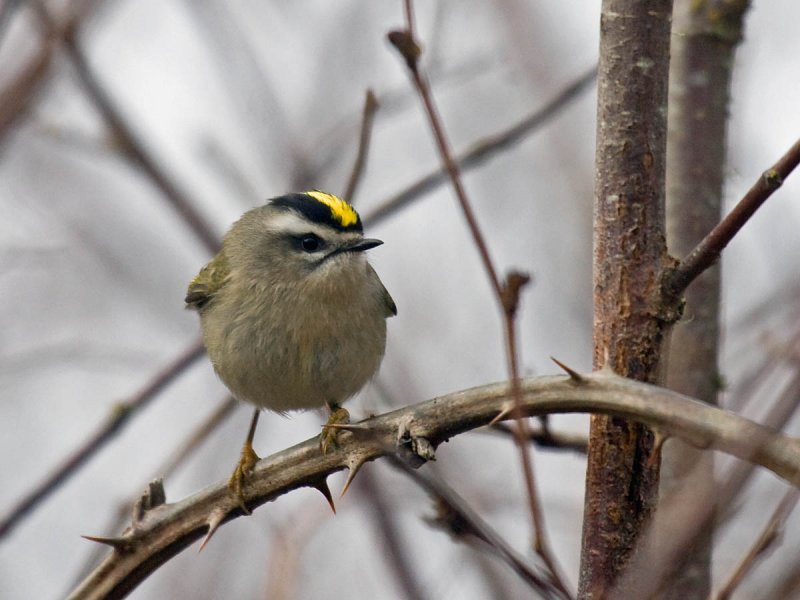 Golden-crowned Kinglet, Cooper Mountain Nature Park, Beaverton, Oregon, 26 January 2011 by Greg Gillson.
 Sexes are similar, though the male has a bit of orange on the crown that is best seen when the crown feathers are raised in agitation.
Those long claws and strong feet are perfect for gleaning insects from the tips of branches. They often hang upside down from branch tips as they search for insects. They may hover-glean, flying in place as they pick at insects.
Constantly on the move in small flocks, they are handsome little birds--a fact only appreciated in these larger-than-life-sized photos of frozen time.
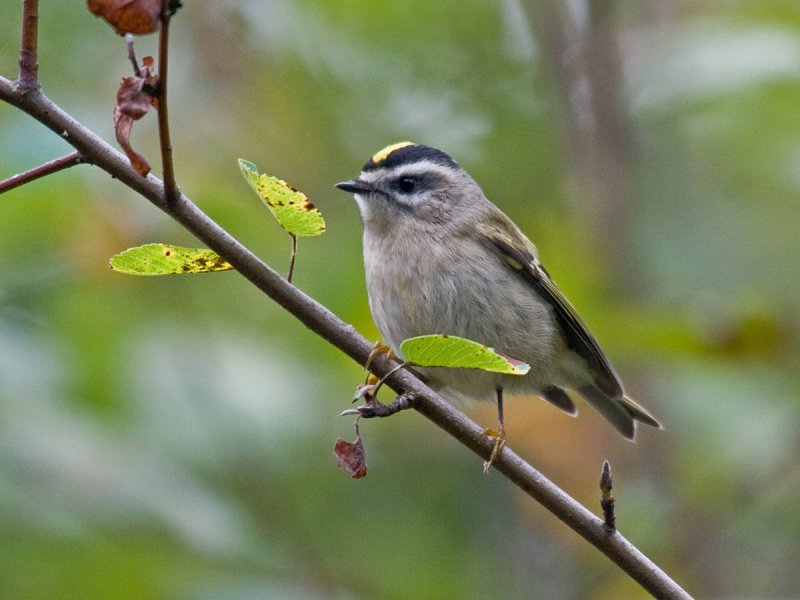 Golden-crowned Kinglet, Cooper Mountain Nature Park, Beaverton, Oregon, 13 October 2011 by Greg Gillson.
