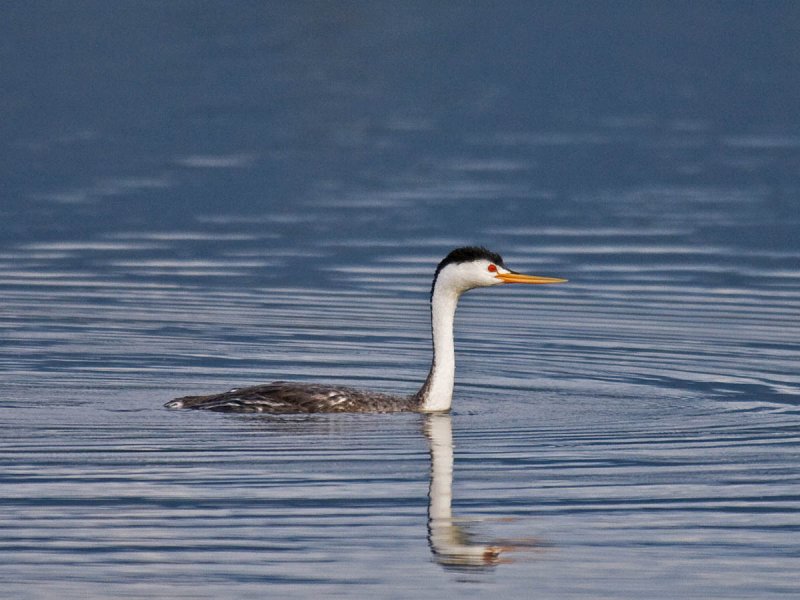
 Clark's Grebe in breeding plumage, Fernhill Wetlands, Forest Grove, Oregon on 5 July 2010 by Greg Gillson.
I don't get to see Clark's Grebes often. They nest primarily east of the Cascades, where I may see them on annual spring visits to Malheur NWR. They tend to winter farther south than Oregon. Thus, I see them only occasionally as edge-of-range migrants, either inland or coastally.
This single bird (above) has been summering near my home for a month now, and I was able to get a few good photos at fairly close range. This was a good opportunity for me to study this bird that is locally rare in NW Oregon.
The Clark's Grebe was originally described as a species in 1858 at the same time as the Western Grebe. Soon thereafter they were lumped together and considered just different color phases of the same species, called Western Grebe. Thus they stayed until 1985, when Clark's Grebe was again given full species status.
Besides plumage differences, which I will discuss below, the Clark's Grebe has a single "kreeek" breeding display call, while Western Grebe gives a two-syllable call of "kree-eek" as they dance across the water together, running side-by-side with their bills held high. Downy young of Western Grebes are gray; downy young of Clark's Grebes are white. Where they occur together (over most of their range, actually), they tend to mate assortively, separating themselves from each other. Hybrids are known, however, and are intermediate in plumage characters.
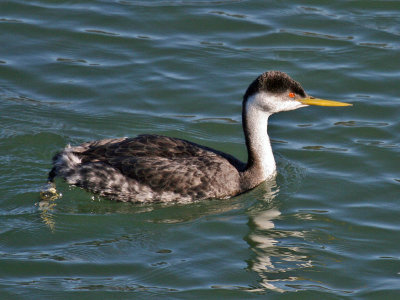
As seen by the above photo, the breeding Clark's Grebe has the red eye surrounded by white feathers of the face. Most importantly, in all plumages, the bill is bright yellow-orange.
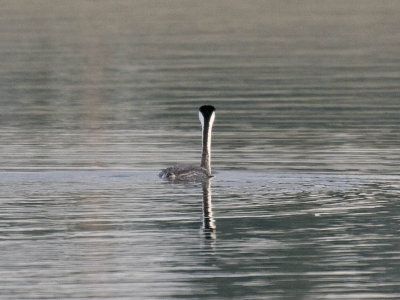 Clark's Grebe, Fernhill Wetlands, Forest Grove, Oregon on 5 July 2010 by Greg Gillson. Click on photo for larger views.
Because some birds appear intermediate, and may be hybrids, there are some supporting identification marks that are important to note. The dark hind-neck is thinner on Clark's Grebe than on Western Grebe. The back and wings tend to be slightly paler on Clark's and one can often note the difference in shade between the black crown and paler lower neck and back (photo above).
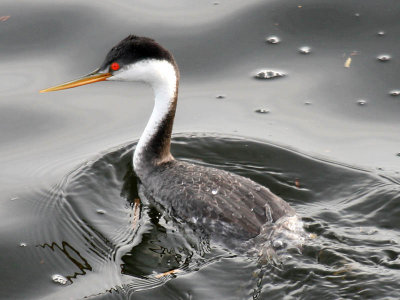 Clark's Grebe in non-breeding plumage, Brownsmead, Clatsop Co., Oregon on 31 December 2007 by Greg Gillson. Click on photo for larger views.
Western and Clark's Grebes are most-similar in plumage during winter. In this third photo (above) note the orange bill color and white triangle on the lores, in front of the eye. This should be enough to identify this bird as Clark's Grebe. In this case, however, the dark hind-neck doesn't appear quite as thin, and the back doesn't appear quite as pale, as typical for most Clark's Grebes.
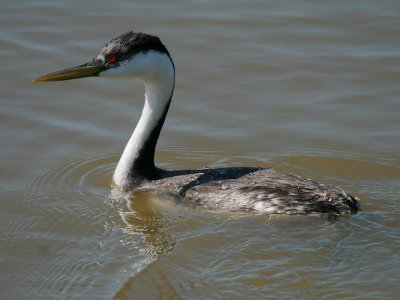 Western Grebe in breeding plumage, Fernhill Wetlands, Forest Grove, Oregon on 15 May 2008 by Greg Gillson. Click on photo for larger views.
This next photo (above) is a Western Grebe in typical breeding plumage. The black of the crown comes down to surround the eye. The lores are dark. The yellowish bill has a definite greenish cast. Supporting marks are the slightly wider dark hind-neck stripe, and darker back.
 Western Grebe in non-breeding plumage, Garibaldi, Tillamook Co., Oregon on 17 January 2009 by Greg Gillson. Click on photo for larger views.
This final photo (above) shows a Western Grebe in non-breeding plumage. It varies very little from the breeding plumage.


-brian-currie.jpg)