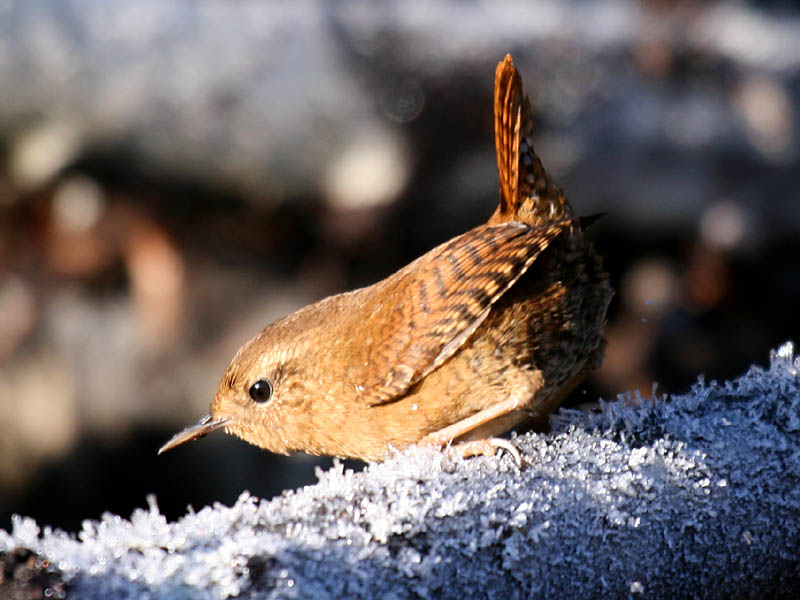
 Pacific Wren, Timber, Oregon, 22 November 2007 by Greg Gillson.
Back in July of 2010 the American Ornithologists' Union (A.O.U.) split the (formerly) holarctic Winter Wren into 3 species: Eurasian Wren (Troglodytes troglodytes), Winter Wren (T. hiemalis), and Pacific Wren (T. pacificus).
The genus name, Troglodytes means someone who lives in a cave--a caveman. It refers to the damp, dark, cave-like root wads and brushy tangles these birds favor.
Here in the Pacific Northwest we have the Pacific Wren. It is a resident bird in damp forests, but we get an influx of winter birds from the north. We have discussed this bird previously, including the possibility of this split, under the former name, Winter Wren.
You can look at a field guide range map and see the different populations in the East and West. However, what I want to show you is your contribution to the range maps. On the eBird site is an animated map of Winter Wren and Pacific Wren in the US.
As the map sweeps through the year, one week at a time, you can see the eastern Winter Wren migrate from the wintering range in the Southeast states to the summer range in just the northern tier of states.
In the West, however, the range of Pacific Wren expands in winter and contracts in summer, but doesn't show north/south migration.
This animated map is only possible because you (the common, everyday, ordinary, bird watcher--no offense intended) use eBird. That map was made with your sightings!

I mean, you do eBird, don't you?
Just as binoculars and field guide has defined a birder for the past 75 years, I believe eBird will define what it means to be a birder in the coming decades. Start now!
You don't want anyone to call you a troglodyte, now, do you?
---
It is my intention, as an eBird convert and champion, to present some ongoing articles on how to use eBird, especially how to get useful and interesting data out of eBird. One of the previous complaints about eBird was that it was (my own former words): "in only." They wanted my data, but didn't give me anything useful back. That has changed. I'll show you how.
See my previous post: What is eBird?