Showing posts with label nectar. Show all posts

Saturday, December 12, 2009

Frozen feeders

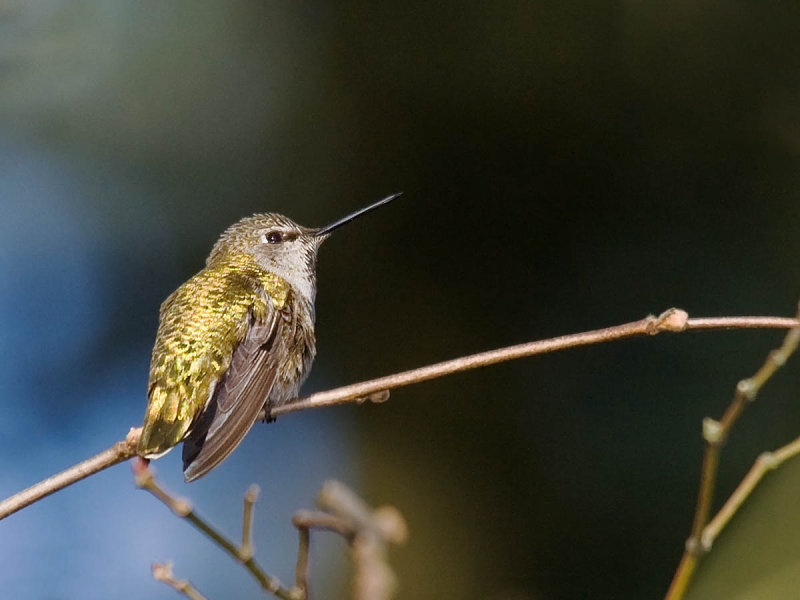
Anna's Hummingbird
We've reached five days in a row now where the temperatures west of Portland, Oregon have not reached above freezing. Water pipes are freezing and people are really bundled up. Clouds have rolled in this Saturday morning, and snow and freezing rain are in the forecast as temperatures rise. After today, rain is the forecast every day for a week.

The photo above is from yesterday, Friday. We have a resident Anna's Hummingbird at our feeder. She defends it from another female and an occasional first-year male. But in this weather the feeders freeze solid in about 4 hours.

The Anna's Hummingbirds are the earliest risers at our feeders, coming in for a drink as soon as there is an orange glow in the eastern sky (as seen in the photo above). They also get a drink at dusk, long after the other birds have left the seed feeders.

How do you keep the feeders from freezing in this weather? Some people hang their feeders near a porch light with a heat lamp in it. In our case, we bring the feeder in at night and put it out before dawn. To keep it from freezing during the middle of the day? We have two feeders and switch them off every few hours as they freeze.

Anna's Hummingbirds are fairly hardy, but like many birds can't survive too many days without liquid water. During these freezing spells, liquid water is more important than food--for all birds.

For more on feeding hummingbirds see the earlier article Bird feeding... Hummingbirds.

Wednesday, April 1, 2009

Bird feeding... Hummingbirds

Anna's HummingbirdFemale Anna's Hummingbird, Rood Bridge Park, Hillsboro, Oregon on 13 March 2009 by Greg Gillson.


The joy of hummingbird watching can be yours quite inexpensively. The Pacific NW has 6 regular species of hummingbirds. Rufous Hummingbirds arrive along the coast in February, and the other inland migrant species return by April. In northern California and from there northward to British Columbia west of the Cascades, the Anna's Hummingbird is a year round resident. It is even found through the year in several towns east of the Cascades with flowering ornamental plants.

Hummingbird nectar is simple: 4 parts water plus 1 part sugar.

Bring water nearly to a boil, then stir in normal table sugar. Make sure all the sugar dissolves. Allow to cool to room temperature. Then fill your hummingbird feeder and hang.

Some tips and myth debunking:

1) Empty the feeder and clean and wash every 3-5 days. Bring down the feeder immediately if the water becomes cloudy (bacteria) or grows dark mold. Use hot soap and water to clean your feeder. If necessary, soak feeder in a mild bleach solution to remove all mold from feeder. Rinse very well before refilling.

2) Fill feeders only full enough to last 2-3 days (bacteria will grow in 3 days if in sun or hot weather). The sugar solution you make will last in the refrigerator a week or two for refills.

3) Never use honey in your hummingbird feeder. The microbes that grow in honey when it goes bad are fatal to hummingbirds.

4) Red food coloring may or may not be bad for hummingbirds, but is totally unnecessary. Most hummingbird feeders have red on them. Do not use food coloring.

5) Feeding birds, including hummingbirds, will not over-power a bird's genetic code to migrate. Remember, Anna's Hummingbirds are year round residents in much of the Pacific NW and can survive several days of snow and freezing weather. Despite all the time they spend at your nectar feeder, the main diet of hummingbirds is insects.

6) Bring hummingbird feeders in at night in subfreezing weather, or hang near a porch bulb to keep it from freezing. But remember, hummingbirds feed most often at dawn and dusk. So wait until dark to take down, and put back up before it becomes light in the morning.

7) Finally, in case you ever were tempted to believe..., no, hummingbirds do not migrate on the backs of geese.