Tuesday, April 7, 2009

At the pond... American Coot

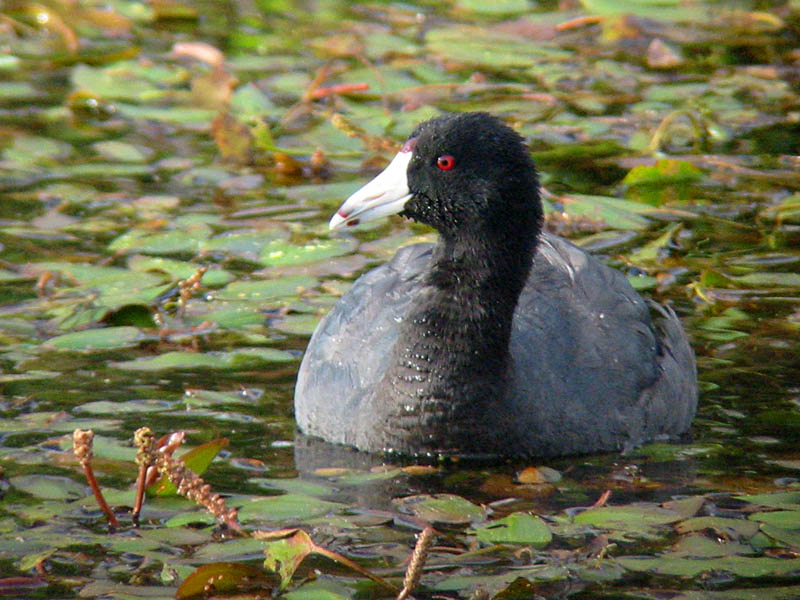
American CootAmerican Coot, Tualatin River NWR, Sherwood, Oregon on 4 August 2007 by Greg Gillson.


At first blush the American Coot appears to be a duck. However, it has a strange white, almost chicken-like bill. One look at the green legs and lobed toes, though, and one quickly realizes it is not a duck!

Rather than a duck-like foot with webbing between the front three toes, each of the coot's long toes have individual web-like flaps to aid in swimming! In this way the feet are lobed similar to those of grebes. However, coots are not closely related to ducks or grebes. Instead, they are more closely related to rails--those secretive marsh dwellers. Coots are very closely related to birds called moorhens or gallinules. Moorhens, though, lack lobes on their very long toes.

There are 11 species of coots in the world, all very similar in appearance. The American Coot has a dark gray body with darker head and neck. The white bill has a dark reddish ring near the tip, and a dark red spot on the forehead frontal shield. The undertail coverts are blackish with white outer patches.

These birds breed widely in marshy wetlands from Alaska to southeastern Canada and southward through Mexico and the West Indies, locally in Central American and Columbia. They build mound nests in the water of cattails and rushes. In winter they use a wider variety of lakes and ponds, withdrawing from the northern portion of their range as these water sources freeze over. During the winter the American Coot becomes even more abundant in the Pacific Northwest, wherever open water remains, especially in coastal estuaries and valleys west of the Cascades and Sierra-Nevada mountains.

To view the feet of coots, visit grassy city parks with a pond in winter. Here American Coots and American Wigeon often graze together on the lawns and become accustomed to close approach by people.

Monday, April 6, 2009

In the backyard... House Finch

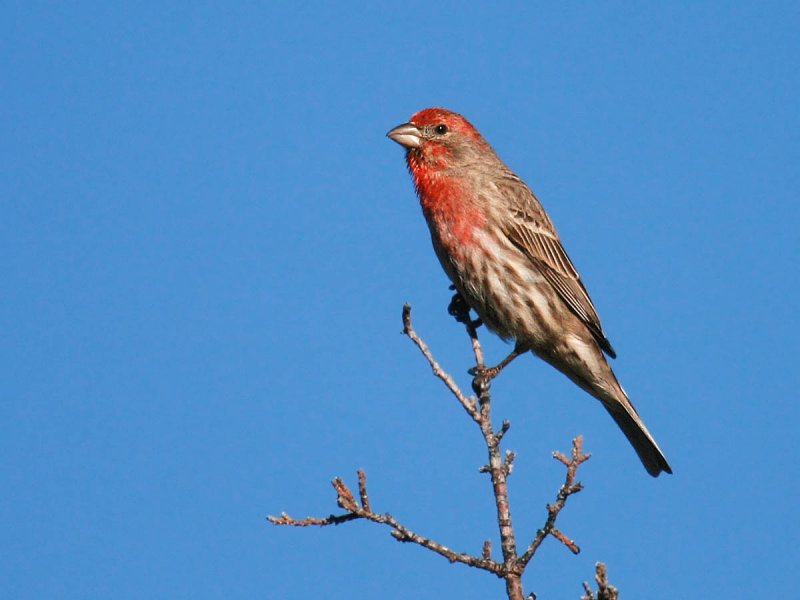
House FinchHouse Finch, Sawyer Park Bend, Oregon on 13 June 2008 by Greg Gillson.


The House Finch enlivens any backyard with the bright red plumage and cheerful rollicking song of the male, and the high-energy antics of the flock at the bird feeder.

Today this species is found in towns across extreme southern Canada and southward across the United States to southern Mexico (Oaxaca). Most birders, however, would be surprised to learn that 70 years ago this finch was restricted to the dry lands of the West. Prior to the 1940's the range of this bird was the arid lands of southeastern Washington, eastern Oregon, southern Idaho, and Wyoming, south through California and New Mexico, and through Mexico.

Wherever towns sprouted up in the West, the House Finch followed. In addition, the House Finch was introduced in the East in the 1940's, and it spread there, as well. Today they can be found in all 48 contiguous states in the US.

While the historical range of House Finch included the Pacific NW, they were not common west of the Cascades until the 1960's, where they are now abundant. They are found in most open habitats, only missing from the deep forests, higher mountains, and extensive grasslands.

Male House Finches are grayish brown above and pale below with strong brown flank streaking, and weak buffy wingbars. Males have red foreheads that wrap around on the eyebrow, red rumps, and red on the throat that often extends to the center of the chest. The amount of red varies between males, as does the exact color, ranging from yellowish to bright red, but usually appears more orangish-red than the look-a-like male Purple and Cassin's Finches, which lack the strong flank streaking. The whole head and shoulders are more pinkish-red on these latter species.

Females are similar to males but lack any red; their faces are rather evenly streaked, without strong eyebrow, ear covert, or moustache stripes that the very similar female Purple and Cassin's Finches show.

House Finches are attracted to seed feeders and may be the primary feeder species throughout the summer in most areas of the Pacific Northwest. Likewise, they form flocks of up to 50 birds in winter, and are a major component of backyard birds in the region.

Saturday, April 4, 2009

In the backyard... Golden-crowned Sparrow

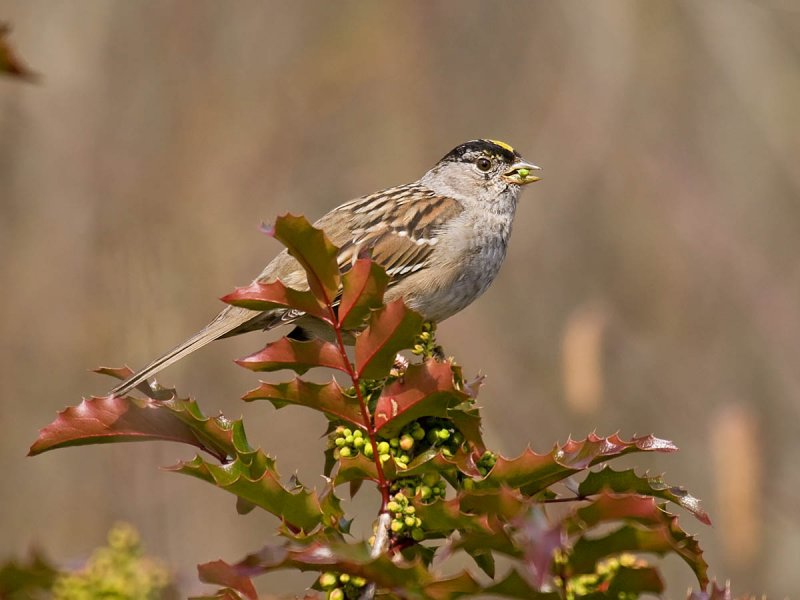
Golden-crowned SparrowGolden-crowned Sparrow, Tualatin Hills Nature Park, Beaverton, Oregon on 13 March 2009 by Greg Gillson.


For most of the fall and winter this large sparrow occurs in rather drab plumage. The first year birds show a diffuse yellow forehead and brownish crown. Winter adults aren't much brighter. But, then, beginning in March (as in the photo above), the birds develop the wide black lateral crown stripe with the golden yellow median for which this bird is named. The birds begin singing in spring, as they make their way north into the mountains. Their song is a three-note plaintive whistle in descending notes, weee peee peer, which some render quite appropriately as: "oh dear me."

In fall and winter, first year Golden-crowned Sparrows might be confused with first year White-crowned Sparrows. However, the White-crowned Sparrows have a more definite brown lateral crown stripe and pale center crown stripe. Also note that the upper mandible of the bill of Golden-crowned Sparrow is dark, while the bill of White-crowned Sparrow is yellow or pink.

Golden-crowned Sparrows breed in willow bogs and dwarf conifers at or above timberline in mountains from western Alaska and Yukon south to southern British Columbia and southwestern Alberta, rarely in the extreme northern Cascades of Washington state.

In winter, birds occur from coastal southeastern Alaska south, primarily west of the Cascades and Sierra Nevadas, in lesser numbers to northern Baja California. They are found in brush piles, blackberry tangles, and deciduous woodland edges, as well as in residential areas with similar dense brushy edges.

They are more widespread in migration, occurring in towns in the Great Basin deserts and mountain foothills to southeastern Idaho, though in much diminished numbers.

Their primary foods are seeds and plant material. The bird in the photo above is eating the new buds of Oregon Grape. They are attracted to backyard bird feeders from September to April.

Thursday, April 2, 2009

Backyard birds of... Burns, Oregon

photo by Larry HammondRed-winged Blackbird and Yellow-headed Blackbird, Hines, Oregon on 10 May 2008 by Larry Hammond.

 
The following common yardbirds are found in Burns and Hines, Oregon. To a large degree this list applies to many towns in the Great Basin eco-region.

The seasons listed are those when most common, though some individuals may occur at other seasons.

California Quail, year round
Red-tailed Hawk, year round
Rufous Hummingbird, spring, summer
Black-chinned Hummingbird, spring, summer
Eurasian Collard-Dove, year round
Rock Pigeon, year round
Mourning Dove, summer
Say's Phoebe, spring, summer, fall
Steller's Jay, winter
American Crow, spring, summer, fall
Townsend's Solitaire, winter
American Robin, year round
Varied Thrush, winter
Cedar Waxwing, fall, winter, spring
European Starling, year round
Orange-crowned Warbler, spring, fall
Yellow-rumped (Audubon's) Warbler, spring, fall
Spotted Towhee, spring, fall
Lark Sparrow, spring
Lincoln's Sparrow, spring, fall
Song Sparrow, spring, fall
White-crowned Sparrow, fall, winter, spring
Dark-eyed (Oregon) Junco, winter
Bullock's Oriole, summer
Yellow-headed Blackbird, spring
Red-winged Blackbird, spring, summer, fall
Brewer's Blackbird, spring
House Finch, year round
Cassin's Finch, spring, summer, fall
Lesser Goldfinch, year round
American Goldfinch, year round
House Sparrow, year round

Less common birds:
Cooper's Hawk, fall, winter
Sharp-shinned Hawk, fall, winter
Great Horned Owl, year round
Western Kingbird, summer
Western Scrub-Jay, year round
Black-capped Chickadee, winter
Mountain Chickadee, winter
Bohemian Waxwing, winter
Nashville Warbler, spring
Golden-crowned Sparrow, spring, fall
Dark-eyed (Slate-colored) Junco, winter
Pine Siskin, winter (irruptive, not common every year)

Because Burns and Hines are on the edge of huge wetlands, there are many birds often seen flying over local backyards:
Canada Goose, year round
Ross's Goose, spring
Snow Goose, spring
Turkey Vulture, spring, summer, fall
Northern Harrier, summer
Bald Eagle, winter
Golden Eagle, year round
Swainson's Hawk, spring, summer, fall
Prairie Falcon, year round
American Kestrel, year round
Greater and Lesser Sandhill Crane, spring
Ring-billed Gull, spring, summer, fall
Franklin's Gull, spring, summer, fall
Northern Raven, year round


This list was provided by Steve Dowlan who lives in Hines, Oregon. Be sure to visit Steve's photo site at Dowlan's Photography Log.

Thanks, also, to Larry Hammond for his great photo of the blackbirds from his backyard in Hines, Oregon.

Wednesday, April 1, 2009

Bird feeding... Hummingbirds

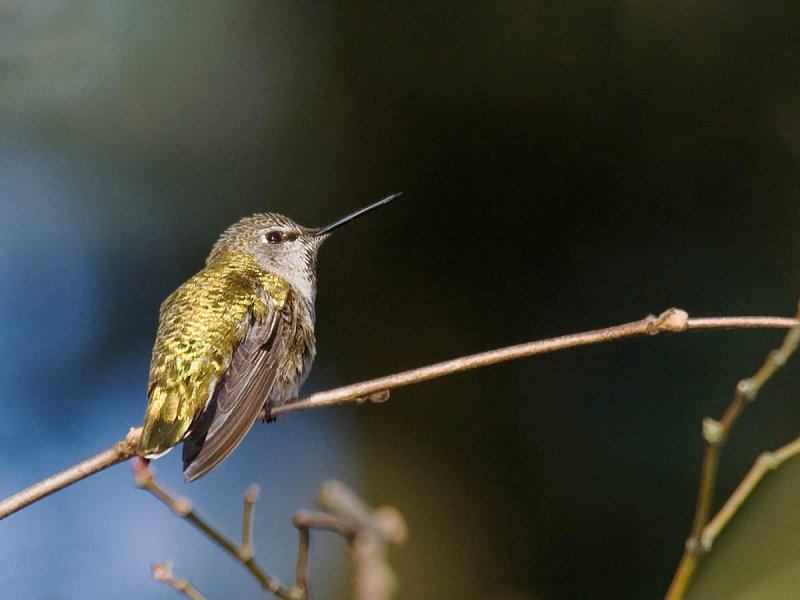
Anna's HummingbirdFemale Anna's Hummingbird, Rood Bridge Park, Hillsboro, Oregon on 13 March 2009 by Greg Gillson.


The joy of hummingbird watching can be yours quite inexpensively. The Pacific NW has 6 regular species of hummingbirds. Rufous Hummingbirds arrive along the coast in February, and the other inland migrant species return by April. In northern California and from there northward to British Columbia west of the Cascades, the Anna's Hummingbird is a year round resident. It is even found through the year in several towns east of the Cascades with flowering ornamental plants.

Hummingbird nectar is simple: 4 parts water plus 1 part sugar.

Bring water nearly to a boil, then stir in normal table sugar. Make sure all the sugar dissolves. Allow to cool to room temperature. Then fill your hummingbird feeder and hang.

Some tips and myth debunking:

1) Empty the feeder and clean and wash every 3-5 days. Bring down the feeder immediately if the water becomes cloudy (bacteria) or grows dark mold. Use hot soap and water to clean your feeder. If necessary, soak feeder in a mild bleach solution to remove all mold from feeder. Rinse very well before refilling.

2) Fill feeders only full enough to last 2-3 days (bacteria will grow in 3 days if in sun or hot weather). The sugar solution you make will last in the refrigerator a week or two for refills.

3) Never use honey in your hummingbird feeder. The microbes that grow in honey when it goes bad are fatal to hummingbirds.

4) Red food coloring may or may not be bad for hummingbirds, but is totally unnecessary. Most hummingbird feeders have red on them. Do not use food coloring.

5) Feeding birds, including hummingbirds, will not over-power a bird's genetic code to migrate. Remember, Anna's Hummingbirds are year round residents in much of the Pacific NW and can survive several days of snow and freezing weather. Despite all the time they spend at your nectar feeder, the main diet of hummingbirds is insects.

6) Bring hummingbird feeders in at night in subfreezing weather, or hang near a porch bulb to keep it from freezing. But remember, hummingbirds feed most often at dawn and dusk. So wait until dark to take down, and put back up before it becomes light in the morning.

7) Finally, in case you ever were tempted to believe..., no, hummingbirds do not migrate on the backs of geese.