Showing posts with label Orange-crowned Warbler. Show all posts

Monday, May 30, 2011

Paul, John, and Anna

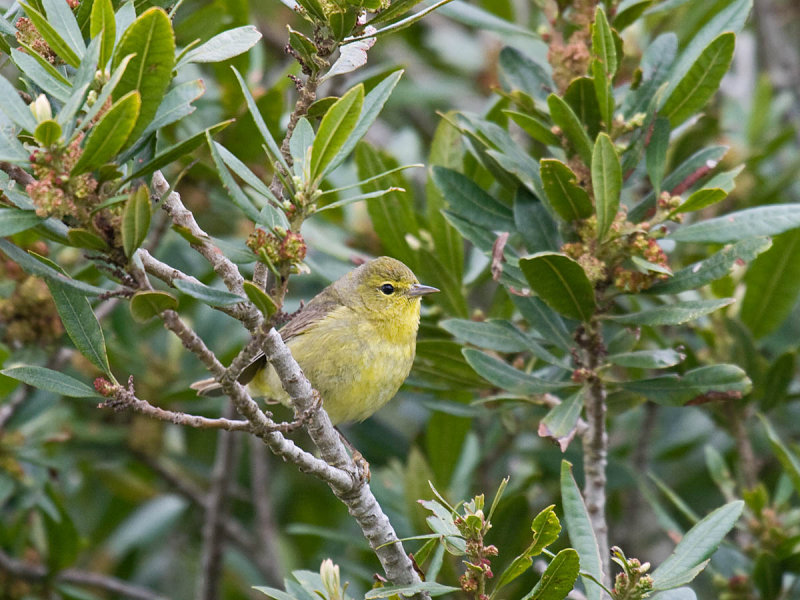
Orange-crowned WarblerOrange-crowned Warbler (lutescens), Beaverton, Oregon, 4 May 2011 by Greg Gillson.


A previous post on subspecies (Why I disagree with Roger Tory Peterson) generated quite a dichotomy of viewpoints on the local birding listserv. It seems that a good number of birders are not anxious to observe so intently as to identify subspecies. They want to, if I may paraphrase, enjoy the beauty of birds without the burden of making it study. Such work would take away their fun.

Of course, I take the opposite view. Learning something new is the ultimate joy, and nothing is more fun than knowledge gained through intense, rigorous study, thought, and observation. I love puzzles and brain teasers. And bird identification can be such a fun mental challenge!

The difference between certain species and subspecies can come down to little more than the annual opinion of a small group of persons on the AOU checklist committee. So, rather than get too technical with subspecies, I will instead treat the birds pictured here more intimately.

Thus, the bird above is not an Orange-crowned Warbler of the subspecies lutescens. This is a photo of Paul. Paul Lutescens.

Paul and his family all look very much alike. While generally olive-green, they are more yellowish throughout than others of their relatives. They are very young-looking; they never turn gray-headed. They always show a broken yellow eyering.

The men in Paul's family are known for their singing. Actually, the other relatives kind of make fun of them. Paul's family sings their little weak trill faster than other relatives do.

Paul and his family build their little summer nest on the Pacific Coast, anywhere from California to SE Alaska. In winter they travel to western Mexico. One year they even visited Guatemala for their winter vacation.
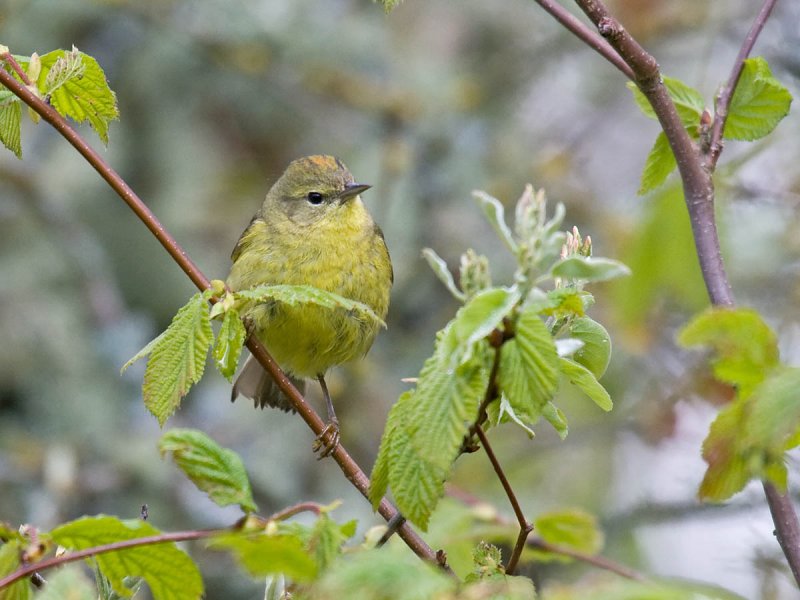
 

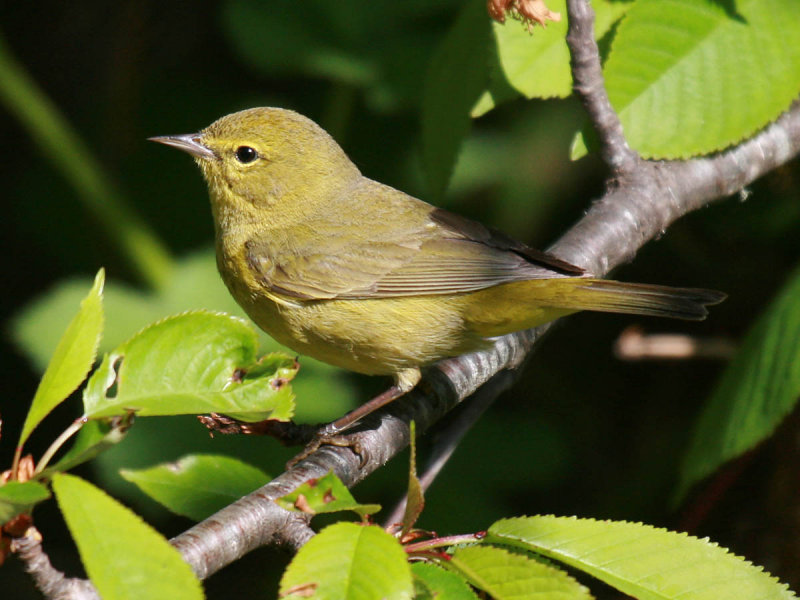
Orange-crowned WarblerOrange-crowned Warbler (orestera), Cooper Mountain, Beaverton, Oregon, 12 May 2011 by Greg Gillson.


The bird above is John Orestera. Though to many bird watchers he and his family looks just like Paul Lutescens, John is happy to set things straight. His family genes makes his family slightly gray-headed--not too much, mind you--just the right amount. Some of his family members have yellowish eyerings, some white.

John and his family are taller than their relatives. And they have longer noses. (Don't stare--it's impolite!)

John has a proud family heritage as Mountain Men. His family spends the summers in the Rocky Mountains or Great Basin ranges. He doesn't travel as far south in winter, only going down to Arizona or Texas, or into northern Mexico. One year the family even went to Disneyland for the winter!
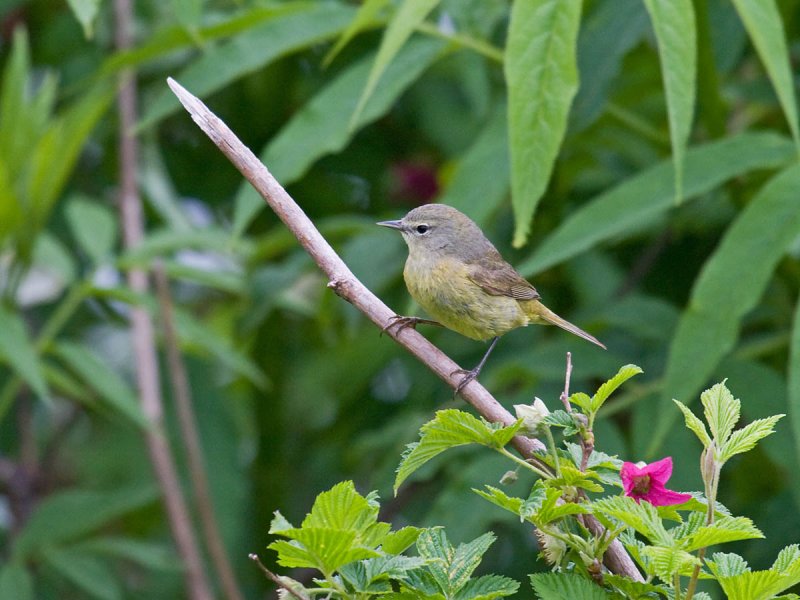
 

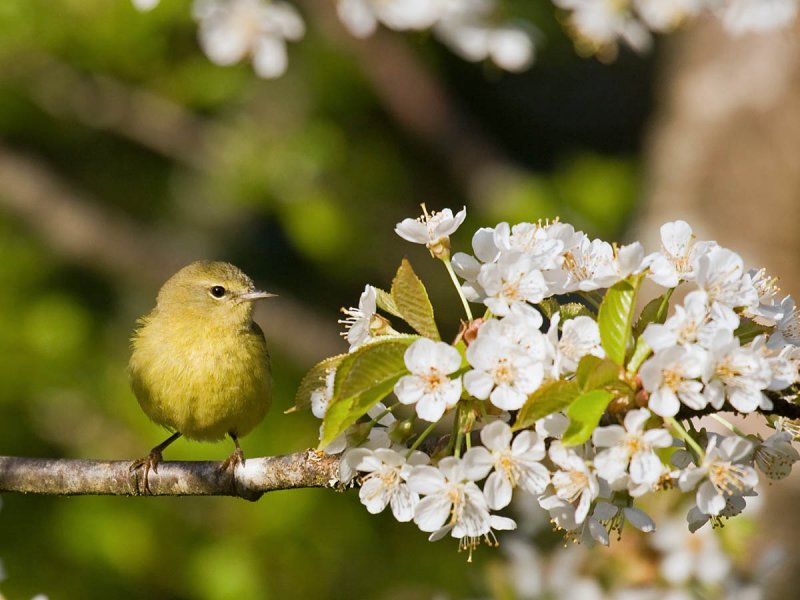
Orange-crowned WarblerOrange-crowned Warbler (celata), Newport, Oregon, 14 May 2011 by Greg Gillson.


This is Anna. Anna Celata. She and her family have their ancestor's very gray head and white eyering. She takes pride in the fact that someone once mistook her oldest daughter, Jenny, for a Tennessee Warbler. Imagine!

Anna and her family don't like the summer heat. They spend the summers in the cool boreal forests, anywhere from central Alaska east to Quebec. Later in fall than other of their relatives, her family travels south in winter to Florida or the Gulf Coast, Texas, Baja, or sometimes southern Mexico.

Paul, John, and Anna all traveled through western Oregon this May on their way to their summer homes.

Now that you know a little more about them you can be friendly. The next time you see the families of Paul, John, or Anna, don't be snooty and pretend you don't recognize them. "Oh, it's just those Orange-crowned Warblers." You know their full names and what they look like.

Say hello for me.

Tuesday, February 15, 2011

How to use eBird... To track migration

Orange-crowned WarblerOrange-crowned Warbler, Newport, Oregon on 30 April 2010 by Greg Gillson.


One of the "games" that birders play is to be the first one locally to see a certain migrant. Birding listservs in spring are often titled: "FOS: ..." for First Of Season.

It is a joy to once again meet up with your bird "friend" in April or May that you may not have seen since last September. Migration is an amazing natural wonder.

However, some individual birds of many of our migrant species, may winter locally. Or, maybe there is one adventurous bird migrating early. Averaging the first arrival date over several years gives a good idea of when the first individuals of a certain species might be expected. But eBird allows us to examine migration in so much more depth.


As we discussed previously (What is eBird?), eBird is a free web-based software tool that allows you to record your bird sightings. With it you can track your personal birding lists. However, its power comes from combining your list with thousands of other birders' lists.

What follows is a detailed explanation of how to use eBird to track migration near you. I want you to be able to do this yourself....

So, the first thing I do is select a location of interest. Since I live in the Willamette Valley bio-region of western Oregon, that's where I start.

eBird.org: View and Explore Data is the tab to choose. I select the abundance Bar Charts. Then I choose my location. Oregon is the state, but now I choose Counties in Oregon and hit Continue.

eBird allows you to combine up to 14 counties at once. That is usually enough to define a smaller region among Oregon's 36 counties. I will choose the 9 counties of the Willamette Valley. In this case I am leaving off the southernmost, Lane County, as it includes part of the coast. Many birds arrive on the coast first, before the inland valleys. Not a perfect solution, but it will do.

Now eBird builds a complete checklist of all sightings ever reported in the area I specified. eBird then creates an abundance bar chart for each "week" of the year (each month is divided into 4 weeks, so some weeks have 7, 8, or 9 days).

Now I scroll down and select Orange-crowned Warbler (right-clicking on my Windows PC mouse and opening in a new tab, so I don't "lose" the entire bar chart and have to hit the "back" button and reload it all).

When the Orange-crowned Warbler page opens, it again shows the bar chart for this species. You can choose any time-frame, in one-month intervals. Below this is a map with all sightings mapped with "push pins." Click on each pin to see the location, date, number of individuals counted, and the name of the observer.

At this time, however, choose the Frequency tab. This will tell you how many (%) of all checklists in your defined area that week reported the species. This tells you how widespread the species was in your area.

Below is the frequency of Orange-crowned Warbler sightings in the Willamette Valley for the years 2007-2010 (right-click and open in new window for a larger view).


By examining the screen shot above, you can see that there are some individual Orange-crowned Warblers found in winter in the Willamette Valley. You can't really be sure if the one bird you see is the "first" detected migrant or not. However, beginning with the 4th week of March (week starting 3/22), Orange-crowned Warbler sightings jump! By the first week of May they are the most widespread, being found on 30% of all checklists reported anywhere in the counties containing the Willamette Valley.

Orange-crowned Warblers then move to the hills to breed, so they aren't quite as widespread during the summer. But in September, they start migrating south and are found in more areas, peaking (being most widespread) the 3rd week of September (week beginning 9/15). By the middle of October, Orange-crowned Warblers are mostly gone.

But now select Totals and see, not how widespread, but how numerous they are throughout the year (screen shot below, right-click and open in new window for a larger view).


Looking at this data, we see that Orange-crowned Warblers are most numerous the 4th week of April (week starting 4/22). And though the Frequency charts showed they were fairly widespread in late September, this Totals chart shows they are not numerically very common then.

How does this compare to what is written in Handbook of Oregon Birds, 2009 by Herlyn and Contreras? Well, they say: "Spring migration begins in mid-Mar along the s. Ore. coast and peaks in Apr.... Fall migrants peak in early to mid-Sep, and most are gone by mid-Oct."

Also listed are compilations of average first-arrival dates: March 21 for Benton County, and March 19 for Portland area.

So, eBird data refines the area and quantifies the general Oregon status given in this great little book.

Some of the other tabs, showing the data in other ways, may prove interesting to you. They will be more accurate as the database grows. Since eBird usage seems to be growing about 25% per year in Oregon, the information gleaned is getting more and more accurate--and interesting.

There it is, then--Orange-crowned Warbler migration in the Willamette Valley charted and graphed. We didn't look at the other tabs. I leave that as an exercise for you.

I am sure you can think of a migrant bird in your area that you would like to graph out this same way.

View all posts with the label: "eBird"

Monday, September 7, 2009

Orange-crowned Warbler... So where is the orange?

Orange-crowned WarblerOrange-crowned Warbler, Hagg Lake, Washington Co., Oregon on 15 May 2008 by Greg Gillson.


Have you seen the violet on the Violet-green Swallow? Have you seen the neck ring on the Ring-necked Duck? Have you seen the orange crown on the Orange-crowned Warbler?

Sometimes it seems that the people who named some of the birds chose the most obscure marks and skipped the obvious. Perhaps that is excusable with the Orange-crowned Warbler. After all, it is an unremarkable little green warbler. It has no contrasting wing bars, tail spots, or spectacles as do some of the other warblers. It has no black throat patch, no stripes on the back, no bright rump patch.

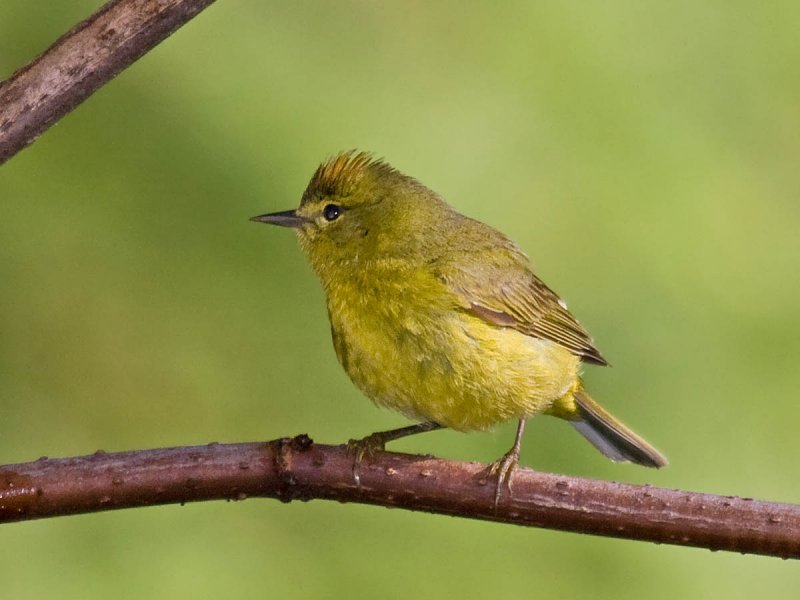
But rather than name this bird the Unremarkable Warbler or the Dull-green Warbler, naturalist Thomas Say searched carefully and found that the base of the feathers on the crown of the male are, indeed, orange in color. He then cleverly chose the scientific species name celata, which means "concealed," in reference to this hidden orange crown.

Orange-crowned Warblers breed in forest edges across Canada and Alaska, and in the West from the Rocky Mountains to the Pacific coast, south as far as Texas and nw Baja, Mexico. They winter in the Gulf States and into Mexico.

The population of these birds breeding in the Pacific Northwest, from the Cascades westward (as in the photos above and below) are, if you can believe it, brighter and more colorful than the northern and Rocky Mountain forms, which have grayish heads.

Orange-crowned WarblerDo you see the orange crown now? Orange-crowned Warbler, Hagg Lake, Washington Co., Oregon on 3 May 2009 by Greg Gillson.


These birds are the earliest warblers to arrive in the Pacific NW (not counting Townsend's and Yellow-rumped Warblers, which winter west of the Cascades). They usually start to appear in mid March. They are abundant migrants in April and early May. They start leaving our area in August, and most are gone by mid-October. But some birds may attempt to winter west of the Cascades in brushy tangles near unfrozen water where insects may remain.

You may have these birds visit your yard during the peak of spring migration. However, they prefer to breed in tangled deciduous or mixed woods, usually in willows near water. If you live along the coast or lower foothills in such "woodsy" habitats, you may have them in your yard all summer. But for most bird watchers in the Northwest, finding this bird regularly will require visiting nearby wet streamside woods.