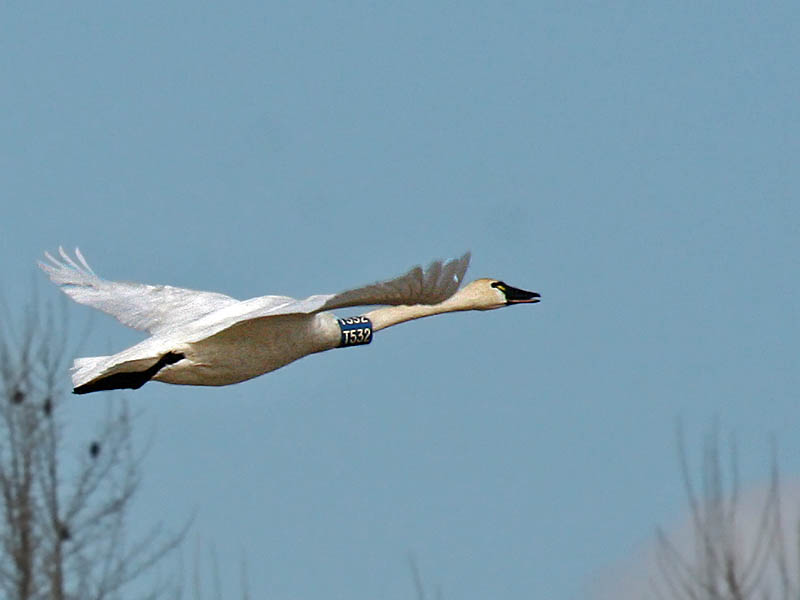
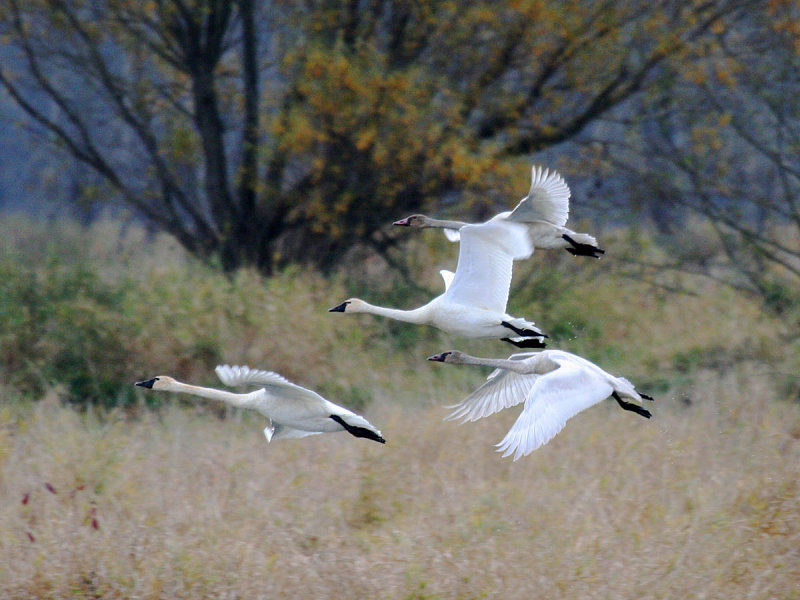
 A family of Tundra Swans, Fernhill Wetlands, Forest Grove, Oregon on 27 November 2008 by Greg Gillson.
Several people have remarked that they love to see the winter flocks of flying swans. If the light is just right, in the early morning or late afternoon, the sun lights up the white wings as they flash against a backdrop of dark storm clouds.
The bugling calls of Tundra Swans can be heard for a mile as the flock flies high overhead--one of the wild sounds of the Pacific Northwest.
The peak of fall migration is November; the peak of spring migration is in February. Birds winter primarily west of the Cascades from southern British Columbia south into California. If water remains open, swans will winter east of the Cascades, frequently at Summer Lake in Oregon and the Klamath Basin in Oregon and California.
Tundra Swans breed across North American tundra areas. A subspecies also breeds in tundra areas of northern Russia.
These swans eat various pond plants which they reach by tipping up in the manner of puddle ducks. With their long necks they can reach various tubers, such as wapato. One favorite food in the Pacific NW is sago pondweed.
Tundra Swans remain paired year-round. In addition, the young stay with the parents through the first year. They migrate south with their parents in the fall, then migrate back to the breeding grounds with them the next spring.
Tundra Swans are slightly smaller than the Trumpeter Swans. In fact, they are probably harder to tell apart then the field guides would have you believe. The deeper call of the Trumpeter is probably the best clue. Trumpeter Swans have been transplanted into some areas of the Pacific NW (eastern Washington and Oregon) as resident breeding birds. They also breed in Idaho and northern British Columbia. The birds in Idaho winter locally. Those Trumpeters that breed in Alaska and northern British Columbia winter south to SW British Columbia and adjacent Washington. Probably less than 100 Trumpeter Swans winter in NW Oregon.