Showing posts with label Birding. Show all posts

Sunday, September 11, 2011

Bird Watcher, Birder, Ornithologist--Who cares?

BirdersPeople watching birds--whatever you call it--at Abbott Creek Burn, Jefferson County, Oregon, 7 June 2009 by Greg Gillson.


It's a perennial discussion. What do bird watchers call themselves? Although you would think that it is silly and doesn't matter, the name we associate with ourselves is very personal and self-defining. Such discussions can be quite emotional.

Recently, there has been discussion of changing the name of the Oregon Field Ornithologists in order to possibly increase membership. It seems that many bird watchers think that this birding organization is only for professional biologists. Not even close to true. Likewise, the organization that is the very definition of the word "birder," the American Birding Association, still wrestles with the word, as it did from its very inception. Having "birding" in its name does not keep the ABA from losing membership in the Internet age.

Very broadly, anyone who watches birds is a bird watcher. The old man that feeds bread to the ducks at the local city park, the neighbor with the empty hummingbird feeder hanging outside the window, visitors to the wildlife refuge to view the Bald Eagles, and the enthusiast who plans her third trip to Borneo this year just to view that one species missing from her huge list of birds she has seen in the world--all these are bird watchers.

Though not without argument, the term that describes a person who searches out and tries to identify all the birds they see, is usually called a birder. Birding often (but not always) includes listing--keeping careful track of birds they see, ticking them off on their list(s). There are life lists, country lists, state lists, county lists, backyard lists, and year lists of all these types and more. A friend once compared it (without bias) to stamp collecting. Birders are concerned with identification and distribution of birds in order to find (collect sightings of) them.

Field ornithology is the study of living birds in their natural habitat. Population status, behavior, and nesting are some of the topics of field ornithology. Recording data (including counting the number of individual birds seen) is a major component of field ornithology.

So, if you like to watch birds and desire to know their names you can be considered a birder. If you have ever participated on a Christmas Bird Count or breeding bird atlas, helped create a park checklist, or submitted sightings to eBird, you are, in fact, participating in a field ornithology activity.

Oregon, Washington, and British Columbia all have their Field Ornithology organizations. These are primarily birding organizations. They host their respective Bird Records Committees, which keep track of, and sanction, the official state bird list and vet rare bird sightings. They often produce a periodical that includes an updated state bird checklist, a comprehensive list of recent bird sightings, details about rare birds discovered, site guides to relatively unknown birding locations, and identification articles.

If you want actual field ornithology, then the East Cascades Audubon Society in Bend, Oregon does many more field ornithology projects than many state field ornithology organizations. Of course, Audubon Societies, in general, are environmental advocacy organizations that have membership primarily made up of the generic "bird watchers" and birders, and very few actual biologists or professional ornithologists.

So, no matter what you call your bird watching activities, you're probably also participating in birding and field ornithology.

Monday, April 4, 2011

Casting the first stone

Benson PondI just know there's a Sora in there--give me a stone! Benson Pond, Malheur National Wildlife Refuge, Oregon, 26 May 2007 by Greg Gillson.


"A sharp keek when a stone is thrown into the marsh."
A Field Guide to the Birds. 1960. Roger Tory Peterson.
When Peterson was a young man, the accepted way to watch birds was along the barrel of a shotgun. Being a good birder a hundred years ago meant being a good shot. One also had to be skillful skinning and preserving the study skins procured. Rather than binoculars and spotting scope, a good birder had to carry a sharp knife and 2 pounds of arsenic to prepare the specimens.

Of course, by 1960 when Peterson was publishing his twenty-seventh impression of his second revised and enlarged edition of his famous field guide, shooting was out, and watching was in.

Thus, the introductory quote above of the voice of Sora, the secretive marsh rail. How many marshes did I fill with stones in my youth--at the suggestion of the greatest bird watcher of all time--hoping to hear a Sora call out?

As we approached the end of the 20th century, however, more thought was being given to the well-being of birds over the perceived "right" to observe birds.

It was about this time that the American Birding Association started up. Its goal was the advancement of birding, which was strongly slanted toward listing and chasing and definitely doing what it took to "get" the bird.

Nevertheless, in recognition of the growing concern for the welfare of birds, they crafted a code of birding ethics:
"Everyone who enjoys birds and birding must always respect wildlife, its environment, and the rights of others. In any conflict of interest between birds and birders, the welfare of the birds and their environment comes first."
Thus, Peterson's field guide changed with the times:
"When hands are clapped, startled birds utter a sharp keek."
Western Birds. 1990. Roger Tory Peterson.
So there we go. In one generation birding went from blasting birds with a shotgun to applauding.

This emphasis on the welfare of birds was certainly good.

But, sadly, it didn't end there.

In recent years there has been a growing theme in the various birding listservs and blogs. If we truly care about birds, this sentiment reasons, we won't guzzle up fossil fuels to find one out-of-place feathered waif. We won't use tapes for audio playback of a bird's song to get a better view. We shouldn't even pish!

In fact, if taken to its logical conclusion, if we truly care about birds, we should stay home and not go out and disturb them by watching them at all!

I think this is very faulty reasoning--and not a lot of fun, either.

Bird watching, even if accompanied by occasional fossil-fuel wasting, tape playback and, God forbid, pishing, creates more people who care about and protect birds and the environment than people who ignore it!

If I gave up bird watching, could I really replace it with an activity that disturbs birds less, in the long run? What should I do instead of "disturbing" birds by watching them--cruise the streets or hang out at the mall?

I submit that my peculiar habit of watching birds, and occasionally pishing them in for others to view, has caused numerous "non-birders" I encounter to notice birds and the world around them in an appreciative and protective way.

Yes, bird watching may slightly "disturb" some birds. But cutting down the forests, filling wetlands, paving over meadows, and creating shopping malls for people who don't even know the birds are there, disturbs more birds more greatly than all the tape playback, pishing or, yes, even stone throwing, by all the bird watchers in the world.

Saturday, May 15, 2010

Birding report: Hagg Lake, Washington County, Oregon

Red-breasted SapsuckerRed-breasted Sapsucker, Hagg Lake, Washington Co., Oregon on 15 May 2010 by Greg Gillson.


Next weekend I am leading a birding trip to Hagg Lake in the Coast Range west of Portland, Oregon. Today I did some scouting to make sure trails were open and passable. There are still spaces left on the trip next Saturday, May 22. We'll take a van from Jackson Bottom Wetlands Preserve in Hillsboro, Oregon. If you wish to join, select trip #24783 and call 503-681-5397 to sign up with Hillsboro Parks & Rec. Dept. Other birding field trips are listed on the Jackson Bottom Wetlands web site.

There are 12 miles of trails around the lake and lots of birds. The most common bird today was EVENING GROSBEAK. The second most common bird was ORANGE-CROWNED WARBLER. Other warblers were quite conspicuous, too--at least in song. WILSON'S WARBLERS, BLACK-THROATED GRAY WARBLERS, MACGILLIVRAY'S WARBLERS, and COMMON YELLOWTHROATS sang from many areas around the lake. I heard, but did not see, 2 YELLOW-BREASTED CHATS. They should become more common next week.

A few flycatchers were in. I heard one WESTERN WOOD-PEWEE and heard many PACIFIC-SLOPE FLYCATCHERS, though seeing them was difficult. Equally shy, several SWAINSON'S THRUSHES were heard, but not seen.

At Scoggins Creek about 35 BAND-TAILED PIGEONS were drinking from the spring there. Several SPOTTED SANDPIPERS were bobbing on the rocks. A RED-BREASTED SAPSUCKER allowed photos.

All in all, a good morning of bird watching.

Here is the list of birds seen...

Mallard 2
Osprey 1
Red-tailed Hawk 4
Band-tailed Pigeon 35
Mourning Dove 2
Rufous Hummingbird 4
Belted Kingfisher 1
Red-breasted Sapsucker 1
Downy Woodpecker 3
Hairy Woodpecker 2
Northern Flicker 2
Pileated Woodpecker 1
Western Wood-Pewee 1
Pacific-slope Flycatcher 7
Hutton's Vireo 3
Warbling Vireo 3
Steller's Jay 5
Western Scrub-Jay 7
American Crow 8
Violet-green Swallow 12
Northern Rough-winged Swallow 3
Barn Swallow 1
Black-capped Chickadee 6
Chestnut-backed Chickadee 10
Red-breasted Nuthatch 3
Brown Creeper 2
Bewick's Wren 4
House Wren 8
Winter Wren 3
Golden-crowned Kinglet 2
Swainson's Thrush 4
American Robin 8
European Starling 6
Orange-crowned Warbler 40
Black-throated Gray Warbler 7
MacGillivray's Warbler 6
Common Yellowthroat 8
Wilson's Warbler 10
Yellow-breasted Chat 2
Western Tanager 7
Spotted Towhee 8
Song Sparrow 6
Dark-eyed Junco 8
Black-headed Grosbeak 20
Red-winged Blackbird 3
Brown-headed Cowbird 15
Purple Finch 2
Red Crossbill 2
Pine Siskin 3
American Goldfinch 5
Evening Grosbeak 85

Friday, July 24, 2009

Willamette Valley Birding Trail


Exciting news!

A new set of birding trails has been added to the Oregon Birding Trail system. Official printed trail guides are due in August 2009. But there is a web site with a preliminary pdf brochure available right now.

Willamette Valley Birding Trail

A birding trail is a self-guided driving birding loop. From Clatskanie in the north along the Columbia River, to Cottage Grove in the southern end of the Willamette Valley, there are 12 birding trail loops. Each loop has numerous birding site stops and some of the highlight birds are listed.

Word has it that this birding trail will also include some bicycle birding loops!

The Willamette Valley Birding trail joins the Cascades Birding Trail, the Coast Birding Trail, the Klamath Birding Trail, and the Basin and Range Birding Trail. To access all the trail brochures online, please visit the Oregon Birding Trails page.

Tuesday, July 14, 2009

Technology trend is changing the way people watch birds

There is a convergence of technology underway that is fundamentally changing the way many people approach watching birds.

You're seeing the technology right now.

The technology trend is the ubiquitous nature of powerful, yet affordable, digital zoom cameras, combined with free photosharing web sites and blogs.

Of course, photographers have been taking pictures of wild birds since at least 1892. And, a century later, birders were discovering en mass "Digiscoping," holding up an inexpensive point-and-shoot digital camera to the best birding spotting scopes.

The problem has been sharing those photos. With the advent of the Internet and digital photography, it was easier to post photos. Easier. Not necessarily easy. If you spent the time and money you could have your own Internet web page and upload the photos there.

Though the word "blog" had not yet been coined (the word "web log" was first used in 1997 and later shortened) Don Roberson's rare bird photo-journal: Monterey County Rarities is a home-grown blog that began in 1998 and continues to this day.

One of the oldest blogs on birds still running in the Pacific NW is Mike Patterson's North Coast Diaries. Patterson started his blog in 2004.

Flickr by Yahoo! has free photo-sharing accounts. It allows users to invite others to look at their photos and leave comments.

Google bought Blogger in 2003 and Picasa in 2004. These free programs combine to allow users easily to share photos and text with others.

Now it is easier than ever before for knowledgeable birders, like Roberson and Patterson, to share their high-quality photos and expert knowledge to help teach others about birds and bird watching. This is certainly a welcome advance in bird watching.

But this is not the trend that is changing the way many people are watching birds.

The New Paradigm

Rather, these digital photography and blog technologies are causing new birders to approach birding in a different way. In the past, a beginning birder would spend time observing birds with binoculars and notepad, then research it in their field guides. They may or may not come to a conclusion about its identity. And if they didn't, the bird was gone and the opportunity lost, except for their written description in their field notebook. If they could accurately describe the bird, then, perhaps, a more experienced birding mentor could help them come to an accurate ID. Keen observation skills in the field were required, along with the ability to describe bird anatomy and, perhaps, crude bird sketching skills.

Now, however, what is clear is that many new bird watchers--for the first time ever--are approaching birding from the photograph first, post on the Internet now, identify later point of view.

Young birderA young birder practices digiscoping birds at Riley Pond, Oregon on 23 May 2009 by Greg Gillson.


Because of this fundamental change to photographing birds even before attempting an identification, Gunnar Engblom in March 2009 went so far as to make the controversial recommendation of buying young or newer birders a digital camera rather than binoculars!

Does this new paradigm cause new birders to overly rely on others to identify birds for them? Will this keep them from ever developing the keen observation skills necessary to become a competent birder? Or, conversely, could the immediate feedback and ability to get a correct identification from experts anywhere in the world actually help a new birder gain more confidence in their identification skills? Could the extra time needed to get the photograph mean more time spent observing the bird and its behavior? And could the post-processing time on the computer to make the photo ready for publication lead to more study of an actual bird's plumage and structure?

Whether you think this is the "correct" way to learn bird identification skills or not, it is clear that a photograph first, identify later, trend is sweeping the birding landscape. A year or two ago a few requests for photo ID help would appear from time to time on the various bird mailing listservs. "If I email my photo of this strange bird to someone, will you help me to identify it?" Now, however, it is not unusual to have several requests per day on the more active birding email lists. "See my new photos," "Photo ID help requested," and "Blog updated" are frequent subjects of email list postings, directing readers to their blog or photo sharing page to view and, more often than not, help out with a bird identification puzzle.

To close this discussion, I'd like to point to you to Samuel Snook's Nature blog. Snook is, as he says: "a 12 year old boy who takes birding very seriously." Read his May 18, 2009 article: Nature: Point Pelee National Park. And I mean read this. Samuel does use one of his photos (and memory of the bird's song) to get help to identify one new bird; then he immediately goes out to find another. At the end of his blog post he thanks his parents for spending time and money to encourage his birding hobby. Any parent would be proud.

Is this the future of birding?

Thursday, June 25, 2009

Can I count it?

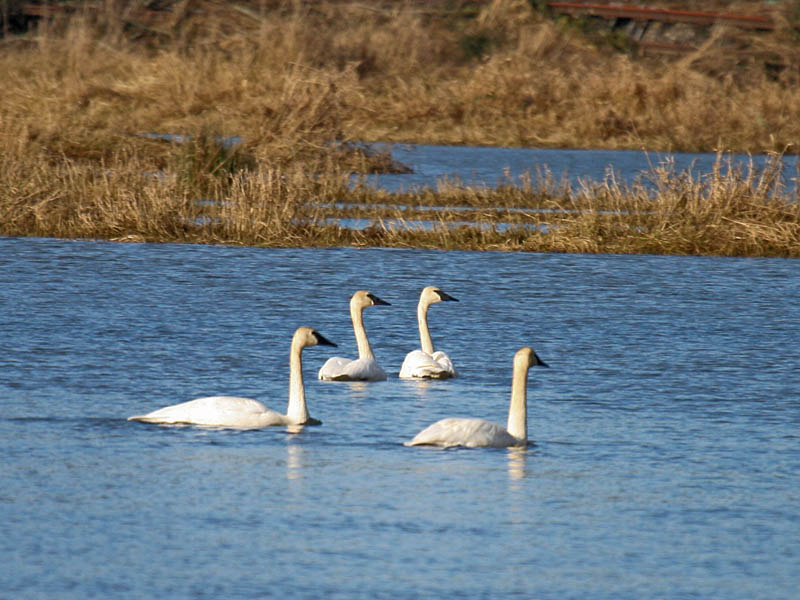
Trumpeter SwanMost Trumpeter Swans in the Pacific NW are wild migrants. However, I learned that these at Brownsmead, Oregon on 31 December 2007 were pen-raised and released locally, thus "uncountable." Photo by Greg Gillson.


One major aspect of "birding" for many people is "listing," keeping track of the bird species that one has seen. These lists can be life-time lists, state lists, backyard lists, year lists, etc.

One question that arises is: "What birds can I count?".

Mary and Jim in Salem, Oregon posted such a question to the Oregon Birders OnLine (OBOL) email discussion list on 24 June 2009: "We saw a Mute Swan in McGilchrist Pond in Salem this afternoon. Are they "countable" for our life list?"

One response included the predictable: "You can count whatever you want, It's your list."

Of course, this is true. But Mary and Jim would not have asked if they were just going to make up their own rules about what they counted. They wanted to know about generally accepted rules about what others consider countable. There can be some healthy competition among the top listers. But even if comparison with others is not your goal, reaching a personal landmark of a list of 200 or 300 or 400 species in one of the Pacific NW states is quite an accomplishment.

Who makes up the rules? In the United States and Canada there is an organization called the American Birding Association that appointed itself the maker of bird counting rules. While this may seem brazen, most birders adhere to these rules because they provide a standard and, well, they just make sense.

For instance, the pertinent rules about counting a bird on your North American list (if you wish to conform strictly to the ABA rules) are basically as follows.

(1) The bird must have been within the prescribed area.
(2) The bird must have been a species currently accepted by the ABA Checklist Committee for lists within its area.
(3) The bird must have been alive, wild, and unrestrained when encountered.


For Jim and Mary's Mute Swan, the question comes down to the "is it wild?" requirement. Since Mute Swan is not a native bird to the Pacific Northwest, we'll assume that the Mute Swan they saw in a park in Salem is not a vagrant wild bird from Eurasia but, rather, an exotic release or the offspring of recently released birds. To answer this "wild" question the ABA has a whole page called Criteria For Determining Establishment of Exotics.

The particular guidelines to note are the requirements that the population of exotic birds is self-sustaining, not directly dependent upon human support, and present for at least 15 years.

Clearly, a single Mute Swan or even a pair or two does not meet the criteria for an established exotic. Even worse, there is a special rule specifically mentioning Mute Swans as an invasive species that is not likely to become self-sustaining because of active control efforts to eradicate any emerging populations.

So, by ABA rules, the Mute Swan seen in Salem is not countable.

By these rules, many Rock Pigeons probably should not be counted (free-flying birds raised by pigeon fanciers). Most populations of Wild Turkeys technically don't meet the 15 year establishment criteria in the Pacific Northwest. Ring-necked Pheasants may not be self-perpetuating west of the Cascades, even though they have been part of the avifauna for a century.

But it's nothing to get dogmatic about. After all, "it's your list," right?