Showing posts with label introduced bird. Show all posts

Monday, November 23, 2009

At the pond... Canada Goose

Canada GooseWestern Canada Goose, Hillsboro, Oregon on 6 December 2008 by Greg Gillson.


Everyone knows the Canada Goose. Everyone except birders, that is. Why do I say this?

Birds of Oregon: a general reference (2003, Marshall, Hunter, and Contreras, editors) lists 8 subspecies of Canada Goose found in Oregon. Some birders attempt to identify these field identifiable subspecies, or races, when they can. Other birders, however, pay no attention to subspecies, as they can't count them as a separate species on their life list. And, well, many birds are just really hard (or impossible) to pin down to a subspecific identification. So why bother?

Well, surprise! The American Ornithologists Union (A.O.U.) recently "split" the Canada Goose into two separate species. The larger birds, some almost the size of swans, are still called Canada Goose, Branta canadensis, while the smaller geese, some the size of city park ducks, are now called Cackling Goose, Branta hutchinsii.

While your friend who knows next to nothing about birds confidently identifies the overhead skein of birds as "Canadian" Geese, you're not so sure anymore.

Cackling Geese cackle, of course, while Canada Geese honk. That's just a sweeping generality, as there seem to be several "tweener" populations that are very difficult to tell apart. In general, Cackling Geese have short necks, stubby little bills, and wing tips that extend well past the tail at rest.

The resident Canada Geese, the ones in city parks and wetlands that lead goslings around in April, are the Western Canada Geese. They are very large, have white breasts and long necks and bills. The bird in the photo above is a Western Canada Goose.

In winter, we are visited by the smaller, white-breasted, Lesser Canada Goose from the north. These are more common east of the Cascades than west.

And, in the Willamette Valley of western Oregon winters a dark breasted Dusky Canada Goose. The Vancouver Canada Goose is very similar. Some of these winter along the coast, as far south as the Nestucca National Wildlife Refuge near Pacific City, Oregon.

The Giant Canada Goose is a bird of the Great Plains that has been introduced widely in North America. There is an introduced resident population on the Lower Columbia River near Astoria, Oregon. Many of these released birds bred with the abundant local resident Western Canada Geese so that most birds here and elsewhere in the Pacific NW showing "Giant" field marks (white foreheads and larger than the Western race) are probably not pure.

I'll write again about the Cackling Goose later this winter. The main identification challenge is separating the Lesser Canada Goose from the Taverner's Cackling Goose. A good article on this is John Rakestraw's blog on the Lesser Canada Goose.

Thursday, June 25, 2009

Can I count it?

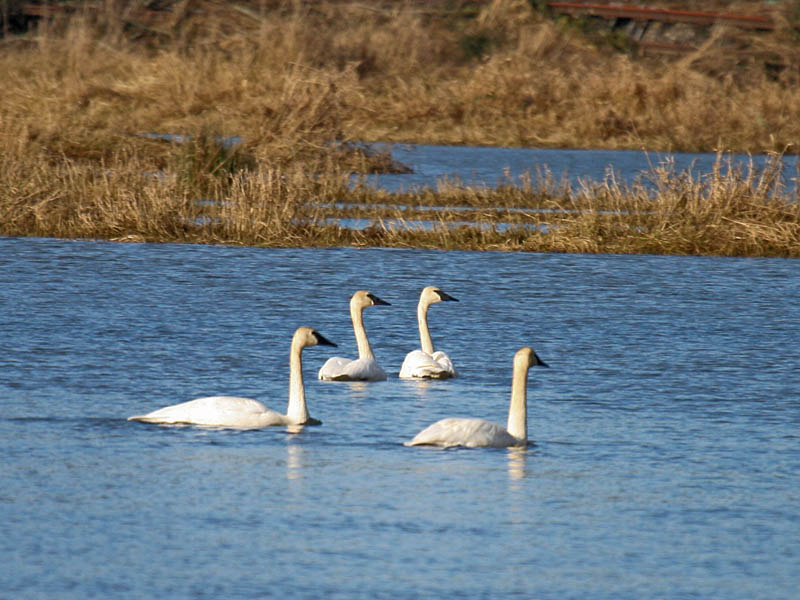
Trumpeter SwanMost Trumpeter Swans in the Pacific NW are wild migrants. However, I learned that these at Brownsmead, Oregon on 31 December 2007 were pen-raised and released locally, thus "uncountable." Photo by Greg Gillson.


One major aspect of "birding" for many people is "listing," keeping track of the bird species that one has seen. These lists can be life-time lists, state lists, backyard lists, year lists, etc.

One question that arises is: "What birds can I count?".

Mary and Jim in Salem, Oregon posted such a question to the Oregon Birders OnLine (OBOL) email discussion list on 24 June 2009: "We saw a Mute Swan in McGilchrist Pond in Salem this afternoon. Are they "countable" for our life list?"

One response included the predictable: "You can count whatever you want, It's your list."

Of course, this is true. But Mary and Jim would not have asked if they were just going to make up their own rules about what they counted. They wanted to know about generally accepted rules about what others consider countable. There can be some healthy competition among the top listers. But even if comparison with others is not your goal, reaching a personal landmark of a list of 200 or 300 or 400 species in one of the Pacific NW states is quite an accomplishment.

Who makes up the rules? In the United States and Canada there is an organization called the American Birding Association that appointed itself the maker of bird counting rules. While this may seem brazen, most birders adhere to these rules because they provide a standard and, well, they just make sense.

For instance, the pertinent rules about counting a bird on your North American list (if you wish to conform strictly to the ABA rules) are basically as follows.

(1) The bird must have been within the prescribed area.
(2) The bird must have been a species currently accepted by the ABA Checklist Committee for lists within its area.
(3) The bird must have been alive, wild, and unrestrained when encountered.


For Jim and Mary's Mute Swan, the question comes down to the "is it wild?" requirement. Since Mute Swan is not a native bird to the Pacific Northwest, we'll assume that the Mute Swan they saw in a park in Salem is not a vagrant wild bird from Eurasia but, rather, an exotic release or the offspring of recently released birds. To answer this "wild" question the ABA has a whole page called Criteria For Determining Establishment of Exotics.

The particular guidelines to note are the requirements that the population of exotic birds is self-sustaining, not directly dependent upon human support, and present for at least 15 years.

Clearly, a single Mute Swan or even a pair or two does not meet the criteria for an established exotic. Even worse, there is a special rule specifically mentioning Mute Swans as an invasive species that is not likely to become self-sustaining because of active control efforts to eradicate any emerging populations.

So, by ABA rules, the Mute Swan seen in Salem is not countable.

By these rules, many Rock Pigeons probably should not be counted (free-flying birds raised by pigeon fanciers). Most populations of Wild Turkeys technically don't meet the 15 year establishment criteria in the Pacific Northwest. Ring-necked Pheasants may not be self-perpetuating west of the Cascades, even though they have been part of the avifauna for a century.

But it's nothing to get dogmatic about. After all, "it's your list," right?

Wednesday, June 17, 2009

In the backyard... House Sparrow

House SparrowHouse Sparrow, Cornelius, Oregon on 10 January 2004 by Greg Gillson.


McSparrow. Perhaps no bird in the world other than the domestic pigeon is so linked to humans as the House Sparrow. Introduced to North America from European populations in the 1850s, 1860s, and 1870s, they spread rapidly. They reached Portland, Oregon in the late 1880s and had a population there of about 500 birds by 1887. They reached Spokane about 1895 and Seattle in 1897.

Ironically, these pest birds were brought to the New World themselves to control insect pests. However, at best, only about 10% of their diet is insects. Primarily they eat weed seeds. They did especially well when travel was primarily by horse-drawn carriage. They ate spilled grain and the undigested seeds in horse droppings. They have been undergoing a measurable population decline since the middle of the 20th century, but are still quite abundant.

In the cities, they found habitat unclaimed by North American birds, except recently the House Finch (See In the backyard... House Finch). So, these birds are quite abundant on city streets and fast-food restaurant trash dumpsters and parking lots (or perhaps I should say car parks in honour of their British background?). However, in the countryside these aggressive little birds took over cavities and bird houses intended for native wrens, swallows, chickadees, and bluebirds.

It is for this reason that most birders don't care to have these birds at their feeders. To reduce House Sparrows from your feeder, do not feed the generic seed mix. It has a lot of "filler" seeds, specifically millet, which House Sparrows love, but native birds don't really care for. House Sparrows are in the Old World weaver family, not the true finches or New World sparrow family. House Sparrows have a more difficult time chewing sunflower seeds than native sparrows and finches. Thus, serving black oil sunflower seeds can make your feeder less attractive to this bird (but not totally, as you can see from the photo above).

These birds are plump and brownish, with a contrasting gray rump, and grayish underparts. Males are patterned quite handsomely with chestnut ear coverts and shoulders. In summer the black throat grows to a black bib across the chest. The female is mostly gray and brown with a broad pale eyeline.

Sunday, April 12, 2009

In the backyard... European Starling

European StarlingEuropean Starling, Forest Grove, Oregon on 11 April 2009 by Greg Gillson.


It's too bad that the European Starling is such a pest. The breeding adult, as in the photo above taken yesterday, with the yellow bill, metallic purple and green iridescence, and white spangles, is actually quite a pretty bird. However, because of its overwhelming numbers and harmful behavior to North America's native birds, this introduced bird is universally hated by American birders.

Birds were released in New York City in 1890. They swarmed the continent, reaching Oregon by 1943. By the 1960's they were abundant, with counts of a million birds or more in Portland, Oregon during winter Christmas Bird Counts.

Starlings nest in tree cavities, throwing out whatever bird may be nesting there, and are blamed for the decline of populations of Lewis's Woodpeckers, Western Bluebirds, Purple Martins, and other cavity nesting species in the Pacific Northwest and across North America. For instance, Gabrielson and Jewett wrote in their 1940 book, Birds of Oregon, that the Western Bluebird in western Oregon, "vies with the robin for first rank as a dooryard bird." By the 1970's the Western Bluebird was eliminated as a backyard bird in western Oregon, and only the tireless efforts of individuals to create "Bluebird Trails" of specially designed bird houses, has returned the bluebird to many lowland areas west of the Cascades.

Not all the blame should be placed at the feet of the Starling, however. Certainly the introduction of another cavity nesting bird from Europe, the House Sparrow (North America releases from 1850-1870), pesticide spraying, expansion of towns and the elimination of family farms and orchards, as well as eliminating standing dead trees in timber harvesting practices, all contributed to the decline in bluebirds and other cavity nesting birds.

In the non-breeding season, the plumage of European Starling is less bright. The bill turns black and the white spangles disappear. Huge fall and winter flocks of slate gray juveniles and blackish adults roost at night in orchards or bridge structures. Black clouds of thousands of birds are often noted in the sky at dusk as birds make their way to the night roost.

Starlings are not related to the New World blackbirds. For one thing, starlings have short tails and shorter, triangular wings. Starlings are closely related to mynas and are fairly good mimics, adding the calls of killdeer, meadowlark, quail, pewee, and other birds to their repertoire, which consists primarily of unmusical squeals, grating cackles, and loud whistles.

Pretty or not, the European Starling is an example of why non-native plants and animals should not be released into the wild.