Showing posts with label questions and answers. Show all posts

Saturday, May 8, 2010

What bird is that?... Questions and answers


Question: (May 8) "My husband and I walk on the beach quite often and see bald eagles all the time. We came upon this eagle two days ago. Luckily we had our camera. Can you give me some info? What kind of eagle is it. We have never seen it in the area before. It was huge! Thanks so much,"

Laurell on Whidbey Island, Washington

Answer: Nice photo! Your bird is a 3rd year immature Bald Eagle. They get this Osprey-like whitish head with dark line through the eye at this age. This bird will be more adult-like next year, though it might not breed for another year or two. Female eagles are larger than males by 10-15%. There is variation anyway, with smaller birds and larger ones.


Question: (March 10) "Hi there,
I’m new to the PNW and am enjoying discovering my new bird neighbors. I’m not a “birder” per se, just enjoy trying (albeit mostly unsuccessfully) to identify who shows up in my backyard.

I understand that there are some regional variations to some pretty common birds that we have in the Northeast, which tends to result in me getting very excited about a “new” bird only to find it’s a PNW variety. Yesterday I noted a “new” bird hanging out with some juncos in a small tree. It looked almost like a robin, with a slightly more subdued reddish underbelly, but it was smaller and had a black beak. Is this another variation on junco? Or something different.

I know it’s difficult for real birders to answer non-birder questions…especially with the limited knowledge and skill at explaining what we see."

Allison, location not given

Answer: It sounds like Spotted Towhee, Allison.


Question: (May 3) "Hello,
I love your blog and the fabulous photos. Every year about this time I get a very brief "passing through" visit of Yellow-rumped Warblers. Maybe they're here longer and I just don't see them, but I don't think so. Clearly they are in breeding plumage. Do you know where they breed?
Thanks."

Suzanne, Vancouver, Washington

Answer: Briefly, Suzanne, here's the scoop. There are two forms of Yellow-rumped Warblers. Both are found in the Pacific Northwest. Huge numbers move north in spring. In early April the majority are the white-throated form, Myrtle Warbler, heading to their northern British Columbia and Alaska breeding grounds. By early May most of the birds moving through are the yellow-throated form, the Audubon's Warbler, which breed locally in the higher mountains of the Pacific NW.

The Myrtle Warbler is widespread across North America. The Audubon's Warbler is restricted to the West. The two forms freely breed together where their ranges overlap, primarily in Alberta. These were considered separate species until the "great lumping of 1973," when flickers, juncos, and orioles were lumped (some subsequently re-split). Read more on Yellow-rumped Warblers.

Saturday, September 26, 2009

What bird is that?... Questions and answers

Question: "This is a tough question with a terrible photo, but can you see this bird that we saw today in the Washington Park Arboretum? It dove under and swam away, afraid of us as we got close. It’s in the water on the middle left of the photo….Long slender neck, black and white head…. Thanks!"

Tera, near Portland, Oregon

Answer: I took the liberty of cropping your photo to better see the bird. So now the bird is in the lower right portion. The ID features of this water bird are the long dagger-like yellow bill, dark gray back, hind-neck, and crown, with white underparts. The long neck is a distinctive field mark, as you note. The diving behavior is important to note.

Your bird is a Western Grebe. They are rather uncommon winter visitors to deep lakes and rivers west of the Cascades. They winter commonly on the ocean.

Western Grebes breed in the Great Basin and Prairies from central Canada south into California and northern Mexico. In the Pacific NW they breed primarily east of the Cascades, but a few breed at Fern Ridge Reservoir near Eugene, Oregon.

For more information on Western Grebe, please visit the Cornell lab of ornithology's online field Guide.


Friday, September 4, 2009

What bird is that?... Questions and answers

American GoldfinchGoldfinch Wine? American Goldfinch, Washington Co., Oregon on 16 May 2008 by Greg Gillson.


Question: Hi Greg. First of all, very beautiful photos on your site!

Secondly, I'm looking for a list of birds that make their homes in Washington, Oregon and Northern Cal. The bird must exist in all three states, and these states should be where most of the population of these birds exist. It would be especially good if they were found in vineyards.

I'm trying to name a wine after one of these birds. Can you help me?

Oh, and I need to have the name figured out by Thursday...

Thanks!

Peggy

Answer: Interesting question, Peggy.

Oregon bird checklist
Washington bird checklist
California bird checklist

Can I make a few suggestions as to birds that may be found in vineyards in
these three areas and may be appropriate names for wines? How about...

Cedar Waxwing
House Wren
Western Bluebird
Black-capped Chickadee
Mourning Dove
Barn Swallow
Swainson's Thrush
Western Tanager
Purple Finch
Spotted Towhee
Song Sparrow
Dark-eyed Junco
American Goldfinch

Saturday, July 11, 2009

What bird is that?... Questions and answers

Question: (June 6) "This bird was sighted in Montesano, Washington. Do you know what kind it is?"

Jennie in Montesano, Washington

Answer: This bird is a Black-headed Grosbeak. If you don't have a field guide that shows multiple plumages, you may have trouble identifying this bird. This bird is a first summer male. It is just barely one year old. It will not attain full adult breeding plumage until April of next year.


Question: (June 7) "Hi Greg,
We live outside of Deming, WA on the what is called the VanZant Dike. We are classified as Foothills with weather forecasts and predictions. There was a small bird that had a nest on the ground in a small tall grassy area right next to one of my raised beds in the garden. I only caught a glimpse of it, but it looked gray and small like a finch. I have lived here for 25 years and have never seen a small bird like that build a nest in the ground here before. Do you know what bird this would be?
P.S. Our puppy being the curious one she is, accidentally stuck her nose in the nest to smell it, before we knew what she was doing, she had smashed the three eggs that were in the nest. It was a sad moment. I had no idea the nest was even there.
Thank you,"

Jan in Deming, Washington

Dark-eyed JuncoAnswer: The Dark-eyed Junco builds its nest on or near the ground. I suspect that it what it is. It will probably build another nest this year as this one has failed (a common occurrence). See In the backyard... Dark-eyed Junco.


Question: (June 11) "Hi Greg,
I appreciate your answers to all "our" questions. In an article a while back, you mentioned that you have to get up early to hear many birds. I get up early...say 3:45 a.m. and go walk the dogs right away. To echo your earlier article, I usually first, hear a song sparrow then the Robins join in (there must be scores singing around Garden Home Park). Every so often, I'll hear a lonesome Mourning Dove but the only other birds I'll hear will be Towhees. In the past few weeks, however, I've been hearing what I'm sure are Violet-Green Swallows en masse twittering all over the neighborhood before even, the Song Sparrows awake. Could this be that Violet Green Swallows are partially nocturnal? It's dark and there are only streetlights and ambient light to give light. They are not flying through the streetlights but are above twittering away. Quite vocal they are: are they keeping in touch through sound? Do they have night vision? and...can they catch insects at this hour in the dark? I know birds migrate overnight but I watch Violet-Green Swallows cavorting all day long while I'm at work in Salem. Do some stay up at night and the others during the day? So many questions....thanks for your input,

PS...when do the warblers start to sing..I never hear any!"

Steve in Garden Home, Oregon

Violet-green Swallow Answer: Yes, Violet-green Swallows can be heard singing at night. In the spring it is not unusual to hear any bird call or sing at night. White-crowned Sparrow, Sora, Killdeer, American Robin, Violet-green Swallow, Common Loon, Yellow-breasted Chat, Ring-necked Pheasant... any of these may be the first bird heard on a Big Day, a crazy birding event starting at midnight and going 24 hours to detect (hear or see) the most birds possible. By June, most birds are feeding young and no longer so enthusiastic about singing to defend their territory or attract a mate. But they will sing periodically through the day, but especially at dawn.

Warblers often sing during migration, April and May, just passing through on their way to their breeding grounds. Once on their breeding grounds they sing regularly. Singing warblers are few in town, they like riparian forest clearings, forest, wetlands, and other places with lots of mosquitoes. Nearby (to Portland) damp forested areas and brushy clear cuts should have Wilson's, MacGillivray's and Orange-crowned warblers. Oak groves will have Black-throated Gray Warblers, as will mixed maple/Douglas-fir woods. If you get above 600 feet you should find Hermit Warblers on up to 3000 feet in Douglas-fir/Western Hemlock, then Yellow-rumped (Audubon's) Warbler above that in the true firs. Common Yellowthroats are in the lowland pond blackberry tangles and perhaps Yellow Warblers in willow wetlands.

Monday, June 29, 2009

What bird is that?... Questions and answers

Question: (June 6) "Hello Greg,
My son and I spotted a unique bird in our backyard. Can you identify this from the attached picture?
Thanks,"

Mike, location not given

Answer: I do, indeed, recognize the silhouette, Mike. That's a Northern Flicker.


Question: (May 30) "Greg, Thanks for your web site. It's very educational and very well laid out.
I work in Salem, Oregon and generally see the same birds that I see in my Portland neighborhood, but last week, I was walking back to my office around 12:30 p.m. and heard a bird song that I'd not heard before. I immediately assumed it was a warbler and I still believe so but I cannot put the song to the bird. I have listened to every warbler song on-line that I might expect in our area and cannot match it. Can you help?
The bird was singing in a mature purple-leaved plum so not a huge tree perhaps singing8-10' up in the tree. I never saw the bird while it was singing. I cautiously circled the tree (going out into the street and across the street to try to see it, but no luck seeing the bird!). This is an area of high-density buildings both government and apartments with heavily-parked lots and lots of pedestrians. There are many mature trees and shrubs around these buildings, however. The purple-leaved plums are the street trees on this street.
The song was fairly fast-paced, sounding more like a Warbling Vireo than any warbler song that I can I.D.
It eventually flushed and flew away from me and I could see that it was warbler sized with a flash of yellow on the rump and perhaps olive. It definitely wasn't a Lesser Goldfinch or an American Goldfinch. It wasn't their song.
Any ideas? The bird was solitary and flew into a large red maple row against a large apartment. I had started to draw a crowd with my cautious movements and my staring into the tree! I thought I better get back to work so didn't see the bird again. I've never seen a Warbling Vireo as I'm mainly a back-yard birder. Could it have been a Warbling Vireo with the yellowish rump? Such a sweet but vigorous song in such an urban area.
Thanks for your help, Greg."

Steve in SW Portland, Oregon

Yellow-rumped Warbler Answer: Steve, while Warbling Vireo is certainly possible at the time and place your saw this bird, the description of the yellow rump just doesn't fit. Thus, I would suggest that it is the most abundant migrant in western Oregon during the spring. Guess what? It has a yellow rump in its name! There are two races of Yellow-rumped Warblers and both migrate through the Pacific NW, Myrtle breeds farther north and starts migrating as early as March, and Audubon's starts in May, but both occur through spring. The voices, both calls and songs, are different. Many recordings are of the more widespread (common in the East) Myrtle Warbler. So make sure you are listening to the correct bird recording. Listen to the Audubon's Yellow-rumped Warbler songs on Cornell's "All About Birds" online field guide site.


Question: (June 3) "Hello Greg - I'm going nuts trying to discover the author of a fantastical call that I hear all day, every day right now. Here's my best description of it:
A single high-pitched, upwardly rising note, that spirals upward in three "loops", ending in a shimmery, echoing glissando effect. I am referring to this unseen bird as the Ventriloquist due to the amazing shimmery finish at the end, like water ripples spreading. It seems that between these beautiful calls, the bird hops around and makes a tiny, quiet, single "po" call. Then the upward-spiralling call again and again. It's so beautiful. I recall hearing it all last Summer and it just started again a few weeks ago.
Today I saw a classic LBB (little brown bird!) in the vicinity of the call... Looked just like a Hermit Thrush or so, with large eye and needle-sharp insectivore bill. Buff color with some speckles at the throat and barely lighter buff belly.
Any hope of IDing this masterpiece? I am always trying to get a glimpse of the singer but the bird is very, very shy. I live near a forested wetland with tons of cover. Lots of Robins around and lots of other birds too. (blog link below) If you can help me, it would be just wonderful. If not, I totally understand!! Thanks for reading this. Sincerely,"

Bonnie in Quilcene, Washington
http://back2theland.blogspot.com

Swainson's Thrush Answer: What a beautiful and accurate description of the song of Swainson's Thrush! Most people have a very difficult time describing a bird song or call, but you nailed it, Bonnie! The spotted thrush with buff underparts is Swainson's and not Hermit Thrush. Hermit Thrushes have more gray underparts and breed in the high mountains (spruce and true fir) and those that breed in Alaska will winter in your lowland woods. Hermit have rusty rump and uppertail. Swainson's Thrushes are rare north of Mexico before mid-April and head back down there in September when their distinctive "whit" and "heep" calls are heard overhead during their night migration. Swainson's Thrushes may be one of the most abundant birds in riparian foothill clear cut regions of red alders before the Douglas fir grow up too much. The other abundant birds in Swainson's Thrush habitat are Wilson's Warblers and Warbling Vireos. Listen to Swainson's Thrush song in Cornell's "All About Birds" field guide.

Thursday, June 25, 2009

Can I count it?

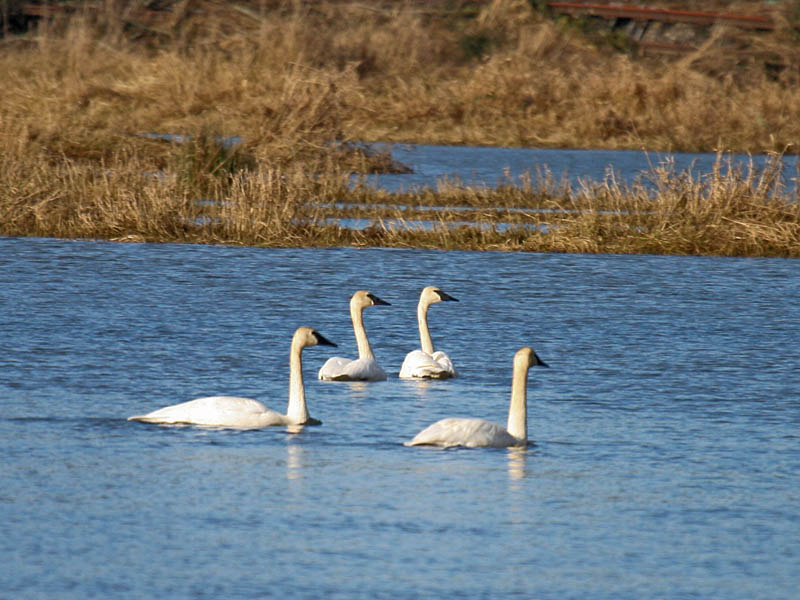
Trumpeter SwanMost Trumpeter Swans in the Pacific NW are wild migrants. However, I learned that these at Brownsmead, Oregon on 31 December 2007 were pen-raised and released locally, thus "uncountable." Photo by Greg Gillson.


One major aspect of "birding" for many people is "listing," keeping track of the bird species that one has seen. These lists can be life-time lists, state lists, backyard lists, year lists, etc.

One question that arises is: "What birds can I count?".

Mary and Jim in Salem, Oregon posted such a question to the Oregon Birders OnLine (OBOL) email discussion list on 24 June 2009: "We saw a Mute Swan in McGilchrist Pond in Salem this afternoon. Are they "countable" for our life list?"

One response included the predictable: "You can count whatever you want, It's your list."

Of course, this is true. But Mary and Jim would not have asked if they were just going to make up their own rules about what they counted. They wanted to know about generally accepted rules about what others consider countable. There can be some healthy competition among the top listers. But even if comparison with others is not your goal, reaching a personal landmark of a list of 200 or 300 or 400 species in one of the Pacific NW states is quite an accomplishment.

Who makes up the rules? In the United States and Canada there is an organization called the American Birding Association that appointed itself the maker of bird counting rules. While this may seem brazen, most birders adhere to these rules because they provide a standard and, well, they just make sense.

For instance, the pertinent rules about counting a bird on your North American list (if you wish to conform strictly to the ABA rules) are basically as follows.

(1) The bird must have been within the prescribed area.
(2) The bird must have been a species currently accepted by the ABA Checklist Committee for lists within its area.
(3) The bird must have been alive, wild, and unrestrained when encountered.


For Jim and Mary's Mute Swan, the question comes down to the "is it wild?" requirement. Since Mute Swan is not a native bird to the Pacific Northwest, we'll assume that the Mute Swan they saw in a park in Salem is not a vagrant wild bird from Eurasia but, rather, an exotic release or the offspring of recently released birds. To answer this "wild" question the ABA has a whole page called Criteria For Determining Establishment of Exotics.

The particular guidelines to note are the requirements that the population of exotic birds is self-sustaining, not directly dependent upon human support, and present for at least 15 years.

Clearly, a single Mute Swan or even a pair or two does not meet the criteria for an established exotic. Even worse, there is a special rule specifically mentioning Mute Swans as an invasive species that is not likely to become self-sustaining because of active control efforts to eradicate any emerging populations.

So, by ABA rules, the Mute Swan seen in Salem is not countable.

By these rules, many Rock Pigeons probably should not be counted (free-flying birds raised by pigeon fanciers). Most populations of Wild Turkeys technically don't meet the 15 year establishment criteria in the Pacific Northwest. Ring-necked Pheasants may not be self-perpetuating west of the Cascades, even though they have been part of the avifauna for a century.

But it's nothing to get dogmatic about. After all, "it's your list," right?

Tuesday, June 9, 2009

What bird is that?... Questions and answers

Question: "We took a trip to the Oregon Coast (Otter Rock) and saw these birds on the beach at Otter Crest. We are unable to identify them. I know they are not loons (no red eyes and the breasts are black), but they don't look like grebes either. Thanks for the help."

Jody and Ed in Anchorage, Alaska

Answer: Your birds are Brant (formerly Black Brant), a type of small marine goose. They breed in Alaska, but on the west and north coasts. Then they migrate over the ocean almost directly to the mouth of the Columbia River. They winter on the West Coast. Thus, it is understandable that you haven't seen this goose in your Anchorage location. [Click photos above for larger view.]


Question: "Thank you for posting bird information on your website. I have a question regarding our state bird the Western Meadowlark. I don't ever remember seeing one and would like to find one. I live in the Portland metro area. Can you tell where and when to go to see our state bird?"

Diane in Portland, Oregon

Western Meadowlark Answer: Western Meadowlark was chosen as the State Bird of Oregon in 1927 by Governor declaration after a vote by Oregon school children. Rumor has it that they were "encouraged" to choose the meadowlark over perhaps more familiar birds. At that time meadowlarks were found in rural areas of western Oregon. Current agricultural practices prevent the Western Meadowlark from nesting in the Willamette Valley except in small numbers, more commonly in the less-populated southern end of the Valley. A few winter in short grass fields in the Portland vicinity and along the outer coast (in winter, try N Marine Drive in the Saint Johns area of Portland, near Smith and Bybee Lakes). However, they are quite common yet in the extensive sage flats of the eastern two-thirds of Oregon. Drive any road east of the Cascades from spring and summer and they will be singing from the fence posts. [Click photos above for larger view.]

There is apparently a movement underway to change the State Bird of Oregon from Western Meadowlark to Osprey.


Send your queries about Pacific Northwest bird identification or behavior or other topics. I'll do my best to figure out what you saw. I'll do some research. Then I'll write an article to answer your question. If you have a certain question, no doubt others will, too, and appreciate knowing the answer. My goal will be to do one Q & A article each week, answering all the questions I receive that week. I'll just use your first name and city in my answers. If you send photos I will likely use them (perhaps cropping and adjusting exposure for the web) so others can see what you are seeing.

Send questions to me using this link: PNWBB Q & A

Saturday, May 30, 2009

What bird is that?... Questions and answers

Question: "We were visiting San Juan Island this last week and saw an orange bird with brown/olive wings. I am wondering if you can help me identify it. I have attached a picture of the orange bird and another one that came to the feeding tray at the same time and I am wondering what the identification is of this bird as well. Thank you."

Joanna

Answer: Yes, Joanna. The larger birds are Red Crossbills. The red one is the male and the olive one is the female. The smaller striped bird is Pine Siskin. These are both common birds throughout the Pacific NW--especially near forested areas. [Click photos above for larger view.]


Question: "Feel a bit sheepish posting this question, since I've been paying attention to birds around Portland for a number of years now, think maybe I'm supposed to know.... but I don't know what these were, I couldn't get binoculars on them on time, then they were gone.

Flock of around 15-20 medium-sized birds flying to the tops of firs at SE 71st and Clinton (ish) in Portland. I only saw them from underneath; they had short tails and their bellies appeared pale and unmarked (not streaky) from where I was (which was on a lawn two houses away from the very tall firs, so possibly too far away to say they weren't streaky). The tail looked darker; the tail was fairly straight across, just a mild convex curve. They were making sharp calls (not whistling like cedar waxwings). These seemed consistent with everything I've heard about red crossbills - the call could have been described as "jip," the flocking, the fir (they hung out on the fir and appeared to be feeding, then flew off as a group) - but I've never actually been certain I've seen a crossbill before, and they didn't look reddish from below. Also, no one on OBOL is talking about seeing crossbills, and I feel like people like to post crossbill sightings if flocks are around.

So.... since I admire the way you identify birds from scanty data... thought I'd impose and provide my meager description.

Thanks for any relief you can provide."

Susan in Portland, Oregon

Answer: Well, my first guess was going to be Cedar Waxwings. I saw my first flock this spring just yesterday, though some hang around Portland most winters.

The reason I don't think your description fits Red Crossbill is that crossbills are generally small and streaked underneath. They are plump, House Finch-sized, but quite short tailed with strong fork or notch, not squared as you describe.

That leaves Evening Grosbeaks. Evening Grosbeaks are everywhere right now, making sharp loud calls. Because they are so common right now I recently wrote In the backyard... Evening Grosbeaks.


Question: "Yesterday I found a nest right next to the house where I was weed eating..., contained very small eggs (2 cm X 1 cm) with many brown speckles. Main color - rather tanish. No birds around. what is this bird ? thank you for your time."

"The nest was rather hidden beside the house, very small nest, eggs in a small round nest with dry grass and a few hairs or fur of another animal."

Sandra in Port Townsend, Washington

Answer: Sandra, one hundred years ago a birder was likely to be one who collected eggs and nests of birds. Birding has changed since then, and it is now illegal to possess nests, eggs, feathers, or any other part or whole wild bird without a permit. Thus, most modern field guides no longer describe the nest and eggs. However, my first bird book does--Peterson's 1969 Field Guide to Western Birds. It is nearly worn completely out, and held together with tape, but I wouldn't be without it, for I wrote in it voice descriptions and other helpful ID tips. But I digress.... Based on the placement of the nest on or near the ground and made of grass, as well as the small speckled eggs, my guess is Dark-eyed Junco. Peterson describes the nest as: "a well-lined cup on ground in woods. Eggs (4-5) spotted)." More information about juncos is in the article In the backyard... Dark-eyed Junco.


Send your queries about Pacific Northwest bird identification or behavior or other topics. I'll do my best to figure out what you saw. I'll do some research. Then I'll write an article to answer your question. If you have a certain question, no doubt others will, too, and appreciate knowing the answer. My goal will be to do one Q & A article each week, answering all the questions I receive that week. I'll just use your first name and city in my answers. If you send photos I will likely use them (perhaps cropping and adjusting exposure for the web) so others can see what you are seeing.

Send questions to me using this link: PNWBB Q & A

Friday, May 22, 2009

What bird is that?... Questions and answers

Question: "Hi Greg: I just posted some yard bird photos on my blog. Can you confirm if the last bird photo on the recent post is a Warbling Vireo? Thanks!"
migrants-in-my-garden

Michele (aka NW Nature Nut)

Warbling Vireo Answer: Yes, Michele, your bird is Warbling Vireo. It is a common migrant in the Pacific NW in May. It nests in cottonwoods, ash, alders, willows along streamsides and in alder thickets in the mountains about 10-15 years following a clear cut, before the fir grows too thick. The Warbling Vireo pictured here I obtained at Calliope Crossing, Sisters, Oregon on 28 May 2005. I need a better photo.


Question: "Hello, This is being written to you to see if you would have any knowledge of what has happened to our bird population, they are all missing this spring. We have a very large back yard and put out bird feeders for our feathered friends, we feed many populations that come through our yard all seasons. We are not hearing anything about this on the news anywhere... [additional text cut] Could you please look into this as we do not have the sources that you do, some enlightenment would be very nice. Thank you,

Chuck & Chris in Oak Grove, Oregon

Answer: I'm sorry to hear that birds seem fewer in your backyard this year. Is there some severe population disaster of which you have not heard? No. At least, nothing that affects all yardbirds and that would be noticeable within just one year. Of course, your habitat (yard) constantly changes, as does the neighborhood, just like any wild place. For instance, over centuries, ponds dry up to become pastures, then savannahs, then forests. During this time the bird populations are changing ever so slightly from year to year. Weather patterns can affect where birds migrate and when, from one year to the next, so they may have skipped your yard this spring. But as for the summer residents, I cannot say why they are less common in your yard this year. I hope they come back! Please see the next Question and Answer.


Question: "Hi, This is probably a very common question. The only birds our yard seems to attract is blue jays and crows. Do you have any advice or could point me in the right direction with a link/contact? I am willing to plant anything to attract something else. We live on 1/2 acre in city limits of Salem, Oregon. Thank you!"

Amy in Salem, Oregon

Answer: Food, water, shelter.

Set up hummingbird feeders, seed feeder (tube or tray) using only black oil sunflower seeds for finches, thistle sock for goldfinches, suet block (until it gets too hot and it melts or it attracts too many starlings) for several winter species.

Set up a simple bird bath or an outdoor fountain or pond.

Plant trees and scattered deciduous and evergreen shrubs for perching and protection. Some native fruit trees are crab apples, elderberry, hawthorn, cherry. Check a local nursery for native plants.

Go to Google.com and type in: 'attracting birds to your backyard'

Here are a couple sites to get you started.

Washington Department of Fish and Wildlife: Backyard Wildlife Sanctuary

Oregon State University Extension Service: Wildflowers that attract birds and butterflies


Send your queries about Pacific Northwest bird identification or behavior or other topics. I'll do my best to figure out what you saw. I'll do some research. Then I'll write an article to answer your question. If you have a certain question, no doubt others will, too, and appreciate knowing the answer. My goal will be to do one Q & A article each week, answering all the questions I receive that week. I'll just use your first name and city in my answers. If you send photos I will likely use them (perhaps cropping and adjusting exposure for the web) so others can see what you are seeing.

Send questions to me using this link: PNWBB Q & A

Sunday, May 17, 2009

What bird is that?... Questions and answers

Patti's nesting House Finch saga...

Question: "A house finch built a nest in the wreath on my front door. It is against the glass window on the door so I have been watching the progress of the nesting female. The eggs hatched about a week ago and the mother bird has been attentive and feeding the babies until today. I haven't seen her at all. Has she abandoned the nest? Also, there have been two male house finches hanging around. Any info would be appreciated."

Patti

Patti writes back on May 9: "I've seen her a few times since my original email to you. I'm not really familiar with bird behavior so was worried. The babies appear to be growing so I guess she's feeding them. Are the males involved in feeding the young also?"

Answer: I looked it up and it seems the male in all finches feed the young, sometimes even feed the female while she is incubating.

Patti writes back on May 10: "This is all new to me - and fascinating! This morning, the mother bird is in the nest with the babies -- is that common behavior at this point (10 days give or take after they've hatched)? I greatly appreciate your info!"

Answer: In general, the birds lay one egg a day until the whole clutch is complete before beginning incubation. Thus, all the eggs can hatch the same day. That takes about 3 weeks. Then, about 3 weeks later the young will fledge.

Patti writes back on May 13: "Yesterday it appeared the nest was empty! That's approx. 2 weeks after hatching. However, both male and female are still hanging around and occasionally look into the nest. That's the wildlife report for now...."

Answer: This seemed a little soon to me, but John K. Terres writes in "The Audubon Society Encyclopedia of North American Birds" (1980) that incubation in House Finch is 12-16 days and that fledglings leave the nest 11-19 days after hatching. So it seems that fledging took place right on schedule... and faster than I had expected! Rarely do we have a chance to follow the entire nesting cycle. But, now, thanks to Patti, we've all been able to experience it from beginning to end. Thanks!


Send your queries about Pacific Northwest bird identification or behavior or other topics. I'll do my best to figure out what you saw. I'll do some research. Then I'll write an article to answer your question. If you have a certain question, no doubt others will, too, and appreciate knowing the answer. My goal will be to do one Q & A article each week, answering all the questions I receive that week. I'll just use your first name and city in my answers. If you send photos I will likely use them (perhaps cropping and adjusting exposure for the web) so others can see what you are seeing.

Send questions to me using this link: PNWBB Q & A

Wednesday, May 13, 2009

What bird is that?... Questions and answers

Send your queries about Pacific Northwest bird identification or behavior or other topics. I'll do my best to figure out what you saw. I'll do some research. Then I'll write an article to answer your question. If you have a certain question, no doubt others will, too, and appreciate knowing the answer. My goal will be to do one Q & A article each week, answering all the questions I receive that week. I'll just use your first name and city in my answers. If you send photos I will likely use them (perhaps cropping and adjusting exposure for the web) so others can see what you are seeing.

Send questions to me using this link: PNWBB Q & A


Question: "Sending photo of what I am pretty sure is a Purple Finch?? It had a very white belly. Is it: 'plain belly-Purple Finch, striped underside-House Finch'???? Thanks so much for your help."

Betty at Foster Lake, Oregon

Answer: You got it right, Betty! That is a male Purple Finch. One way to help separate Purple and House Finches is that the House Finch has most of its orange-red concentrated on the forehead, upper breast, and rump. As you can see on your photo (click photo for larger view), your bird is generally washed with pinkish-red across the top of the head and all down the back and wing coverts--too much reddish wash for House Finch. Another clue. Purple Finches have a pale eyebrow that wraps around the back of the ear coverts. This is obvious on females, but on the male (including your photo) these are pinkish red, but still obvious. House Finches are rather streaky on the head, but without any obvious pattern wrapping around the ear coverts. This photo of Purple Finch shows the relatively unstreaked flanks. As shown in our previous post, In the backyard... House Finch, these birds have heavily streaked sides and flanks.


Question: "I am sending you a photo I took today--I think there were actually two different birds very similar to this one. This bird was black, not brown, and when it flew it had the red wing bar above the obvious yellow bar. It would seem to me to be a male red-wing but it is so striped as the females."

Betty at Foster Lake, Oregon

Answer: In a previous Question and answer column, Johnny sent in a photo of a female Red-winged Blackbird. Your bird is similar, a bit darker, but showing a bit of red and yellow wing stripe (click photo for larger view). What is it? Well, Betty, this is a first-year male Red-winged Blackbird. It is almost a year old, having hatched out some time last year between May and July. While in many species, birds-of-the-year molt into adult-like plumage in fall and winter, some species--like this Red-winged Blackbird--have a distinctive first-year plumage. You can tell that this bird has fresh, new plumage because the feather edges of the back and wing feathers are all outlined with crisp, pale feather edges. These soon wear off. By mid summer this bird will be solid black throughout and look quite like an older adult male.


Question: "I am attaching a photo I put on flickr for OBOL ID. They confused me because of the different head color I was thinking male/female but found out it was possibly age difference on the birds so I couldn't identify them originally. Another good lesson learned."

Betty at Foster Lake, Oregon

Answer: Thanks for the additional photos, Betty. The bird on the left with the buffy or ruddy eyebrow and throat is an adult female Red-winged Blackbird (click photo for larger view). As it is too early in the year for juvenile blackbirds, the bird on the right is a one-year-old female Red-winged Blackbird. In my previous answer I mentioned the fresh feathers with the crisp, pale edges, remember? Can you see that this right hand bird has fresher feathers? Notice especially the pale edges that almost create wingbars on that younger bird. Then see how those pale tips are not so obvious on the older bird. You know, most experienced birders don't look at these common birds as closely as you have. Well done. We have certainly learned a lot about Red-winged Blackbird plumage. Thank you for your questions, Betty!

Sunday, May 3, 2009

What bird is that?... Questions and answers

Send your queries about Pacific Northwest bird identification or behavior or other topics. I'll do my best to figure out what you saw. I'll do some research. Then I'll write an article to answer your question. If you have a certain question, no doubt others will, too, and appreciate knowing the answer. My goal will be to do one Q & A article each week, answering all the questions I receive that week. I'll just use your first name and city in my answers. If you send photos I will likely use them (perhaps cropping and adjusting exposure for the web) so others can see what you are seeing.

Send questions to me using this link: PNWBB Q & A


Question: "Hey Greg, My name is Mark.. and I live in... Lake Oswego. I was just looking out my rear window 2 stories up into a large Big Leaf Maple and saw what I thought was a Solitary Vireo (which one I am not sure, Cassin's?) but it had a red patch on the top of its head. This startled me, so I tried to find photos or mention of a red headed vireo but there doesn't seem to be such a thing....do you know what it was I saw? Greenish with white wing bars and buff colored underneath, belly and breast. Don't currently have access to my bird books. TIA, Mark"

Mark in Lake Oswego, OR

Ruby-crowned Kinglet Answer: A small green bird such as you describe could be a vireo, as you first guessed, Mark. Both Cassin's and Hutton's vireos match your description in the Pacific Northwest--except for one important detail as you discovered--vireos do not have red crowns! A small green bird that does have a red crown is Orange-crowned Warbler. They are very common in spring migration (right now) and through the summer in the West. However, they do not show obvious white wingbars as you describe. That leaves the tiny Ruby-crowned Kinglet (as shown in the thumbnail to the left; click for a larger view). Now, only the males have the red crown. And as in the Orange-crowned Warbler, the red only shows when the bird raises its crown feathers. This happens when they are aggitated--perhaps when displaying before a female or when upset about an intruder into their territory.


Question: "Hi Greg, I spotted this wonderful bird having a mid-afternoon meal in my garden. What beautiful markings he/she had. I’ve not seen birds like this here before.... Can you tell me what species it is? Thank so much."

Claudia in Portland, OR

Answer: Your bird is a male Northern Flicker, Claudia, a type of woodpecker. They are often found on the ground eating ants--their favorite food! We have an article on that bird here: In the backyard... Northern Flicker.

Tuesday, April 21, 2009

What bird is that?... Questions and answers

Send your queries about Pacific Northwest bird identification or behavior or other topics. I'll do my best to figure out what you saw. I'll do some research. Then I'll write an article to answer your question. If you have a certain question, no doubt others will, too, and appreciate knowing the answer. My goal will be to do one Q & A article each week, answering all the questions I receive that week. I'll just use your first name and city in my answers. If you send photos I will likely use them (perhaps cropping and adjusting exposure for the web) so others can see what you are seeing.

Send questions to me using this link: PNWBB Q & A

This week's questions seem to have repeating themes. All four questions this week came from Washington, two from Bellingham, two were American Robins, and two were birds nesting in evergreen wreaths on the front door!


Question: "Our fresh Christmas [wreath] did great through the winter so we left it hanging on our front door. About 3 to 4 weeks ago I noticed activities of a robin around the wreath. I thought it was picking up tweaks to build its nest until later I found out that it was actually building a nest on the Wreath. There were 3 eggs in the nest and the mother bird has been with them at times... We restrained from using our front door but. The garage door is located in the front of the house. Every time the garage door opens and closes it still alarms the bird and it flies away. With the bird being gone so often and at times for a prolonged period of time would the eggs hatch? I thought about bringing the nest with the wreath to show my daughter's kindergarten class. I hesitated because she hasn't given up her eggs yet. Sound pretty silly questions but please educate me on this. Thank you!"

A mom in Olympia, WA

Answer: Robins are quite tolerant of human disturbance. Once the eggs are laid the mother bird will be less likely to leave the nest. You are correct, though, that the eggs may fail if they cool off too much while the adults are flushed away from their nest. Robins may attempt to renest up to 3 times in a season. It is their way of assuring offspring as, on average, only 2 nestlings live to adulthood to replace the parents every 4-6 years or so--the average life span of an adult bird. One thing to keep in mind, though. It is illegal to possess the nest, eggs, feathers, or body of birds in the US without a license. Thus, taking the old nest to your child's school, while an excellent nature lesson, is a bad citizen lesson! Perhaps you can find a volunteer at a local Audubon Society that has the proper permits and collection for a fun school assembly show-and-tell.


Question: "Hi Greg - I have a wreath on my front porch a small brown/beige bird has made a nest in. There are three blue eggs in the nest. Is there any way to identify what kind of bird it is? Thanks."

Linda in Seattle, WA

Answer: I believe your bird--if not an American Robin as above--is the House Finch. The female is all brown, while the male has a red forehead and breast. The eggs will hatch about 3 weeks after they are laid and the young will leave the nest about 3 weeks after that. See: In the backyard... House Finch.


Question: "I live in Bellingham and have heard a distinct pre dawn song for years. I used to listen it when I was burning the midnight oil in college, when I heard it I knew I needed to kick it up a notch to complete my paper. Recently I was walking to my car at 4:30 and noted the same measured warble. What bird would most likely produce this pre-dawn song in this area? I wish I had a recording of it but I don't."

W in Bellingham, Washington

Answer: The earliest riser and one of the first singers in spring, is the American Robin. See: In the backyard... American Robin. You can find a recording of the song on the Cornell Laboratory of Ornithology's web site: All about birds: American Robin. Another bird that might sing early in the pre-dawn in April is White-crowned Sparrow.


Question: "Can you help identify a bird for us? We live in a rural area outside Bellingham and have several different types of birds from small to the larger Robins and even ducks and some geese. The bird in question is a "robin" sized greyish bird, that looks in many ways like a dove, with a distinctive black bib on its chest and robin red colors under its wings."

David outside Bellingham, WA

Answer: David, your bird is In the backyard... Northern Flicker.

Thursday, April 9, 2009

What bird is that?... Questions and answers

You have questions. Lots of questions!

This article starts a new feature. Send your queries about Pacific Northwest bird identification or behavior or other topics. I'll do my best to figure out what you saw. I'll do some research. Then I'll write an article to answer your question. If you have a certain question, no doubt others will, too, and appreciate knowing the answer. My goal will be to do one Q & A article each week, answering all the questions I receive that week. I'll just use your first name and city in my answers. If you send photos I will likely use them (perhaps cropping and adjusting exposure for the web) so others can see what you are seeing.

Send questions to me using this link: PNWBB Q & A

To get this started, and serve as a template for future Q & A's, Johnny in Sandy, Oregon agreed to help with the first batch of questions and he even supplied photos. Thanks, Johnny. Here we go...


Click for larger view "I had the arrival of a group of about 8 or 9 birds that I believe to be Pine Siskins, the day after the first Lesser Goldfinches came to my Njer seed feeder. The Goldfinches have not returned since the new guys took over. And they are constantly bickering and trying to keep everyone else from eating (see photos). Also these guys really put away the grocerys. They eat, go get a drink and eat some more. I don't know how they can fly the eat so much. Are they always like this, or is my flok simply a bunch of hooligans?"

Johnny
Sandy, Oregon

The tiny, goldfinch-sized Pine Siskins are heavily streaked with a strongly notched tail. In flight you can see the yellow wing stripe (Click photo for larger view). They are irruptive in nature, following food sources (seeds and budding trees); they can be unpredictably abundant one year, but perhaps absent or uncommon the next. They breed in the pine forests in mountains in the Pacifc NW, but descend to the lowland regularly in spring for the tree and flower buds. They may occasionally remain through the summer in the lowlands to breed if there is a reliable food source. They are highly social throughout the year, foraging in large flocks, often driving other larger birds from the feeder. In a few weeks they will likely disappear to the mountains. For more information, see Cornell Laboratory of Ornithology's web site on the Pine Siskin Irruption of 2008-09 that is happening primarily in the East. This article has many additional interesting facts about Pine Siskins.


Click for larger view "I had several new birds in my back yard yesterday. This one is a dead ringer for the female version of the Red Winged Blackbird, (even though it doesn't look at all like a black bird to me) that is on my backyard birds chart. Is It a Blackbird?"

Johnny
Sandy, Oregon

This is, indeed, a female Red-winged Blackbird. Although it may look like a large sparrow at first, its shape reveals its identity. The long, very pointed bill and flat forehead is common to the blackbirds, cowbirds, meadowlarks, and orioles, which are all in the same family. Sparrows have shorter, conical beaks and most have rather rounded heads. I will unabashedly point you to my Red-winged Blackbird photo album. Compare the head and bill shape of the males with the females. Then go over to my Song Sparrow photo album and compare the bill shape to that of the blackbirds.


Click for larger view "I had both of these guys in my yard yesterday. I'm pretty sure the yellow one is just a House Finch, but the other bird doesn't look like any I've been able to find. Look closely at the color around the eye."

Johnny
Sandy, Oregon

You are correct, Johnny, these are House Finches. The male is yellowish-orange and within normal range of color variation for this species. See our recent article on House Finches. The other bird is a female. I'm no expert on this, but the female appears to be suffering from the disease, avian conjunctivitis. Birds suffering from this disease display "red, swollen, watery, or crusty eyes; in extreme cases the eyes are so swollen or crusted over that the birds are virtually blind." This disease was first noted in the Eastern population of House Finches in the Washington D.C. area in 1994. It broke out in the West in 2004. For more information see the Cornell Laboratory of Ornithology's web page, House Finch Disease Survey.