Thursday, January 10, 2013

Field-friendly bird sequence
Chickadee and Wren-like Songbirds

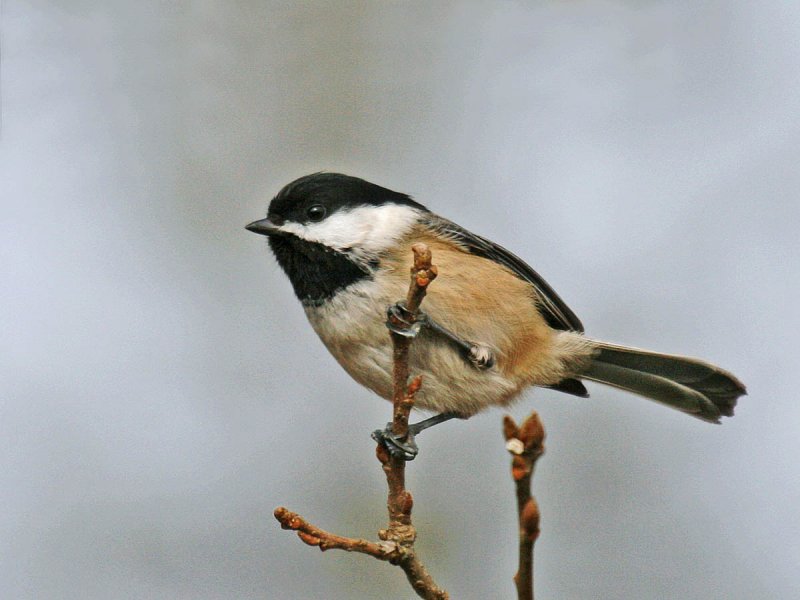
Black-capped Chickadee
Black-capped Chickadee, Hillsboro, Oregon February 1, 2009 by Greg Gillson.
The 13 categories of North American birds listed in the Field-friendly bird sequence: Part II are:

Swimming Waterbirds
Flying Waterbirds
Wading Waterbirds
Chicken-like Birds
Raptors
Miscellaneous Landbirds
Aerial Landbirds
Flycatcher-like Birds
Thrush-like Songbirds
Chickadee and Wren-like Songbirds
Warbler-like Songbirds
Sparrow and Finch-like Songbirds
Blackbird-like Songbirds

A beginner should be able to quickly place a bird they see into one of these categories.

Chickadees, nuthatches, bushtit, creeper, wrentit, wrens, and gnatcatchers make up this grouping of small, plump, active birds found in wooded and brushy habitats. Chickadees and nuthatches frequent bird feeders.

White-breasted NuthatchWhite-breasted Nuthatch. Hillsboro, Oregon. March 13, 2009 by Greg Gillson.


Brown Creeper
Brown Creeper. Hillsboro, Oregon. March 13, 2009 by Greg Gillson.


Bewick's Wren
Bewick's Wren. Hayward, Oregon. May 16, 2008 by Greg Gillson.


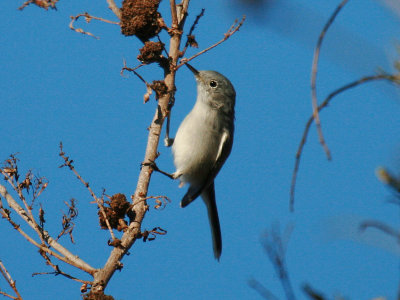
Blue-gray Gnatcatcher
Blue-gray Gnatcatcher. San Diego, California. October 31, 2008 by Greg Gillson.


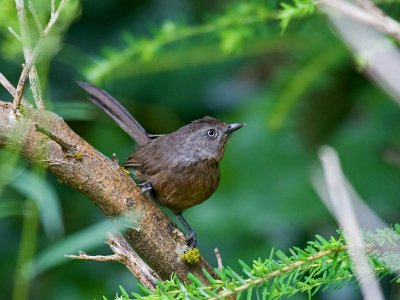
Wrentit
Wrentit. Lincoln City, Oregon, July 30, 2011 by Greg Gillson.


Bushtit
Bushtit. Hillsboro, Oregon. September 1, 2008 by Greg Gillson.


Friday, December 28, 2012

eBird best practices
Get to know your local Reviewer

In the last year eBird acceptance and participation continues to increase--at least it seems so to me. Most birders know what eBird is; many are using it.

As you bird in different areas you are likely to see some unusual species or high numbers that trip the eBird filter. Soon thereafter, you get an email with the subject: "Question about your [bird name] observation in eBird." Rather than shuffle these off to your spam filter (kidding!) look at these emails from eBird Reviewers as a chance to get to know an expert in an area.

OK, first off, it is possible that the local Reviewer is NOT the most expert person on the bird status of that county. But they were the most expert to volunteer to be the eBird Reviewer for that county. So, when Oregon started getting eBird Reviewers, I was initially given about 12 counties. However, 5 of those counties were in NE Oregon--a rural area with few birders. I had books on status of birds in the area, but there were many species whose status I was uncertain. I was so happy when local NE Oregon Trent Bray agreed to be Reviewer for those counties.

That leaves me with 5 counties in NW Oregon. I consider myself the expert in one of those counties, and have considerable experience birding in the others. Nevertheless, Mike Patterson in Clatsop County is the local expert in that county. He expresses no interest in being eBird Reviewer for his home county. I don't blame him; it is a bit of work that you have to take from someplace else (like actually watching birds).

Mike sometimes gives me "status updates" when he disagrees with where the filter levels are set. One of his observations was that the filter levels seem like they were set by someone from "out of town." Of course, that's true. The county filter levels were set initially with state-wide status and then refined from there--several counties lumped as one, then individual counties spit from them. There is always more work to be done. Reviewers will be happy to reset filters if you suggest reasonable limits. But each species in each county has it own filter settings.

Another observation that Mike made was that the filter levels seemed set for "average" birders rather than the actual county status. Yes, true. Hard-to-identify species generally have their filter numbers set to trip at a lower number than the actual status. For instance, I set Thayer's Gulls in Lincoln County, Oregon to trip with perhaps 10 birds, when over 50 are sometimes possible. However, inexperienced birders can easily misidentify hybrid Glaucous-winged x Western Gulls (perhaps the most common winter gull along the northern Oregon coast) as Thayer's. In such a case, I mark in the Review Tool as "unexceptional" tallies of Thayer's Gulls from birders whose expertise I know. But I am also able to look at the whole list and see if they have all the gulls in the correct proportions. If I don't know the person and the numbers of other gulls don't seem right, then I send them an email ("Question about your [bird name] observation in eBird") asking for more details. As an eBird Reviewer I can tell a lot about a person's expertise by looking at their list and number of species.

Now that I've gone off on a tangent, let me bring it back to you getting to know the Reviewer. This is important: when you are entering your sightings into the eBird checklist, every time the automatic filter says something like "That's an unusual bird! Are you sure?" a real person (eBird Reviewer) will be looking at the record to verify it.

If you don't leave any comments the Reviewer will send you an email asking for more details. We want plumage and behavior descriptions. However, if you can add just the clinching field marks you used to your comments when entering the sighting, that's often enough that the Reviewer doesn't have to send you an email to get clarification (not that the Reviewer minds--that's their job).

There is a "canned" message, but most Reviewers will personalize it. Some Reviewers don't like to "lead" a report by suggesting an alternative bird, but I see nothing wrong with saying: 'you reported this bird which is very rare here at this time of year, yet your list is missing a common look-a-like bird. Could it have been the common bird, instead?' Something like that. Or, 'wow! That's a high number. Can you verify that it isn't a typo?'

Most (but not all) eBird Reviewers are willing and happy to share their knowledge. When they contact you to verify one of your sightings, look at it as an opportunity to learn status, distribution, and ID of local birds. Be open to suggestions (not defensive), ask questions, get to know your local Reviewer and improve your birding!
Tuesday, December 18, 2012

Where is summer?

Depressed Meadowlark
My trip to the beach last week produced some good bird sightings. By that I mean that I saw some birds I hadn't seen for a while and that I was delighted to see. What I didn't mean was that I saw these birds very well. I felt like I needed a flashlight to go birding at noon.

Well it is winter. At 45 degrees latitude you subtract 23 degrees (tilt of earth on axis) in December. At NOON the sun is only 22 degrees above the southern horizon. Add layers of dark drizzly clouds. Make it damp and foggy. It always feels like dusk in winter. Not dawn--that implies that if you wait it will get lighter. No, dusk. You better look now because it will be too dark to see if you wait.

I love Oregon--the ocean, mountains, deserts, fields, and forests. I live in western Oregon in the verdant valleys below the temperate rain forests. I love it especially from May-July, when it is sunny and warmer, yet not too hot. Later September and October are nice, too. Frankly, though, even though it is the winter rains that make the rest of they year so pleasant and green, I feel like the depressed-looking meadowlark above... I can't wait until summer!

Monday, December 17, 2012

Field-friendly bird sequence
Thrush-like Songbirds

Hermit Thrush
Hermit Thrush, Lava Lake, Oregon June 12, 2008 by Greg Gillson.
The 13 categories of North American birds listed in the Field-friendly bird sequence: Part II are:

Swimming Waterbirds
Flying Waterbirds
Wading Waterbirds
Chicken-like Birds
Raptors
Miscellaneous Landbirds
Aerial Landbirds
Flycatcher-like Birds
Thrush-like Songbirds
Chickadee and Wren-like Songbirds
Warbler-like Songbirds
Sparrow and Finch-like Songbirds
Blackbird-like Songbirds

A beginner should be able to quickly place a bird they see into one of these categories.

Included in the Thrush-like Songbirds are shrikes, thrashers and mockingbirds, thrushes and bluebirds, dipper, pipits, larks, tanagers, orioles, meadowlarks.

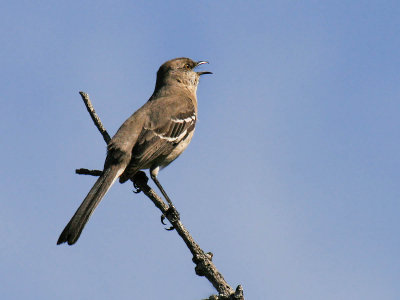
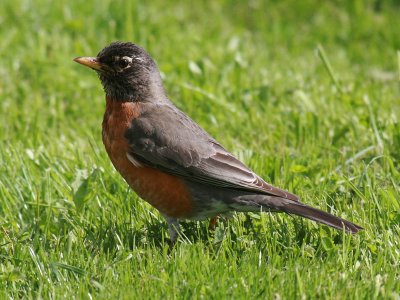
Medium-sized land birds with generally plump bodies and long tails. The American Robin, Mockingbird, and Meadowlark are familiar representatives of this taxonomically diverse group that have a similar body shape.

Northern Mockingbird. San Diego, California. March 7, 2008  by Greg Gillson.


Western Meadowlark. Malheur NWR, Oregon. May 29, 2010 by Greg Gillson.


American Robin. Hillsboro, Oregon. May 11, 2008 by Greg Gillson.


Western Bluebird. Beaverton, Oregon. March 19, 2011 by Greg Gillson.


Western Tanager. Malheur NWR, Oregon. May 29, 2010 by Greg Gillson.


American Dipper. Klamath County, Oregon. February 17, 2012 by Greg Gillson.


Bullock's Oriole. Malheur NWR, Oregon. May 24, 2009 by Greg Gillson.


Thursday, November 29, 2012

Western Sandpiper or Dunlin? Winter ID challenge

Dunlin, October 3, 2004. Forest Grove, Oregon by Greg Gillson.

Both Western Sandpipers and Dunlins can be abundant at times in the Pacific Northwest. In breeding plumage you would never mistake one for the other. From late fall through early spring, however, when both species are in drab non-breeding plumage, with long drooping bill and black legs, many birders have trouble separating them.

A very general statement of status in the Pacific NW follows. Western Sandpipers are abundant spring and early fall migrants throughout, with a few wintering along the immediate coastline and Puget Sound. Dunlins are abundant spring and late fall migrants, and common winter visitors wherever there is open water and wetland shores coastally or inland.

The problem with mistaken identification occurs from November through March when primarily only Dunlin are expected inland. Even in larger bays on the coast and the shores of Puget Sound, where a few Western Sandpipers may be found in winter, Dunlin are far more numerous than Western Sandpipers, November through March. Reports of large flocks of Western Sandpipers inland during the winter are likely in error, though singles do occur from time to time, west of the Cascades. There are going to be occasional exceptions to the status stated, but this warning is one to follow: be careful identifying Western Sandpipers after early October (and until early April) in the Pacific Northwest--they are much more likely to be Dunlin.


Western Sandpiper non-breeding plumage
Western Sandpiper, September 6, 2008. Forest Grove, Oregon by Greg Gillson.

The accompanying photos show juvenile Dunlin and Western Sandpiper mostly molted into their nonbreeding plumage. Now Dunlin are bigger, 8-1/2 inches long compared to 6-1/2 for Westerns, but that's not always apparent if there is nothing to compare with. Least Sandpipers are barely smaller than Westerns, and may be found more regularly in late fall and winter. So if there are any of those present, Dunlin will look much larger. Killdeer should appear approximately twice the size of Western Sandpipers, while Dunlins should be about 2/3 the size of a Killdeer.

Dunlin appear rather smooth brownish-gray throughout, including the head and across the breast. They appear almost hooded.

Western Sandpipers are paler gray and a bit more streaky and contrasty on the crown and back, with white throat and breast with perhaps a few streaks coming down from the shoulder. The pale eyebrow and face contrasts with darker ear coverts.

In flight both are similar in appearance with thin white wing stripe on the tips of the greater secondary coverts, and drooping bill. The voices aren't so different that you'd notice right away and remember. So pay special attention to the throat and breast. And remember... Dunlin are more likely in winter than Western Sandpipers, especially inland.