Monday, June 29, 2009

What bird is that?... Questions and answers

Question: (June 6) "Hello Greg,
My son and I spotted a unique bird in our backyard. Can you identify this from the attached picture?
Thanks,"

Mike, location not given

Answer: I do, indeed, recognize the silhouette, Mike. That's a Northern Flicker.


Question: (May 30) "Greg, Thanks for your web site. It's very educational and very well laid out.
I work in Salem, Oregon and generally see the same birds that I see in my Portland neighborhood, but last week, I was walking back to my office around 12:30 p.m. and heard a bird song that I'd not heard before. I immediately assumed it was a warbler and I still believe so but I cannot put the song to the bird. I have listened to every warbler song on-line that I might expect in our area and cannot match it. Can you help?
The bird was singing in a mature purple-leaved plum so not a huge tree perhaps singing8-10' up in the tree. I never saw the bird while it was singing. I cautiously circled the tree (going out into the street and across the street to try to see it, but no luck seeing the bird!). This is an area of high-density buildings both government and apartments with heavily-parked lots and lots of pedestrians. There are many mature trees and shrubs around these buildings, however. The purple-leaved plums are the street trees on this street.
The song was fairly fast-paced, sounding more like a Warbling Vireo than any warbler song that I can I.D.
It eventually flushed and flew away from me and I could see that it was warbler sized with a flash of yellow on the rump and perhaps olive. It definitely wasn't a Lesser Goldfinch or an American Goldfinch. It wasn't their song.
Any ideas? The bird was solitary and flew into a large red maple row against a large apartment. I had started to draw a crowd with my cautious movements and my staring into the tree! I thought I better get back to work so didn't see the bird again. I've never seen a Warbling Vireo as I'm mainly a back-yard birder. Could it have been a Warbling Vireo with the yellowish rump? Such a sweet but vigorous song in such an urban area.
Thanks for your help, Greg."

Steve in SW Portland, Oregon

Yellow-rumped Warbler Answer: Steve, while Warbling Vireo is certainly possible at the time and place your saw this bird, the description of the yellow rump just doesn't fit. Thus, I would suggest that it is the most abundant migrant in western Oregon during the spring. Guess what? It has a yellow rump in its name! There are two races of Yellow-rumped Warblers and both migrate through the Pacific NW, Myrtle breeds farther north and starts migrating as early as March, and Audubon's starts in May, but both occur through spring. The voices, both calls and songs, are different. Many recordings are of the more widespread (common in the East) Myrtle Warbler. So make sure you are listening to the correct bird recording. Listen to the Audubon's Yellow-rumped Warbler songs on Cornell's "All About Birds" online field guide site.


Question: (June 3) "Hello Greg - I'm going nuts trying to discover the author of a fantastical call that I hear all day, every day right now. Here's my best description of it:
A single high-pitched, upwardly rising note, that spirals upward in three "loops", ending in a shimmery, echoing glissando effect. I am referring to this unseen bird as the Ventriloquist due to the amazing shimmery finish at the end, like water ripples spreading. It seems that between these beautiful calls, the bird hops around and makes a tiny, quiet, single "po" call. Then the upward-spiralling call again and again. It's so beautiful. I recall hearing it all last Summer and it just started again a few weeks ago.
Today I saw a classic LBB (little brown bird!) in the vicinity of the call... Looked just like a Hermit Thrush or so, with large eye and needle-sharp insectivore bill. Buff color with some speckles at the throat and barely lighter buff belly.
Any hope of IDing this masterpiece? I am always trying to get a glimpse of the singer but the bird is very, very shy. I live near a forested wetland with tons of cover. Lots of Robins around and lots of other birds too. (blog link below) If you can help me, it would be just wonderful. If not, I totally understand!! Thanks for reading this. Sincerely,"

Bonnie in Quilcene, Washington
http://back2theland.blogspot.com

Swainson's Thrush Answer: What a beautiful and accurate description of the song of Swainson's Thrush! Most people have a very difficult time describing a bird song or call, but you nailed it, Bonnie! The spotted thrush with buff underparts is Swainson's and not Hermit Thrush. Hermit Thrushes have more gray underparts and breed in the high mountains (spruce and true fir) and those that breed in Alaska will winter in your lowland woods. Hermit have rusty rump and uppertail. Swainson's Thrushes are rare north of Mexico before mid-April and head back down there in September when their distinctive "whit" and "heep" calls are heard overhead during their night migration. Swainson's Thrushes may be one of the most abundant birds in riparian foothill clear cut regions of red alders before the Douglas fir grow up too much. The other abundant birds in Swainson's Thrush habitat are Wilson's Warblers and Warbling Vireos. Listen to Swainson's Thrush song in Cornell's "All About Birds" field guide.

Saturday, June 27, 2009

American Avocet at Malheur refuge

American AvocetAmerican Avocet, Hines, Oregon on 23 May 2009 by Greg Gillson.


Malheur National Wildlife Refuge is an oasis in Oregon's sage desert southeast corner. This special area provides many opportunities for observing large, unique birds at close range in spring. I had the opportunity to spend nearly a week at Malheur in late May. Here is another photo from that trip.

Two of the most flamboyant shorebirds at Malheur are the Black-necked Stilt and American Avocet. While the black-and-white stilt sports impossibly long coral red legs, the avocet displays a rusty head and upturned bill perched on long blue-gray legs.

The range of American Avocet is a bit complex, but primarily seasonal wetlands in western North America. It is found in the prairie potholes of central Canada and the US. It is also found in the Great Basin lakes. Other breeding areas include coastal California from San Francisco south into Baja, Gulf coast of Texas and Mexico, interior Mexico, and isolated East Coast areas as far north as Virginia. Birds winter coastally from central California southward.

In the Pacific NW these striking birds breed in wetlands from SE British Columbia, southern Idaho, southeastern Washington, eastern Oregon, and northern California and southward. Winter birds are regular from San Francisco Bay, south.

The edges of the breeding range and the number of birds breeding in any location fluctuates from year-to-year based on water levels regionally. During periods of drought in the Southwestern United States, birds may move farther north in larger numbers in spring.

Thursday, June 25, 2009

Can I count it?

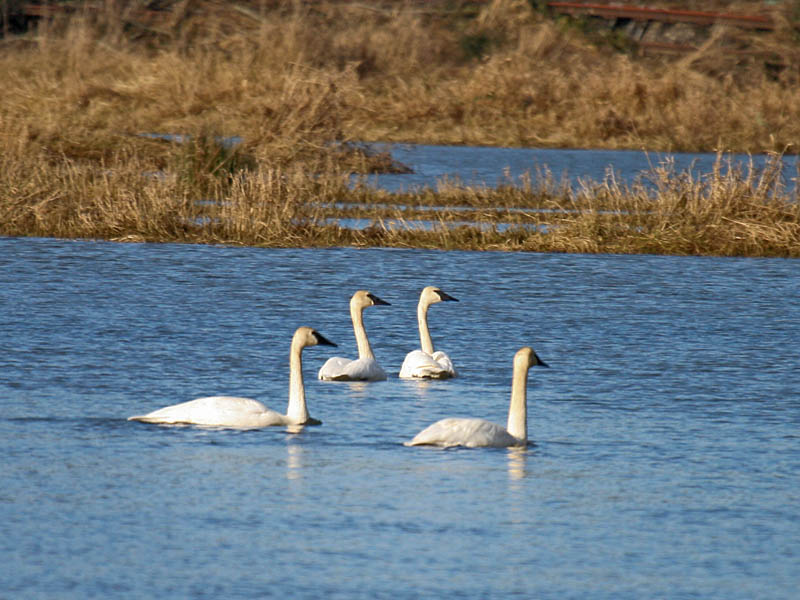
Trumpeter SwanMost Trumpeter Swans in the Pacific NW are wild migrants. However, I learned that these at Brownsmead, Oregon on 31 December 2007 were pen-raised and released locally, thus "uncountable." Photo by Greg Gillson.


One major aspect of "birding" for many people is "listing," keeping track of the bird species that one has seen. These lists can be life-time lists, state lists, backyard lists, year lists, etc.

One question that arises is: "What birds can I count?".

Mary and Jim in Salem, Oregon posted such a question to the Oregon Birders OnLine (OBOL) email discussion list on 24 June 2009: "We saw a Mute Swan in McGilchrist Pond in Salem this afternoon. Are they "countable" for our life list?"

One response included the predictable: "You can count whatever you want, It's your list."

Of course, this is true. But Mary and Jim would not have asked if they were just going to make up their own rules about what they counted. They wanted to know about generally accepted rules about what others consider countable. There can be some healthy competition among the top listers. But even if comparison with others is not your goal, reaching a personal landmark of a list of 200 or 300 or 400 species in one of the Pacific NW states is quite an accomplishment.

Who makes up the rules? In the United States and Canada there is an organization called the American Birding Association that appointed itself the maker of bird counting rules. While this may seem brazen, most birders adhere to these rules because they provide a standard and, well, they just make sense.

For instance, the pertinent rules about counting a bird on your North American list (if you wish to conform strictly to the ABA rules) are basically as follows.

(1) The bird must have been within the prescribed area.
(2) The bird must have been a species currently accepted by the ABA Checklist Committee for lists within its area.
(3) The bird must have been alive, wild, and unrestrained when encountered.


For Jim and Mary's Mute Swan, the question comes down to the "is it wild?" requirement. Since Mute Swan is not a native bird to the Pacific Northwest, we'll assume that the Mute Swan they saw in a park in Salem is not a vagrant wild bird from Eurasia but, rather, an exotic release or the offspring of recently released birds. To answer this "wild" question the ABA has a whole page called Criteria For Determining Establishment of Exotics.

The particular guidelines to note are the requirements that the population of exotic birds is self-sustaining, not directly dependent upon human support, and present for at least 15 years.

Clearly, a single Mute Swan or even a pair or two does not meet the criteria for an established exotic. Even worse, there is a special rule specifically mentioning Mute Swans as an invasive species that is not likely to become self-sustaining because of active control efforts to eradicate any emerging populations.

So, by ABA rules, the Mute Swan seen in Salem is not countable.

By these rules, many Rock Pigeons probably should not be counted (free-flying birds raised by pigeon fanciers). Most populations of Wild Turkeys technically don't meet the 15 year establishment criteria in the Pacific Northwest. Ring-necked Pheasants may not be self-perpetuating west of the Cascades, even though they have been part of the avifauna for a century.

But it's nothing to get dogmatic about. After all, "it's your list," right?

Tuesday, June 23, 2009

Oregon Shorebird Festival

Wandering TattlerWandering Tattler on Shorebird Festival Field Trip, Bandon, Oregon on 2 September 2007 by Greg Gillson.


The 23rd annual Oregon Shorebird Festival will be held August 28-30, 2009 at the Oregon Institute of Marine Biology in Charleston, Oregon.

This year the Festival will be a joint venture with the annual meeting of the Oregon Field Ornithologists. There will be field trips during the day and presentations in the evenings, suitable for all levels of birding interest.

One evening presentation is by birdsong recordist Geoff Keller: "My Most Memorable Field Recording Experiences." Another presentation will be by well-known birder Jim Danzenbaker: "A Workshop on the Nuances of Shorebird Identification."

There are two pelagic trips this year. The Bird Guide, Inc. will lead an 8 hour trip on Saturday, and a 5 hour trip on Sunday offshore to see albatrosses, shearwaters, jeagers, auklets, and other seabirds and marine life. Separate advanced pre-registration for the pelagic trips is required at The Bird Guide Pelagic Trips web site.

For more information and registration for the Oregon Shorebird Festival, please see the Oregon Shorebird Festival web page.

Saturday, June 20, 2009

Backyard birds of... Campbell River, British Columbia

Fox SparrowA muddy Sooty Fox Sparrow, Forest Grove, Oregon on 8 December 2007 by Greg Gillson.


The following common yardbirds are found in Campbell River, British Columbia.

The seasons listed are those when most common, though some individuals may occur at other seasons.

Band-tailed Pigeon, spring, summer, fall
Rufous Hummingbird, spring, summer
Red-breasted Sapsucker, year round
Downy Woodpecker, year round
Hairy Woodpecker, year round
Pileated Woodpecker, year round
Northern Flicker, year round
Olive-sided Flycatcher, spring, summer
Steller's Jay, year round
Northwestern Crow, year round
Common Raven, year round
Barn Swallow, spring, summer
Chestnut-backed Chickadee, year round
Bushtit, year round
Red-breasted Nuthatch, year round
Brown Creeper, year round
Winter Wren, year round
Golden-crowned Kinglet, year round
Ruby-crowned Kinglet, fall, winter, spring
Swainson's Thrush, spring, summer
American Robin, year round
Varied Thrush, year round
Cedar Waxwing, spring, summer
European Starling, year round
Orange-crowned Warbler, spring, summer
Wilson's Warbler, spring, summer
Common Yellowthroat, spring, summer
Western Tanager, spring, summer
Black-headed Grosbeak, spring, summer, fall
Spotted Towhee, year round
Chipping Sparrow, spring, summer
Savannah Sparrow, spring, summer, fall
Dark-eyed Junco, year round
White-crowned Sparrow, year round
Golden-crowned Sparrow, fall, winter, spring
Fox Sparrow, fall, winter, spring
Lincoln Sparrow, fall, winter, spring
Song Sparrow, year round
Red-winged Blackbird, year round
Brewer's Blackbird, year round
Brown-headed Cowbird, spring, summer, fall
Bullock's Oriole, spring, summer
House Finch, year round
Purple Finch, year round
Red Crossbill, fall, winter, spring
American Goldfinch, spring, summer, fall
Pine Siskin, year round
Evening Grosbeak, fall, winter, spring

This checklist is based on information provided in the
Checklist of Campbell River area birds by Narrow Escape Vacation Rental.